





More FTMO Challenges fail because traders break the rules than because they miss the profit target. While FTMO publishes its rules clearly, the information is spread across multiple pages, and many third-party guides still contain outdated or conflicting explanations.
This guide brings together the FTMO rules that matter most, explaining what changes between the 1-Step and 2-Step Challenges and between the Evaluation and Funded stages.
Quick Answer
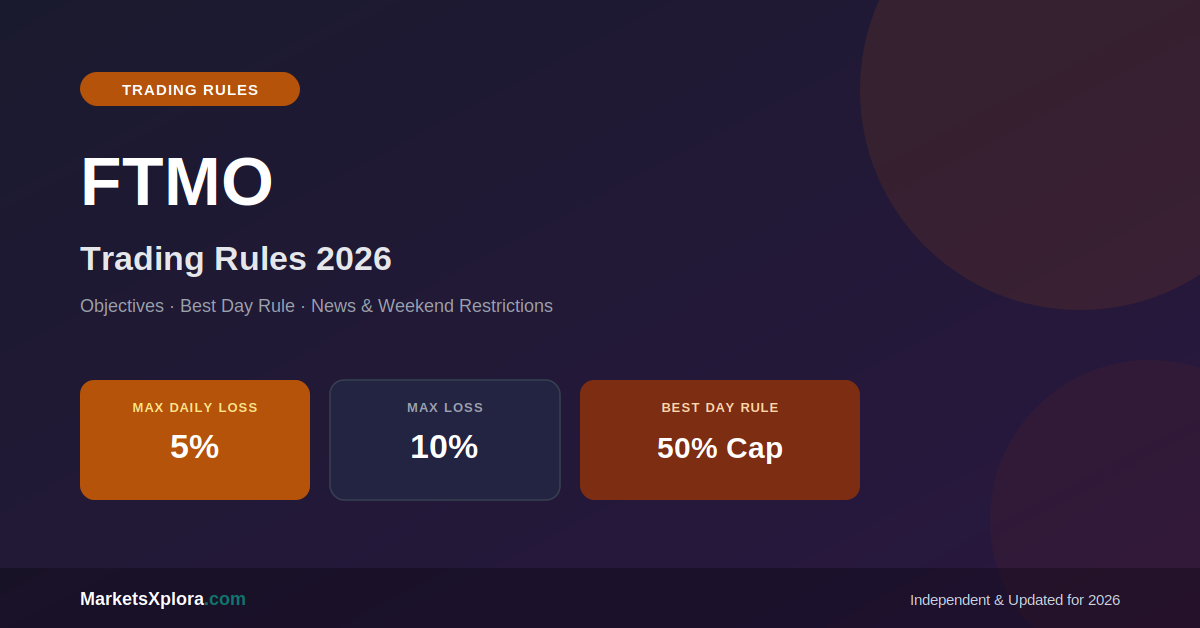
FTMO’s core rules are a 5% max daily loss and 10% max total loss on the 2-Step Challenge (static drawdown), versus a single 10% EOD-trailing max loss with no separate daily limit on the 1-Step. The 1-Step adds a Best Day Rule instead of a formal consistency requirement. News trading and weekend holding are unrestricted during evaluation on every account — the real restrictions only apply once you’re funded, and only on Standard accounts.
FTMO Trading Objectives: 1-Step vs 2-Step
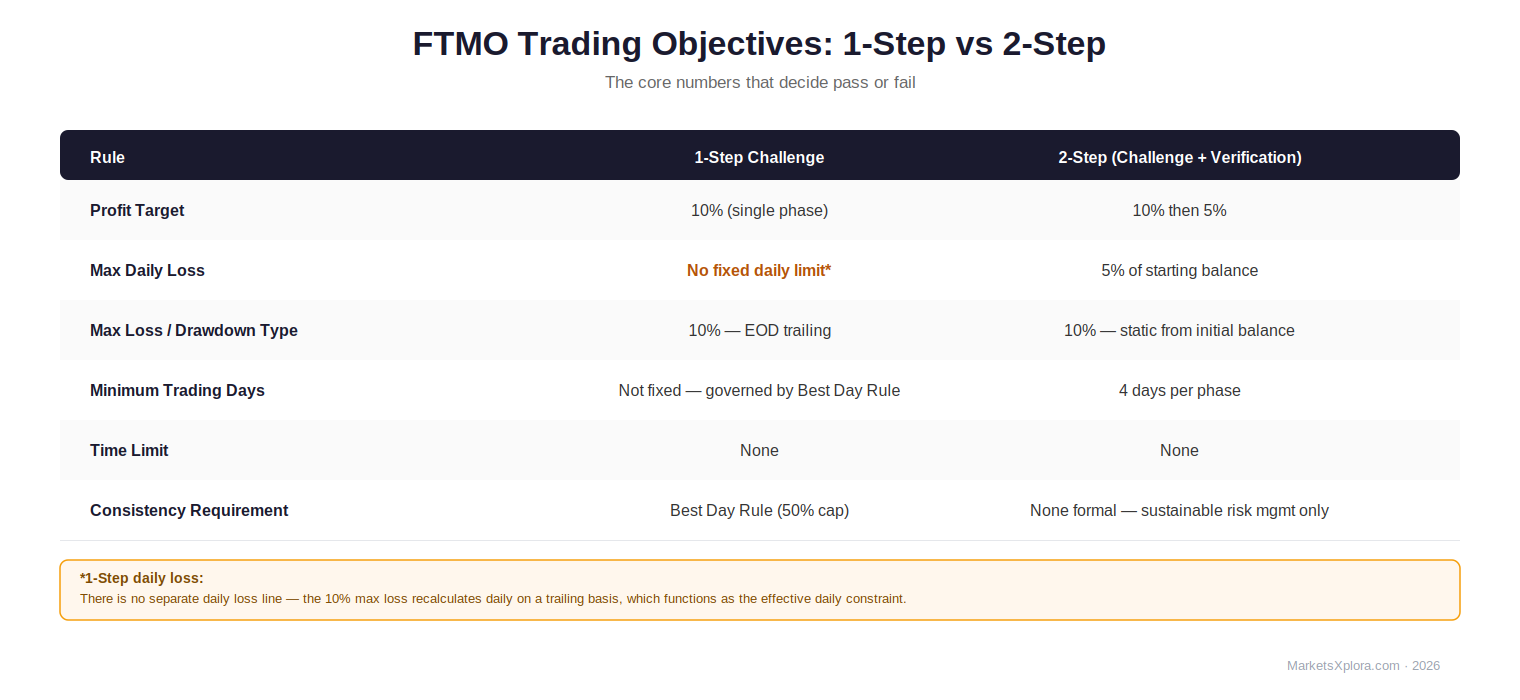
These are the numbers that directly determine whether you pass or fail your Challenge. They differ meaningfully between the two evaluation models, which is the first thing to get straight before you trade a single position.
Max Daily Loss vs Max Loss — the distinction that matters
The 2-Step Challenge uses two separate risk limits: a 5% Max Daily Loss and a 10% Max Loss. The Max Loss is calculated from your starting account balance and remains fixed throughout the evaluation.
The 1-Step Challenge works differently. There is no separate daily loss limit. Instead, it uses a 10% end-of-day trailing drawdown that adjusts based on your highest end-of-day balance. As your account grows, the drawdown floor moves up with it, making risk management more demanding than the 2-Step’s fixed-loss model.
Editor’s note: “Trailing” drawdown is the single most misunderstood term in prop trading rules. It does not mean the limit gets easier as you profit — it means the floor moves up with your peak balance, so profit you’ve made can become room you can no longer give back. Traders coming from static-drawdown firms consistently underestimate this on their first 1-Step attempt.
The Best Day Rule (1-Step Challenge Only)
This is the rule that catches the most 1-Step traders off guard, largely because it isn’t framed as a “consistency rule” the way competitors’ equivalents are — but it functions like one. It states that no single trading day can account for more than 50% of your total positive-days profit.

The calculation only counts closed profits from green (positive) days — red days and open positions are excluded from the total. In practice, this means you need at least two or three genuinely profitable trading sessions. A single outsized winning trade cannot carry the entire Challenge, even if you earned the profit legitimately.
Because of this, the Best Day Rule effectively creates a practical minimum of multiple profitable days on the 1-Step Challenge. FTMO does not set an explicit four-day minimum as it does for the 2-Step, but most traders will need at least 2–3 sessions to satisfy the rule.
Don’t try to work around it. FTMO’s Forbidden Trading Practices policy specifically prohibits strategies that artificially spread the profit from a single trade across multiple days, including hedging or taking opposing positions on correlated instruments. Such practices can result in a rule violation regardless of whether you meet the Best Day Rule.
Does FTMO Have a Consistency Rule?
This is worth clarifying because the “30% consistency rule” is still widely cited in FTMO guides as though it were a mandatory evaluation requirement. According to FTMO’s own FAQ, that is not the case for the 2-Step Challenge. As long as you maintain sustainable risk management, you do not face an additional formal consistency requirement beyond the standard Trading Objectives.
FTMO does show a Consistency Score, but the company currently describes it as an informational metric. It does not determine whether you pass or fail the Evaluation.
It’s a data point they track, not a pass/fail gate, on the 2-Step model. On the 1-Step, the Best Day Rule above functions as the closest thing FTMO has to an enforced consistency requirement.
News Trading & Weekend Holding Rules
This is where account type — not evaluation model — determines your restrictions, and where the timing (evaluation vs. funded) matters more than most traders expect.
During the Evaluation (Challenge + Verification)
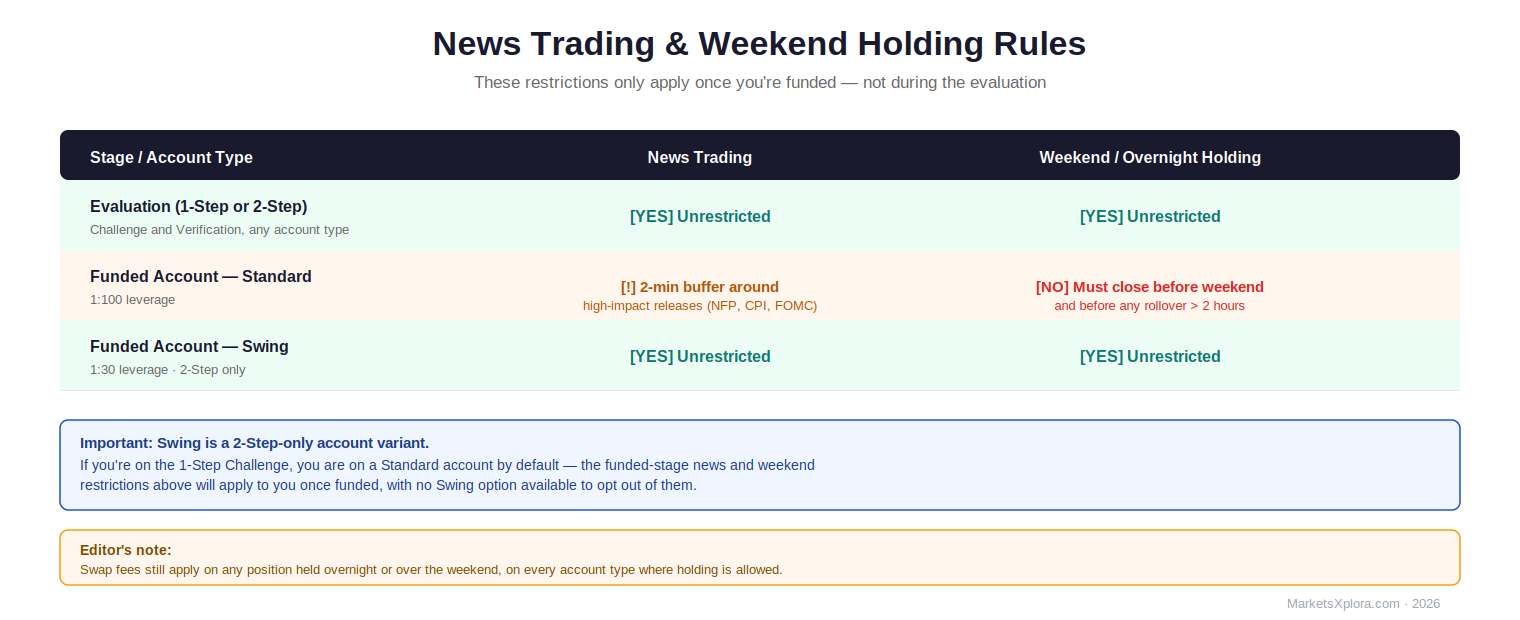
News trading and weekend/overnight holding are unrestricted on every account type during both the 1-Step and 2-Step evaluation phases. You can trade through NFP, hold into the weekend, and manage positions however your strategy requires — the restrictions below don’t switch on until you’re funded.
Once Funded — Standard Account
A 2-minute buffer applies around high-impact news releases (NFP, CPI, FOMC, and similar): you cannot open or close positions on directly affected instruments within that window. Positions must also be closed before the weekend market close, and before any market break or rollover period exceeding 2 hours.
Once Funded — Swing Account
Both restrictions are removed entirely. The trade-off, as covered in our FTMO Account Types & Fees guide, is leverage capped at 1:30 versus 1:100 on Standard, and Swing is only available on the 2-Step Challenge — if you’re on the 1-Step, you’ll be funded on a Standard account with no Swing option to remove these restrictions.
Editor’s note: Swap fees apply on any position held overnight or over a weekend regardless of account type, wherever holding is permitted — factor that cost in even when the rules allow you to hold.
Become an FTMO Trader
Prove your trading skills and gain access to a funded FTMO Account with one of the world’s most recognized proprietary trading firms.
Trading involves risk. Challenge rules, profit splits, and scaling opportunities depend on the selected FTMO program.
Forbidden Trading Practices
FTMO’s Terms & Conditions (Clause 5.4) set out practices that can lead to disqualification or account termination even if your Trading Objectives are technically met. At a high level, these fall into a few categories:
- Gaming the Best Day Rule — hedging, holding opposing positions on correlated instruments, or otherwise artificially distributing one trade’s profit across multiple days without proportionally distributing the underlying market risk.
- Position sizing inconsistency — opening substantially larger or smaller positions, or a substantially different number of positions, compared to your own established pattern on that or any other FTMO account.
- Non-replicable strategies — any approach that wouldn’t be reasonably possible when trading real capital in the actual market, including latency arbitrage and exploits that rely on simulated-environment quirks rather than genuine market conditions.
- Gambling-style behavior — all-in position sizing or similarly reckless risk-taking, particularly around high-impact news events.
- Multi-account strategy duplication — running identical strategies across multiple registrations in a way that pushes combined active funded accounts past FTMO’s stated threshold.
Expert Advisors (EAs) and automated strategies are permitted, provided they comply with the same policy — FTMO’s stated concern is specifically with latency arbitrage, tick-scalping exploits, and HFT-style strategies with extremely short hold times, not with automation itself.
What Happens If You Break a Rule?
Breaching the Max Daily Loss or Max Loss limit during the Challenge or Verification stage fails that evaluation attempt — you’d need to purchase a new Challenge to try again, at the fee for your chosen account size and model (see our full fee breakdown). On a funded account, breaching Max Loss results in account termination. Violations under the Forbidden Trading Practices policy can range from removal of the conflicting positions up to full account termination, depending on severity, at FTMO’s discretion.
Verdict: Trading Within FTMO’s Rules
FTMO’s rules are more flexible than many traders assume. During the evaluation phase, all accounts allow news trading and weekend holding, removing restrictions commonly found at competing prop firms. The main challenges are the 1-Step Challenge’s trailing drawdown and Best Day Rule, which place a greater emphasis on consistency than aggressive profit targets.
Before purchasing a Challenge, decide whether you need a Standard or Swing account. Standard accounts introduce news-trading and weekend-holding restrictions after funding, while Swing accounts remove those limits but are available only through the 2-Step Challenge.
Related
FTMO Review 2026: Rules, Fees, PFLS Score & OANDA Deal
FTMO Account Types & Fees: Full 2026 Pricing Breakdown
Is FTMO Legit? 2026 Review & Trust Score
FAQs
What is FTMO’s maximum daily loss?
On the 2-Step Challenge, 5% of your starting daily balance. The 1-Step Challenge has no separate daily loss line — its 10% Max Loss recalculates daily on a trailing basis instead.
What is the FTMO Best Day Rule?
A 1-Step Challenge rule stating that no single trading day’s closed profit can exceed 50% of your total profit across all positive days. Red days and open positions don’t count toward the total.
Does FTMO have a consistency rule?
Not a formal one on the 2-Step model beyond sustainable risk management — FTMO’s Consistency Score is informative only and doesn’t affect Evaluation outcomes. The 1-Step’s Best Day Rule is the closest equivalent to an enforced consistency requirement.
Can I trade news events with FTMO?
Yes, without restriction during the Challenge and Verification stages on any account. Once funded, Standard accounts have a 2-minute buffer around high-impact releases; Swing accounts have no restriction.
Can I hold positions over the weekend with FTMO?
Yes, without restriction during evaluation on any account. Once funded, Standard accounts must close positions before the weekend; Swing accounts can hold through it freely.
Is the Swing account available on the 1-Step Challenge?
No. Swing is only available on the 2-Step Challenge. The 1-Step Challenge funds you on a Standard account only.
Are Expert Advisors (EAs) allowed on FTMO?
Yes, provided they comply with the Forbidden Trading Practices policy — the restriction targets latency arbitrage and HFT-style exploits, not automation itself.
What happens if I breach a rule during the Challenge?
Breaching the Max Daily Loss or Max Loss limit fails that evaluation attempt, requiring a new paid Challenge to retry. On a funded account, breaching Max Loss results in account termination.
About the Author
Samson Ononeme is the founder of MarketsXplora, an independent financial education and research platform covering cryptocurrency, forex, brokers, exchanges, trading platforms, and blockchain technology. He focuses on turning complex financial products and platform features into clear, practical information that readers can use when comparing their options.
Crypto & Blockchain
Forex & Brokers
Financial Research
Trading Platforms