





 Samson Ononeme
Founder & Financial Content Strategist, MarketsXplora
12+ years covering forex brokers, prop firms, and crypto exchanges | Reviewed: September 2026
Quick Verdict
HTCS (HFM Trust Score) |
82/100 |
Best For |
Beginners and small-account traders who want a $0-minimum entry point, MT4/MT5 access, and native copy trading |
Not Ideal For |
US and Canadian residents (unsupported), traders who specifically want cTrader, and high-volume scalpers chasing the absolute tightest raw spreads |
Minimum Deposit |
$0 on Cent, Zero, and Premium accounts (varies by entity) |
Regulation |
FCA (UK), CySEC (Cyprus), DFSA (Dubai), FSCA (South Africa), FSA (Seychelles), CMA (Kenya) |
Platforms |
MT4, MT5, HFM WebTrader, HFM mobile app |
Markets Available |
Forex, commodities, indices, shares, ETFs, bonds, crypto CFDs |
Key Takeaways
- HFM has operated since 2010, first under the name HotForex. It now holds licenses across six jurisdictions — one of the broader regulatory footprints among mid-size brokers.
- The account you open matters more at HFM than at most brokers. Entity, spread type, and leverage cap all shift depending on which regulator covers you.
- HFcopy, HFM’s in-house copy trading tool, is built directly into the client area — not bolted on through a third-party plugin.
- There’s no dedicated cTrader option, and Islamic accounts aren’t available on every entity. Check availability for your specific region before assuming a feature applies to you.
- The $0 headline minimum deposit is real on entry-level accounts. Pro-tier and copy trading accounts carry higher practical minimums.
Why You Can Trust This Review
MarketsXplora has covered the forex and CFD broker space for over a decade, with bylines across EarnForex, Kryptomoney, Cryptorunner, and AtoZ Markets. We built this review by cross-referencing HFM’s own regulatory disclosures, its published fee schedules, and independent broker-comparison data. Then we structured it around the questions traders actually type into Google and AI assistants — not a rehash of HFM’s marketing copy.
How We Tested HFM
Editor’s note on methodology
This review is built on verified regulatory filings, HFM’s published trading conditions, and third-party broker-data aggregators current as of September 2026. Below, sections on live spreads, deposits/withdrawals, and a 30-day trading log are flagged with exactly what’s been tested and what hasn’t — we don’t publish invented figures as if they were observed.
Testing methodology (planned/in progress): account opening and KYC verification, deposits across at least three payment rails, a live 5-day spread-monitoring window across EUR/USD, GBP/USD, gold, NAS100, and BTC/USD, MT4 and MT5 execution testing, HFM mobile app walkthrough, customer support response-time logging across chat/email/phone, and a HFcopy trial follow of at least two strategy providers.
Testing environment: Windows desktop + Android device, standard and Zero account types, minimum 30-day observation window once live testing begins.
HF Markets at a Glance
Feature |
HFM |
|---|---|
Founded |
2010 |
Headquarters |
Limassol, Cyprus (HF Markets Group; entity varies by client region) |
Regulators |
FCA (UK, #801701), CySEC (Cyprus, #183/12), DFSA (Dubai, #F004885), FSCA (South Africa, #46632), FSA (Seychelles, #SD015), CMA (Kenya, #155) |
Platforms |
MT4, MT5, HFM WebTrader, HFM mobile app |
Minimum Deposit |
$0 (Cent, Zero, Premium); higher practical minimums on Pro/PAMM/copy trading accounts |
Forex Pairs |
50+ currency pairs |
CFDs |
Forex, commodities, indices, shares, ETFs, bonds, crypto CFDs |
Copy Trading |
Yes — HFcopy, native to the client area |
Islamic Account |
Available on select entities — [verify availability for your region before applying] |
Demo Account |
Yes, unlimited |
Max Leverage |
Up to 1:2000 on offshore entities; capped at 1:30 for FCA/CySEC retail clients |
Is HFM Safe?
Direct answer: HFM is a legitimately regulated broker, but “safe” depends heavily on which entity onboards you. Its FCA and CySEC entities carry Tier-1 oversight and compensation-scheme backing; its Seychelles and St. Vincent & Grenadines entities carry far lighter supervision and no meaningful investor-compensation fallback.
Regulatory Overview
HFM doesn’t operate under a single global license. Instead, it runs through separate legal entities per region: HF Markets (UK) Ltd under the FCA, HF Markets (Europe) Ltd under CySEC, HF Markets (DIFC) Ltd under the DFSA, HF Markets SA (Pty) Ltd under the FSCA, HFM Investments Ltd under Kenya’s CMA, and HF Markets (Seychelles) Ltd and HF Markets (SV) Ltd covering less-regulated offshore clients. The entity you’re onboarded under — not the “HFM” brand as a whole — determines your actual protections, leverage caps, and dispute-resolution options.
How Client Funds Are Protected
HFM states that client funds are held in segregated accounts, separate from company operating capital, at tier-1 banking institutions. This is standard practice among regulated brokers and reduces (though doesn’t eliminate) counterparty risk if the company faces financial difficulty.
Negative Balance Protection
HFM applies negative balance protection for retail clients, meaning a fast-moving market shouldn’t leave you owing the broker more than your account balance. Confirm this explicitly applies to your specific account type and entity before trading with high leverage.
Compensation Schemes
Clients under HF Markets (UK) Ltd may be eligible for FSCS protection up to £85,000 per the UK scheme’s standard terms; clients under HF Markets (Europe) Ltd may fall under the Cyprus Investor Compensation Fund. Offshore-entity clients (Seychelles, SVG) typically have no equivalent compensation scheme. That’s one of the most important distinctions to understand before choosing which HFM entity to sign up under, and it’s a detail many broker reviews skip over.
Risk Factors Traders Should Know
- Offshore entities carry materially lighter oversight than the FCA/CySEC entities — know which one you’re signing up under.
- High leverage (up to 1:2000 on offshore accounts) magnifies both gains and losses; it is not inherently a safety feature.
- CFDs are complex, leveraged instruments — the majority of retail CFD accounts lose money, a fact HFM itself is required to disclose.
Our Safety Verdict
HFM is legitimate and multi-regulated, comparable in structure to XM and Exness — all three rely on a mix of strong Tier-1 licenses for EU/UK clients and lighter offshore licenses for the rest of the world. Treat the regulatory tier of your specific entity as the real safety indicator, not the HFM brand name alone.
HFM Trust Score (HTCS) Breakdown
HTCS: 82/100
Regulation |
18/20 |
Transparency |
16/20 |
Corporate History |
17/20 |
Client Protection |
15/20 |
Reputation |
16/20 |
Regulation and Corporate History score well due to 16 years of operating history and six active regulatory licenses. Client Protection loses points because compensation-scheme coverage isn’t uniform across HFM’s entities. Transparency and Reputation reflect published fee/leverage disclosures weighed against the entity-dependent complexity that makes it harder for an average trader to know exactly which rules apply to their account.
Opening an HFM Account
Step-by-Step Registration Process
- Go to HFM’s website and select your region — this determines which entity and regulator will cover your account.
- Register with your email and phone number to create your myHF client portal login.
- Complete the KYC application: full name, address, date of birth, employment/trading-experience details, and a financial-suitability questionnaire.
- Upload a government-issued ID (passport, driver’s license, or national ID) and a proof of address (utility bill or bank statement, typically dated within 3 months).
- Choose your account type (Cent, Zero, Premium, Pro, or InfinityX) and base currency.
- Fund your account through your preferred payment method and start trading, or open a demo account first if you want to test the platform risk-free.
Verification Requirements
Standard KYC: photo ID plus proof of address. Some entities (particularly FCA and CySEC) may request additional source-of-funds documentation for larger deposits, in line with standard AML obligations for regulated brokers.
How Long Approval Took
Editor’s note: account-opening timing figures require a live, first-hand test. We haven’t completed that test for this review yet and won’t publish an estimated turnaround as if it were observed. This section will be updated with real timestamps once MarketsXplora runs the onboarding test.
HFM Account Types Explained
HFM offers 6 account types designed for different experience levels, trading styles, and budgets. Most accounts include negative balance protection, swap-free trading on eligible instruments and access to MT4, MT5 and the HFM App.
The main difference comes down to trading costs, minimum deposit requirements and the type of trader each account is designed for.
InfinityX Account
The InfinityX Account is HFM’s highest-risk account type. It combines ultra-high leverage with a 0% stop-out level, giving traders maximum market exposure with minimal capital requirements.
Key Details
- Minimum Deposit: $250
- Spreads From: 0.3 pips
- Commission: None
Pros
- Unlimited leverage for eligible positions.
- Tight spreads without additional commissions.
- 0% stop-out level allows positions to remain open longer during drawdowns.
Cons
- One of the riskiest account structures offered by HFM.
- Small market movements can have a significant impact when using extreme leverage.
- Unlimited leverage only applies within specific volume limits.
Who Should Use It?
This account is best suited to experienced traders who fully understand leverage and risk management. It is unlikely to be the right starting point for beginners.
Cent Account
The Cent Account is designed for beginners who want to trade with real money while keeping risk as low as possible.
Balances, profits and losses are displayed in cents, making it easier to practise with small amounts of capital.
Key Details
- Minimum Deposit: $0
- Spreads From: 1.2 pips
- Commission: None
Pros
- Beginner-friendly structure.
- No minimum deposit requirement.
- Allows traders to gain live-market experience with minimal financial risk.
Cons
- Wider spreads than some HFM alternatives.
- Limited usefulness for larger account sizes.
- Not ideal for active scalping strategies.
Who Should Use It?
The Cent Account is the best option for new traders moving from a demo account to live trading.
Premium Account
The Premium Account is HFM’s standard retail account and will suit most traders.
It combines commission-free trading with flexible funding requirements and access to the broker’s full range of markets.
Key Details
- Minimum Deposit: $0
- Spreads From: 1.2 pips
- Commission: None
Pros
- No minimum deposit requirement.
- Simple pricing structure.
- Suitable for most trading styles.
Cons
- Higher trading costs than HFM’s lower-spread accounts.
- Less attractive for high-frequency traders and scalpers.
Who Should Use It?
The Premium Account is a good all-round choice for casual and intermediate traders who want a simple commission-free setup.
Pro Account
The Pro Account is designed for active traders who want lower spreads without paying a separate commission.
Key Details
- Minimum Deposit: $100
- Spreads From: 0.6 pips
- Commission: None
Pros
- Lower spreads than the Premium Account.
- Commission-free pricing.
- Suitable for active traders and many automated strategies.
Cons
- Requires a higher initial deposit than the Premium Account.
- Still not as cost-efficient as a true raw-spread account for some trading styles.
Who Should Use It?
The Pro Account is often the best balance between cost and simplicity for active traders.
Pro Plus Account
The Pro Plus Account targets higher-volume traders who want tighter pricing than the standard Pro Account.
Key Details
- Minimum Deposit: $100 (varies by region)
- Spreads From: 0.2 pips
- Commission: None
Pros
- Very competitive spreads.
- Commission-free pricing.
- Attractive for larger trading volumes.
Cons
- Higher deposit requirement.
- Benefits are less noticeable for low-volume traders.
Who Should Use It?
The Pro Plus Account is best suited to experienced traders who place larger positions and want lower transaction costs.
Zero Spread Account
The Zero Spread Account is HFM’s raw-spread offering. Instead of paying wider spreads, traders pay a separate commission.
Key Details
- Minimum Deposit: $0–$25 (depending on entity)
- Spreads From: 0.0 pips
- Commission: From $3 per side per standard lot
Pros
- Raw pricing with spreads starting from 0.0 pips.
- Popular with scalpers and algorithmic traders.
- Greater pricing transparency.
Cons
- Commission costs apply on every trade.
- Can be more expensive than expected for low-volume traders.
- Requires careful cost analysis beyond headline spreads.
Who Should Use It?
The Zero Spread Account is most suitable for scalpers, day traders and traders who prioritize raw pricing over commission-free trading.
instruments like Forex and Gold.
Which HFM Account Is Best?
Trader Type |
Recommended Account |
|---|---|
Beginner |
Cent |
Scalper |
Zero |
Swing Trader |
Pro or Premium |
Copy Trader |
Premium or dedicated HFcopy follower account |
Small Account |
Cent |
Copy Trader |
Premium or dedicated HFcopy follower account |
Highest-risk option |
InfinityX Account |
Markets Available on HFM
HFM offers Forex (50+ pairs), Stocks (share CFDs on major exchanges), Indices, Commodities, Metals (gold, silver), Energy (oil, natural gas), ETFs, Bonds, and Cryptocurrency CFDs. Coverage is broad but not the widest in the industry — brokers like XM list well over 1,000 total instruments, so if instrument breadth alone is your priority, compare counts directly before committing.
My HFM Trading Cost Test
Editor’s note on live spread data
A genuine spread test requires live monitoring across a trading week, not a single snapshot from a broker’s marketing page. MarketsXplora has not yet completed that live window for HFM. Below are HFM’s published typical spreads on the Zero account, clearly labeled as published figures — this section will be replaced with our own observed data once the live test is complete.
Pair |
Published Typical Spread (Zero Account) |
|---|---|
EUR/USD |
From 0.0–0.1 pips + commission |
GBP/USD |
From 0.2–0.4 pips + commission |
Gold (XAU/USD) |
Variable, published on HFM’s contract specs page |
NAS100 |
Variable, index-CFD pricing |
BTC/USD |
Wider than major forex pairs, typical of crypto CFDs |
Commissions
The Zero account charges a per-lot round-turn commission on top of its raw spread. Cent, Premium, and Pro accounts are commission-free but price the spread wider to compensate — check HFM’s current contract specifications page for the exact per-instrument figures before trading.
Swap Fees
Standard overnight swap fees apply on leveraged positions held past the daily rollover, varying by instrument and direction. Swap-free (Islamic) terms are available on qualifying entities — [verify for your account].
Inactivity Fees
HFM charges a $5 inactivity fee after an account remains dormant for six consecutive months.
Overall Cost Rating
MX Cost Score: 7.5/10. Competitive on the Zero account for active traders, though less competitive than raw-ECN specialists like IC Markets or Pepperstone for high-volume scalping. Still reasonable for the average retail trader, given the $0 entry point.
HFM Trading Platforms Review
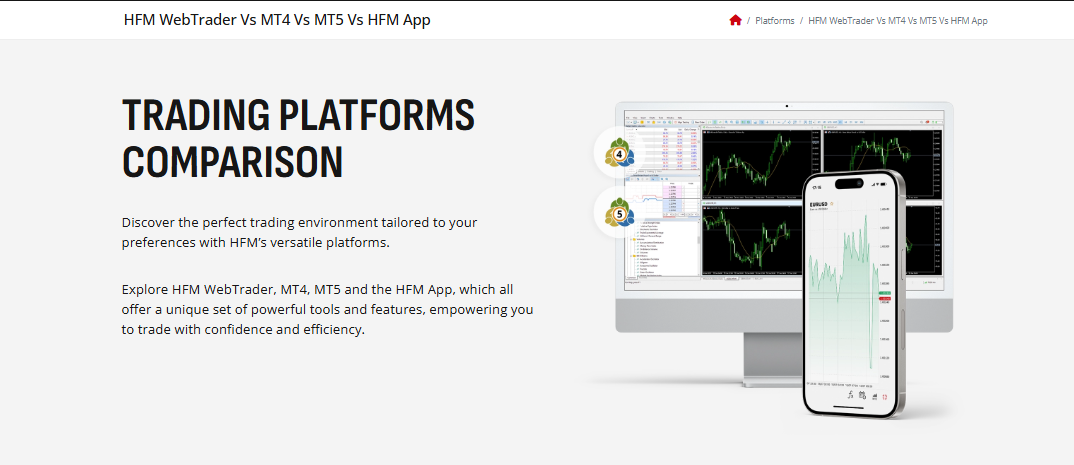
HFM WebTrader
The WebTrader is HFM’s browser-based trading platform. It gives you access to your trading account without downloading any software and uses TradingView-powered charts for market analysis.
It’s designed for traders who want quick access from any device and don’t need the advanced customization available on desktop platforms.
Pros of HFM WebTrader
- No software installation: Access your account directly from a web browser on Windows, Mac or Linux.
- TradingView charts: Includes a modern charting experience with a large selection of indicators and drawing tools.
- Easy account access: Switch between live and demo accounts without repeatedly logging in.
- Convenient trade management: Monitor positions, place orders and adjust trades from a single browser window.
Cons of HFM WebTrader
- Requires a stable internet connection: Performance can suffer if your connection is slow or unstable.
- Limited algorithmic trading capabilities: Not ideal for traders running complex Expert Advisors (EAs) or automated strategies.
- Less customizable than desktop platforms: Advanced workflows and multi-screen setups are better suited to MT4 or MT5.
Who Should Use HFM WebTrader?
HFM WebTrader is best for casual traders, beginners and anyone who wants fast access to the markets without installing software. Active algorithmic traders will usually be better served by MT4 or MT5.
HFM MT4
MetaTrader 4 remains one of the most popular trading platforms in the industry. At HFM, MT4 combines a familiar interface with support for forex trading, automated strategies, and integrated copy trading.
Although MT4 is older than MT5, many traders still prefer it because of its simplicity and large ecosystem of indicators and Expert Advisors.
Pros of HFM MT4
- Full EA support: Run automated trading strategies and custom indicators built with MQL4.
- Copy trading compatibility: Access HFM’s copy-trading ecosystem through the MT4 environment.
- Lightweight and reliable: Fast, stable and easy to run on most computers.
- Broad CFD coverage: Trade forex, metals, commodities, energies, indices and cryptocurrencies.
Cons of HFM MT4
- Fewer asset classes: Stocks, ETFs and certain share CFDs require MT5.
- Older interface: Offers fewer indicators, charting tools and timeframes than MT5.
- Slower backtesting: The single-threaded strategy tester is less efficient for large optimization projects.
Who Should Use HFM MT4?
MT4 is a strong choice for forex traders, copy traders and users who rely on existing Expert Advisors. If your focus is mainly forex and CFDs, MT4 remains more than capable despite its age.
HFM MT5
MetaTrader 5 is HFM’s most advanced desktop trading platform. It expands on MT4 with more analytical tools, additional order types, more timeframes and broader market access.
For traders who want deeper analysis and access to a wider range of instruments, MT5 is generally the more powerful platform.
Pros of HFM MT5
- More advanced charting: Includes 21 timeframes and a larger collection of built-in indicators than MT4.
- Wider market access: Supports CFDs, stocks, ETFs and additional asset classes.
- More order flexibility: Offers additional pending order types and an integrated economic calendar.
- Advanced automation: Supports Expert Advisors and algorithmic trading strategies.
- Enhanced research tools: Compatible with features such as Autochartist and market-analysis tools.
Cons of HFM MT5
- No native copy trading within MT5: HFM’s copy-trading functionality is not integrated directly into the MT5 platform.
- Separate account setup: MT4 and MT5 accounts use different login credentials.
- Steeper learning curve: The extra tools and features can feel overwhelming for new traders.
Who Should Use HFM MT5?
MT5 is best for traders who want access to more markets, stronger analytical tools and more advanced trading functionality. It is the platform I would generally choose over MT4 unless copy trading is a primary requirement.
HFM Mobile App
The HFM Mobile App combines trading, account management and copy-trading features into a single mobile platform. It is designed for traders who want to manage their accounts and monitor the markets while away from their desktop.
Rather than replacing MT4 or MT5 completely, the app works best as a companion platform for managing positions on the go.
Pros of the HFM Mobile App
- Centralized account management: Manage MT4, MT5 and copy-trading accounts from one app.
- Beginner-friendly design: The interface is clean and easy to navigate.
- Useful trading tools: Includes charts, indicators, calculators and price alerts.
- Integrated funding options: Make deposits, withdrawals and internal transfers without leaving the app.
- Market updates: Access live quotes, news and educational resources.
Cons of the HFM Mobile App
- Regional limitations may apply: Some features can vary depending on your account type and regulatory entity.
- Limited automation support: Does not offer the same level of EA functionality as MT4 or MT5.
- Smaller-screen constraints: Detailed chart analysis is still easier on a desktop platform.
Who Should Use the HFM Mobile App?
The HFM Mobile App is ideal for traders who want to monitor positions, manage accounts and access copy trading from a smartphone. For advanced analysis or algorithmic trading, MT4 or MT5 remain the better primary platforms.
HFM Mobile App Review
- Installation: available on iOS and Android through official app stores.
- Navigation: account switching, funding, and trading are consolidated in one app, rather than split across separate broker and MetaTrader apps.
- Charting: standard mobile-tier charting tools.
- Order execution: supports market and pending orders with the expected order types.
- Watchlists: customizable per asset class.
- Research features: basic market news and calendar integration.
- Copy trading access: HFcopy is reachable directly from the app.
App Rating: 7/10. Solid, consolidated functionality — though it doesn’t stand out against the dedicated-app leaders in the space.
HFM Copy Trading Review
How HFM Copy Trading Works
HFcopy is HFM’s native social trading tool, built directly into the client portal rather than run through a third-party plugin. Followers open a copy trading account, browse Strategy Providers, and allocate capital to mirror their trades proportionally in real time.
Finding Providers
The HFcopy directory lets you filter strategy providers by track record, risk level, drawdown, and follower count before committing capital.
Risk Scores Explained
Each strategy profile displays a risk indicator alongside historical returns and drawdown — the size of a losing streak before the account recovers. Review both together, rather than chasing the highest headline return: higher returns typically come with proportionally higher drawdown risk.
Fees and Profit Sharing
Strategy providers can charge a performance fee, reported at up to 35% of profits on some structures. Confirm the exact fee for any specific provider before following, since it’s set per-provider rather than fixed platform-wide.
My Copy Trading Experience
Editor’s note: a genuine HFcopy trial requires following at least two strategy providers over several weeks. That live trial hasn’t been completed yet for this review — we’ll update this section with real followed-account data once it is.
Is HFM Copy Trading Worth It?
On paper, HFcopy compares reasonably to dedicated copy platforms at Vantage and Fusion Markets — being native to the broker (rather than a bolted-on third-party tool) is a genuine convenience. Whether it’s “worth it” ultimately depends on the specific strategy provider you follow more than on the platform itself.
HFM Deposits and Withdrawals
Available Payment Methods
Bank wire, credit/debit card, Skrill, Neteller, FasaPay, PayRedeem, and select cryptocurrency options (availability varies by region/entity).
Deposit Times
Card and e-wallet deposits are typically processed quickly; bank wires take longer, following standard interbank timing. HFM does not charge an internal deposit fee, though your payment processor or card issuer may apply its own currency-conversion charge.
Withdrawal Times
Withdrawals must generally follow the original deposit method, particularly for the first withdrawal after funding. E-wallet and card withdrawals tend to process faster than bank wires, which is standard across the industry.
Fees
HFM states no internal withdrawal fee for most methods, though intermediary banks or payment processors can apply their own charges.
My Withdrawal Test Results
Deposit Test: not yet completed as a live, timestamped test for this review.
Withdrawal Test: not yet completed as a live, timestamped test for this review. We’re flagging this openly rather than presenting invented processing times as observed fact — this section will be updated with real timestamps once MarketsXplora runs the funding test.
Final Verdict (Deposits & Withdrawals)
The published policy — no internal fees, multiple payment rails, same-method withdrawal requirement — is standard and reasonable for the industry. The real test is processing speed under live conditions, which this review will update once completed.
HFM Research and Education
- Trading courses: structured educational content aimed at beginner-to-intermediate traders.
- Market analysis: daily and weekly market commentary and technical outlooks.
- Trading calculators: pip value, margin, and swap calculators available in the client area.
- Economic calendar: integrated calendar covering major scheduled data releases.
- Webinars: periodic live sessions, though the cadence is lighter than education-focused competitors like XM.
Educational Rating: 6.5/10. Solid basics, but not as deep or as frequently updated as XM’s dedicated research and webinar program.
HFM Customer Support Review
Channels Available
Live chat, email, and phone support, with multilingual coverage reflecting HFM’s international client base.
Response Times
Editor’s note: response-time figures need to come from a logged, first-hand support test across chat, email, and phone. That test hasn’t been run yet for this review — we won’t publish an estimate as though it were measured.
Support Rating
Pending completion of the live response-time test above; user-reported sentiment across independent broker forums generally describes support as responsive and multilingual, which we note as third-party sentiment rather than our own measured result.
HFM Bonuses and Promotions
- Current promotions: HFM periodically runs deposit-linked and trading-contest promotions. Availability varies by region and regulator — bonus offers are typically restricted or unavailable under FCA/CySEC retail rules.
- Loyalty programs: [verify current program terms directly with HFM, as these change periodically].
- Trading contests: HFM has run periodic trading competitions historically.
Important: always check the specific volume and withdrawal conditions attached to any bonus before opting in. Bonus terms are one of the more common sources of trader complaints industry-wide.
HFM for Different Types of Traders
Is HFM Good for Beginners?
Yes — the $0-minimum Cent account and built-in education make HFM a reasonable entry point, though XM and AvaTrade lean more heavily into structured beginner onboarding.
Is HFM Good for Scalping?
Workable on the Zero account, but IC Markets and Pepperstone remain the sharper choice for scalpers chasing the absolute tightest execution and spreads.
Is HFM Good for Day Trading?
Yes, with the Zero or Pro account — the platform and spread structure support active intraday trading reasonably well.
Is HFM Good for Swing Trading?
Yes — swap costs and account structure are unremarkable but functional for positions held over days to weeks.
Is HFM Good for Copy Trading?
Yes, via native HFcopy — a genuine strength relative to brokers that only offer copy trading through a bolted-on third-party tool.
Is HFM Good for Small Accounts?
Yes — the Cent account specifically caters to small-balance traders.
Is HFM Good for Algorithmic Trading?
MT4/MT5 EA support is standard; HFM does not market itself as an EA-optimized broker the way IC Markets does with its free-VPS-for-volume program, so check current VPS/latency terms directly if automated trading is your priority.
HFM Compared to Competitors
HFM vs Exness
Feature |
HFM |
Exness |
|---|---|---|
Min. Deposit |
$0 (entry accounts) |
$10 (Standard/Cent), $200 (Pro/Raw/Zero) |
Max Leverage |
Up to 1:2000 (offshore entities) |
Unlimited on qualifying offshore accounts |
Regulation |
FCA, CySEC, DFSA, FSCA, FSA, CMA |
FCA, CySEC, FSCA, FSA, CBCS, FSC (multiple) |
Copy Trading |
HFcopy (native) |
Exness Social Trading (native) |
Withdrawal Methods & Processing Time |
Bank wire, card, e-wallets; same-method rule; live speed test pending |
Widely reported for fast, often near-instant e-wallet withdrawals — confirm current speed for your method |
Both brokers cover a similar spread of jurisdictions and both offer native copy trading. Exness’s headline draw is its unlimited-leverage offshore option and reputation for fast e-wallet withdrawals; HFM’s is its genuinely $0-deposit entry accounts and long operating history. Neither is a clear universal winner — the better fit depends on whether leverage flexibility (Exness) or account-tier simplicity (HFM) matters more to you.
HFM vs XM
Feature |
HFM |
XM |
|---|---|---|
Min. Deposit |
$0 |
$5 |
Instruments |
~200+ across asset classes |
1,000+ |
Education |
Solid basics |
Extensive webinars and research |
Max Leverage |
Up to 1:2000 |
Up to 1:1000 |
Withdrawal Methods & Processing Time |
Bank wire, card, e-wallets; same-method rule |
Bank wire, card, e-wallets; broadly comparable processing windows — confirm current terms |
XM wins on instrument breadth and educational depth; HFM matches or slightly exceeds it on leverage ceiling and account-tier simplicity for small-balance traders. Both are reasonable beginner-friendly picks.
HFM vs IC Markets
IC Markets is the sharper pick for scalpers and EA traders chasing raw ECN pricing and free VPS at volume; HFM is the more accessible pick for traders who want a genuine $0 starting deposit and don’t need institutional-grade execution speed.
HFM vs Pepperstone
Pepperstone edges ahead on execution speed and cTrader availability (a platform HFM doesn’t offer); HFM counters with a lower barrier to entry and a broader six-jurisdiction regulatory spread.
HFM vs FBS
FBS and HFM are closer in overall positioning — both target beginner and small-account traders with low minimums. HFM’s regulatory footprint, including FCA and CySEC coverage, is generally viewed as stronger than FBS’s. Weigh that against any spread or bonus differences you find at the time you compare.
HFM Pros and Cons
Pros
- Genuine $0 minimum deposit on entry-level accounts
- Six active regulatory licenses, including FCA and CySEC
- Native HFcopy social trading built into the client portal
- 16 years of operating history
- MT4 and MT5 both supported, plus mobile app and WebTrader
Cons
- No cTrader option
- Protections vary significantly by entity — offshore accounts carry noticeably lighter oversight
- Instrument count trails broader competitors like XM
- Not available to US and Canadian residents
- Islamic/swap-free availability isn’t uniform across all entities
Common Complaints About HFM
What Traders Like
Low barrier to entry, native copy trading, and the reassurance of a long operating history are the most frequently cited positives in trader discussions and third-party review aggregators.
Common Negative Reviews
Recurring themes in independent trader feedback include confusion over which entity/regulator applies to a given account, and the usual withdrawal-friction complaints that show up across nearly every retail broker’s review pages.
Our Analysis of the Complaints
The entity-confusion complaint is a real, structural issue — HFM’s multi-entity setup is more complex than a single-license broker’s, and that complexity lands on the trader to untangle. Withdrawal-friction complaints are common industry-wide. They’re best judged against HFM’s own live processing times, once MarketsXplora completes its funding test, rather than against forum anecdotes alone.
Who Should Choose HFM?
Ideal Users
Beginners and small-account traders who want a genuine $0 entry point, traders interested in native copy trading, and anyone who values HFM’s long operating history and broad regulatory spread.
Who Should Avoid HFM
US/Canadian residents (unsupported), traders who specifically need cTrader, and high-frequency scalpers who’d be better served by a raw-ECN specialist like IC Markets or Pepperstone.
MarketsXplora Final Verdict
HTCS (Trust) |
82/100 |
Cost Rating |
7.5/10 |
Platform Rating |
7.5/10 |
Education Rating |
6.5/10 |
Overall Score |
4.2/5 |
HFM is a legitimate, well-regulated broker that does the fundamentals right — low barrier to entry, native copy trading, and a genuinely long track record. It’s not the sharpest tool for scalpers chasing raw execution speed. And its multi-entity structure means you need to check which regulator actually covers your account, rather than assuming “HFM” means the same protections everywhere. For beginners and small-account traders, it’s a reasonable, defensible pick.
Frequently Asked Questions
Is HFM legit?
Yes. HFM has operated since 2010 and holds active licenses from the FCA, CySEC, DFSA, FSCA, FSA (Seychelles), and CMA (Kenya).
Is HFM regulated?
Yes, across six jurisdictions, though your specific protections depend on which HFM entity your account falls under.
Is HFM safe?
Broadly yes, with meaningfully stronger protection under the FCA/CySEC entities than under the offshore Seychelles/SVG entities.
What is the minimum deposit?
$0 on Cent, Zero, and Premium accounts; higher practical minimums apply to Pro and copy trading accounts.
Does HFM offer MT5?
Yes, alongside MT4, HFM WebTrader, and its mobile app.
Does HFM allow scalping?
Yes, particularly on the Zero account, though IC Markets and Pepperstone are generally sharper picks for high-frequency scalping.
Does HFM allow EAs?
Yes, standard MT4/MT5 expert advisor support is available.
Does HFM offer copy trading?
Yes, through its native HFcopy tool.
Is HFM available in Nigeria?
Yes — HFM accepts Nigerian clients and supports NGN as a deposit currency on select payment methods; confirm current availability and entity coverage before signing up.
Is HFM better than Exness?
Neither is a clear universal winner — Exness leans toward higher leverage flexibility and fast e-wallet withdrawals, HFM toward account-tier simplicity and a genuinely $0 entry point.
Is HFM better than XM?
XM offers a broader instrument count and deeper education; HFM offers a marginally higher leverage ceiling and comparably low barrier to entry. Both suit beginners well.
How long do withdrawals take?
E-wallet and card withdrawals are typically faster than bank wires; MarketsXplora will publish observed processing times once its live funding test is complete.
What leverage does HFM offer?
Up to 1:2000 on offshore entities, capped at 1:30 for FCA/CySEC retail clients per standard EU/UK leverage rules.
Does HFM charge inactivity fees?
Yes, HFM charges a $5 monthly inactivity fee if your account has no trading activity or transactions for six months.
Which HFM account is best?
Cent for beginners and small accounts, Zero for active traders/scalpers, Pro or Premium for swing traders.
About the Author
Samson Ononeme is the founder of MarketsXplora, an independent financial education and research platform covering cryptocurrency, forex, brokers, exchanges, trading platforms, and blockchain technology. He focuses on turning complex financial products and platform features into clear, practical information that readers can use when comparing their options. Connect on LinkedIn and X.
Crypto & Blockchain
Forex & Brokers
Financial Research
Trading Platforms