

Our Editorial Testing Methodology
MarketsXplora exists to help traders and investors make decisions with real money on the line. Because of that, we hold ourselves to a testing standard that goes beyond rewriting a broker’s marketing page or a manufacturer’s spec sheet. Every review published on this site is built on a documented, repeatable process. This page explains exactly what that process is.
Our Core Commitment
MarketsXplora’s mission is to deliver unbiased, evidence-based evaluations of forex and CFD brokers, prop trading firms, crypto exchanges, hardware wallets, and fintech/money-transfer services. We do not accept payment to alter a score, hide a flaw, or inflate a rating. If a product fails our testing parameters, we report it — even when that product is a commercial partner.
How Our Scoring Works
Every review category on MarketsXplora is scored against a proprietary, weighted framework built specifically for that product type. This is what allows readers to compare two brokers, or two prop firms, on the same measurable terms rather than on marketing claims.
Forex & CFD Brokers
Scored using our Broker Trust Score framework (ETCS, and its regional adaptations TTCS and PTCS), which weighs regulation, execution quality, cost transparency, and withdrawal reliability.
Prop Trading Firms
Scored using our Prop Firm Legitimacy Score (PFLS), which weighs challenge rule transparency, payout track record, and the fine print around refunds, daily loss limits, and account variants.
Crypto Exchanges
Scored using our Blockchain/Crypto Trust Score (BTCS), and the Thai-market-specific METS framework, which weigh custody practices, liquidity, fee structure, and regulatory standing.
Hardware Wallets
Evaluated on security architecture, operational performance, setup friction, cost-to-value, and manufacturer support responsiveness — see our five-pillar protocol below.
Fintech & Money Transfer
Scored using our True Cost of Currency (TCC) framework, which surfaces the real all-in cost of a transfer once exchange-rate markup and hidden fees are accounted for, not just the advertised fee.
Regional Access Scores
For country-specific content we apply localized access frameworks — including the Thai Trader Access Score (TTAS) and the Bangladesh Trader Access Score (BTAS) — which weigh local deposit/withdrawal rails, language support, and regulatory access alongside the base framework for that product category.
How We Test: Our Hands-On Protocol
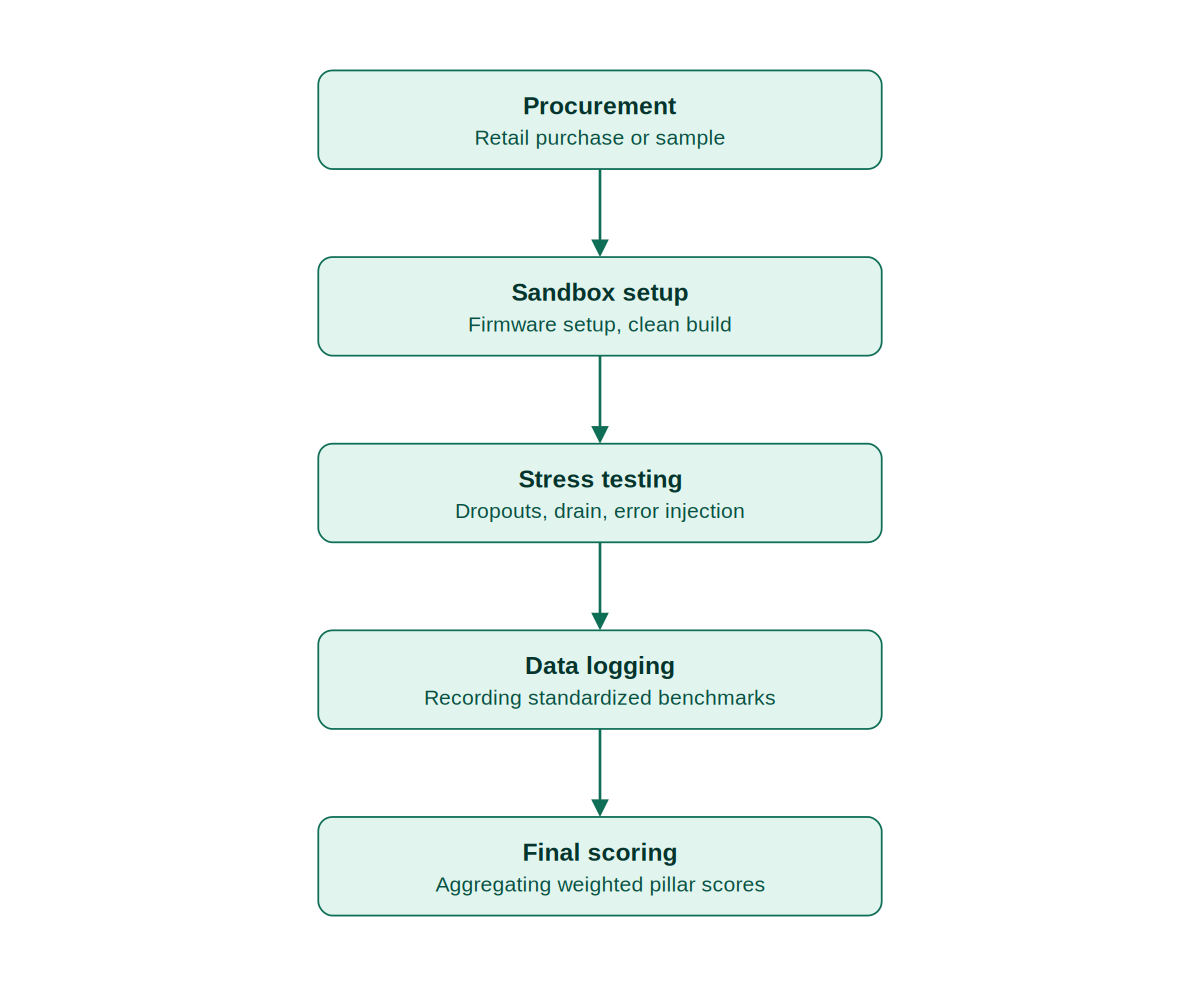
Our testing process differs by product category, because a broker and a hardware wallet fail in different ways. Here is what happens before a review is published.
Forex, CFD & Prop Firm Protocol
- Live capital, not just demos. Our reviewers open live trading accounts and, where applicable, purchase prop firm challenges with real funds. We do not base a verdict purely on a risk-free demo environment.
- Real-world friction testing. We record actual deposit speed, withdrawal processing time, slippage during live execution, and — for prop firms — how challenge rules (daily loss limits, refund conditions, account-type restrictions) play out in practice rather than as advertised.
- Cross-referencing the fine print. Every fee, rule, and condition is checked against the provider’s own current terms before publication, and corrected across our content whenever a provider changes its terms.
Hardware Wallet Protocol
- Retail purchase or manufacturer sample. Most devices are bought at retail under normal customer conditions. Where a manufacturer provides a review unit at no cost, we disclose this on the individual review and test it against the same protocol and scoring criteria as a retail unit — acceptance of a free sample never affects the score.
- Minimum 14-day operational cycle. Each device runs a minimum 14-day test cycle across both iOS and Android before we publish a verdict.
- The Five Pillars we log data against:
- Security & Cryptographic Integrity — secure element certification, open- vs. closed-source firmware, clear-signing safety during smart contract interactions.
- Operational Performance — cold-boot time, Bluetooth/NFC pairing time, app sync speed, battery depletion.
- UI & Accessibility — onboarding friction, screen readability in direct sunlight and low light, button responsiveness.
- Cost-to-Value — retail price against direct competitors, plus any hidden ecosystem or network fees.
- Support Infrastructure — we open anonymous support tickets and time the manufacturer’s real response and resolution quality.
Crypto Exchange & Fintech Protocol
- Account-level verification. We verify custody model, supported fiat rails, and KYC/withdrawal friction directly on the platform rather than from a press kit.
- All-in cost modeling. For money-transfer and exchange reviews, we calculate the true cost of a transaction — advertised fee plus exchange-rate markup — using our TCC framework, rather than repeating a provider’s headline fee.
Affiliate & Commercial Disclosure
MarketsXplora uses affiliate links. If a reader clicks a link on our site and makes a purchase or opens an account, we may receive a commission at no additional cost to them.
For some hardware wallet reviews, the manufacturer provides the device we test at no cost rather than us purchasing it at retail. We disclose this on the individual review whenever it applies. Neither a commission nor a free sample has any influence on our testing protocols, data, or final scores — where the data shows a non-partner or a self-purchased unit performing better, we say so.
Meet the Team
 MarketsXplora is led by Samson Ononeme, founder and financial content strategist, with 12+ years in financial content and bylines at EarnForex, Kryptomoney, Cryptorunner, and AtoZ Markets. Connect on LinkedIn and X.
Frequently Asked Questions
Do you get paid to review a product?
We use affiliate links, and we may earn a commission if a reader clicks through and opens an account or makes a purchase. That commission never affects the score a product receives — our testing data determines the verdict, not our commercial relationships. If a paying partner underperforms a non-partner on the data, we rank it lower and say so.
Do you test with real money?
Yes, wherever that’s the realistic condition a reader will face. We open live trading accounts and fund prop firm challenges with real capital rather than relying only on demo environments, and we purchase hardware wallets at retail with our own funds. This is how we catch real-world friction — slippage, withdrawal delays, payout disputes — that a demo account or a manufacturer review unit won’t show.
How do you score each product?
Every category has its own proprietary, weighted framework built for that product type — including our Prop Firm Legitimacy Score (PFLS), Broker Trust Score (ETCS), Blockchain/Crypto Trust Score (BTCS), and True Cost of Currency (TCC) for money transfer. Each framework converts our raw testing data — execution speed, withdrawal friction, security architecture, real cost — into a single comparable score, so two products in the same category are always measured on the same terms.
Do you update reviews after they’re published?
Yes. When a provider changes its fees, rules, or terms, we correct our published content to match — including propagating a fix across every related article, not just the original review. Every review also carries a visible freshness signal so readers can see when it was last verified.
Do you accept free products from manufacturers?
For some hardware wallet reviews, yes — the manufacturer supplies the device we test rather than us buying it at retail. We disclose this on the individual review whenever it applies. A free sample runs through the same protocol and scoring criteria as a self-purchased unit and has no influence on the final score.
Why do some reviews rank an affiliate partner lower than a non-partner?
Because our scores come from testing data, not commercial arrangements. If a partner’s execution speed, payout track record, or cost-to-value is weaker than a competitor’s on the metrics we measure, the competitor scores higher — regardless of which one is our affiliate partner.