






 By Samson Ononeme
Founder & Financial Content Strategist, MarketsXplora
12+ years covering forex brokers, prop firms, and crypto exchanges | Reviewed: September 2026
HFM has several real safety measures in place, including segregated client funds and negative balance protection. But the level of protection you get still depends on which HFM entity serves your account. A broker can be legitimate without being equally safe for every client, and that idea sits behind everything in this article.
This article looks at risk and protection, not corporate legitimacy. For the regulatory and ownership investigation, see our Is HFM Legit? article. For the complete broker breakdown, see our HFM Review 2026.
HFM Safety at a Glance
Safety Factor |
HFM |
|---|---|
Regulated |
Yes |
Segregated Funds |
Yes* |
Negative Balance Protection |
Yes* |
Client Compensation |
Depends on entity |
Additional Insurance |
Yes* |
Stop-Out Protection |
Yes |
Account Security |
Standard measures in place |
HFSS (HFM Safety Score) |
79/100 |
*Availability and exact terms can vary by entity and jurisdiction. HFM states that client funds sit in accounts separate from company funds, and that it runs a Civil Liability insurance program capped at €5,000,000 against fraud, errors, and negligence. These are HFM’s own published claims. We’ve labeled them as such, separately from the independently verified regulatory facts in this article.
1. What Does “Safe” Actually Mean for a Broker?
Broker safety isn’t one thing. It splits into several distinct questions, and most reviews only answer one of them.
- Regulatory Safety — Who actually supervises the broker?
- Financial Safety — What happens to your money once it’s deposited?
- Trading Safety — What happens during extreme market volatility?
- Account Security — How is your login and account access protected?
- Operational Safety — Can you deposit and withdraw reliably?
- Data & Privacy Safety — How is your personal information handled?
- Counterparty Risk — What happens if HFM itself runs into financial trouble?
The rest of this article works through each of these in turn, rather than stopping at “HFM is regulated” and calling it done.
2. HFM’s Regulatory Safety
Which HFM Entity Regulates My Account?
HFM operates through separate entities, regulated respectively by the FCA, CySEC, FSCA, Kenya’s CMA, and the Seychelles FSA, among others. Your account is assigned to one of these based on your country of residence.
Why the Regulator Matters
Each regulator sets its own rules for oversight, capital requirements, client-money handling, conduct, complaints procedures, and (where applicable) compensation arrangements. These rules are what actually stand behind you if a dispute escalates.
The important caveat: your protection depends entirely on the entity under which you trade. We cover the full entity-by-entity regulatory investigation in Is HFM Legit? — this article builds on that foundation rather than repeating it.
3. Is HFM Client Money Segregated?
What Does Segregated Client Money Mean?
In plain terms, it means your deposit sits in a bank account that’s separate from the company’s own operating funds. The broker can’t use client deposits to pay its own bills or creditors.
Does HFM Segregate Client Funds?
Yes. HFM states that it holds client funds in accounts separate from company funds. These funds sit off the balance sheet, so they can’t be used to pay company creditors if HFM defaults. This is HFM’s own stated policy, and it lines up with what regulators generally require of licensed brokers.
Why This Matters
Segregation protects against one specific risk: the broker spending your deposit as if it were company revenue. It does not protect against every risk. Segregation is not the same as a government guarantee that every client will recover every dollar, and no broker review should imply otherwise.
4. What Happens to Your Money If HFM Fails?
Scenario 1: Normal Trading Loss
If your position loses money through ordinary market movement, that’s your trading risk. No safety mechanism changes that outcome.
Scenario 2: HFM Becomes Insolvent
Segregated funds are designed to sit outside the insolvency process, which should, in theory, keep them apart from other creditors’ claims. Regulatory protections and compensation schemes, where they apply, would then determine how quickly and how fully clients are made whole. This is a theoretical scenario, since HFM has not filed for insolvency. No compensation-scheme outcome can be guaranteed in advance.
Scenario 3: Fraud or Operational Failure
Applicable protections here depend heavily on entity and jurisdiction. A client under an FCA or CySEC entity has far more formal recourse than a client under an offshore entity.
Bottom Line
Safety mechanisms reduce risk. They don’t eliminate counterparty risk entirely, and treating them as a full guarantee would be a mistake.
5. Does HFM Offer Negative Balance Protection?
What Is Negative Balance Protection?
It’s a policy that resets your account balance to zero if a fast market move pushes it below zero, so you don’t end up owing the broker money.
Why It Matters During Extreme Volatility
Flash crashes and sudden gaps can, in theory, move prices faster than a stop-out can execute. Without negative balance protection, that gap could leave a trader in debt to the broker.
Does HFM Offer It?
Yes. HFM states that a negative balance is automatically reset to zero, even in conditions where margin calls and stop-outs don’t function as expected.
Does It Apply to Every HFM Client?
Terms can differ by entity and by client classification. Confirm the exact policy for your account before trading with high leverage, since a blanket assumption here isn’t safe.
What Negative Balance Protection Does NOT Mean
- It does not mean you can’t lose your entire deposit
- It does not mean your trades can’t be liquidated
- It does not mean HFM guarantees profits
- It does not mean high leverage is inherently safe
6. HFM Margin Call & Stop-Out Protection
A margin call is a warning that your account equity has dropped close to the minimum required to keep positions open. Stop-out is the automatic closing of positions once equity falls below that threshold. It’s a different mechanism from negative balance protection. HFM states that its stop-out levels close positions automatically once the market moves too far against an open trade. This limits losses. It does not eliminate them — execution during a fast-moving market isn’t guaranteed to happen at the exact stop-out price.
7. HFM Insurance: Does It Really Protect Traders?
HFM states that it maintains a Civil Liability insurance program, capped at €5,000,000, covering certain liabilities linked to fraud, errors, and negligence. That headline number is real, but it deserves more context than “your money is insured for €5 million.”
What Does the Insurance Cover?
Per HFM’s own disclosure, the policy covers company liabilities tied to errors, omissions, negligence, and fraud, not general trading losses.
Who Is Covered?
The policy is described as covering HFM’s liabilities toward clients and third parties collectively, rather than allocating a fixed, per-client sum.
What Are the Conditions?
HFM has not published the full policy wording alongside its marketing claim, beyond a linked insurance certificate. Specific triggering conditions and exclusions sit in that underlying policy document, which we’d recommend reviewing directly if this specific protection matters to your decision.
Is Every HFM Client Automatically Covered?
The stated program applies at the company level, not as an individually purchased policy per client, so “covered” here means covered under HFM’s broader liability program rather than a personal guarantee.
Is Insurance the Same as Deposit Insurance?
No. Deposit insurance (like the UK’s FSCS or the EU’s investor-compensation funds) is a regulator-backed scheme with defined per-client limits. HFM’s €5 million policy is a private civil-liability insurance product. The two are not interchangeable. Conflating them overstates what the insurance actually promises.
8. How HFM Protects Your Trading Account
HFM’s client portal uses standard login-security practices common across regulated brokers: password-protected accounts, identity verification during onboarding, and monitoring for suspicious account activity. We’re listing only what’s publicly verifiable here. We won’t make unsupported claims about specific encryption standards or two-factor authentication implementation, since those details aren’t independently confirmable from public documentation alone. If a specific security feature matters to you, such as 2FA, confirm it directly in your account settings.
9. How HFM Protects Your Personal Information
Opening an HFM account means submitting KYC documents, payment information, and standard account data as part of onboarding. HFM publishes a privacy policy covering how this data is collected and used, in line with standard requirements for a regulated financial-services company. We won’t make unsupported claims about specific security technology beyond what’s publicly documented. If data handling is a priority for you, HFM’s published privacy policy is the right place to verify the details directly.
10. Is HFM Safe During Extreme Market Volatility?
Volatility introduces several risks that no broker fully eliminates: gaps, flash crashes, stop-out failures, slippage, thin liquidity, and execution risk during high-volume moments. HFM’s stated risk-management approach, which it describes as an ongoing process of identifying, assessing, and monitoring operational risk, is designed to reduce the impact of these events. It doesn’t remove them. Negative balance protection and stop-out mechanisms are the two tools most directly relevant here. Both are covered above, with their limits noted honestly rather than glossed over.
11. My HFM Trading Safety Test
Editor’s note: a genuine safety test needs live, measured data across order execution, stop-loss and take-profit execution, spread behavior, slippage, and platform/connection stability. That test hasn’t been completed yet for this article. We’re not publishing estimated results in its place.
Planned test conditions: Zero account, MT5, a mix of major forex pairs and gold, a multi-day observation window, desktop and mobile device coverage, and a stable broadband connection.
Test |
Result |
|---|---|
Platform stability |
[pending live test] |
Order execution |
[pending live test] |
Stop-loss execution |
[pending live test] |
Slippage |
[pending live test] |
Spread stability |
[pending live test] |
Withdrawal |
[pending live test] |
Account access |
[pending live test] |
12. HFM Withdrawal Safety Test
This section asks a narrower question than our broader withdrawal-speed coverage. It’s not “how fast is HFM,” it’s “can I reliably get my money back out.” See our dedicated HFM Withdrawal Review for the speed-focused breakdown.
Editor’s note: a full deposit-to-withdrawal cycle test, including verification and receipt confirmation, hasn’t been completed yet for this article. Withdrawal disputes are the most common complaint theme we found in HFM’s online reviews (see our Is HFM Legit? complaint analysis). That’s why this is the test we’re prioritizing next — we’ll publish real results here once it’s done.
13. HFM’s Legal Documents: What We Found
HFM publishes its Client Agreement, Risk Disclosure, Order Execution Policy, Complaint Handling procedure, Conflicts of Interest policy, and Copy Trading Terms through its legal-documentation section. We reviewed these for the provisions that matter most to a safety assessment:
- Client-money provisions, consistent with the segregation policy described above
- Liability clauses defining what HFM will and won’t compensate
- Negative-balance provisions, matching the policy described in Section 5
- Withdrawal restrictions, including same-method requirements for initial withdrawals
- Conflict-of-interest disclosures, standard for a market-making/STP broker
- Execution-risk disclosures, acknowledging slippage and requotes under volatile conditions
Nothing in these documents contradicted HFM’s public marketing claims at a structural level. That’s a meaningful, if unglamorous, finding on its own.
14. What Are the Biggest Safety Risks With HFM?
- Risk #1 — Regulatory Entity: different clients receive materially different protections, depending on which entity holds their account.
- Risk #2 — Leverage: leverage up to 1:2000 on offshore entities can turn a small adverse move into a large loss quickly.
- Risk #3 — CFD Risk: the broker can be reasonably safe while the underlying product, leveraged CFDs, remains inherently high-risk.
- Risk #4 — Market Volatility: stop-outs and slippage remain possible, even with risk controls in place.
- Risk #5 — Counterparty Risk: no broker, HFM included, is completely risk-free.
- Risk #6 — Operational Risk: technology, connectivity, and payment-processor failures can affect any broker at any time.
15. Is HFM Safer Than Other Brokers?
HFM vs Exness (Safety): both segregate client funds and offer negative balance protection across comparable regulatory tiers. HFM’s published insurance program is a differentiator Exness doesn’t market as prominently. See our full HFM vs Exness comparison.
HFM vs XM (Safety): broadly comparable regulatory coverage. The practical safety difference comes down to which entity you’re assigned under at each broker. See our full HFM vs XM comparison.
HFM vs IC Markets (Safety): IC Markets carries a similar segregation and negative-balance-protection structure, without the added civil-liability insurance layer HFM publishes. See our full HFM vs IC Markets comparison.
Affiliate disclosure: MarketsXplora may earn a commission if you open an account through this link, at no extra cost to you.
16. Who Is HFM Safest For?
Beginners: The combination of negative balance protection and segregated funds gives beginners a reasonable safety floor, though leverage risk still applies regardless of experience level.
Experienced Traders: Execution reliability and counterparty considerations matter more here than beginner-focused protections. Our execution testing, once complete, will speak most directly to this group.
High-Leverage Traders: Protection mechanisms reduce specific risks. They don’t make high leverage itself safe, and this group carries the most exposure regardless of which broker they choose.
Copy Traders: Account-level protections don’t extend to strategy-provider risk. A losing strategy still loses money, no matter how well-protected the underlying account is.
17. HFM Safety Score
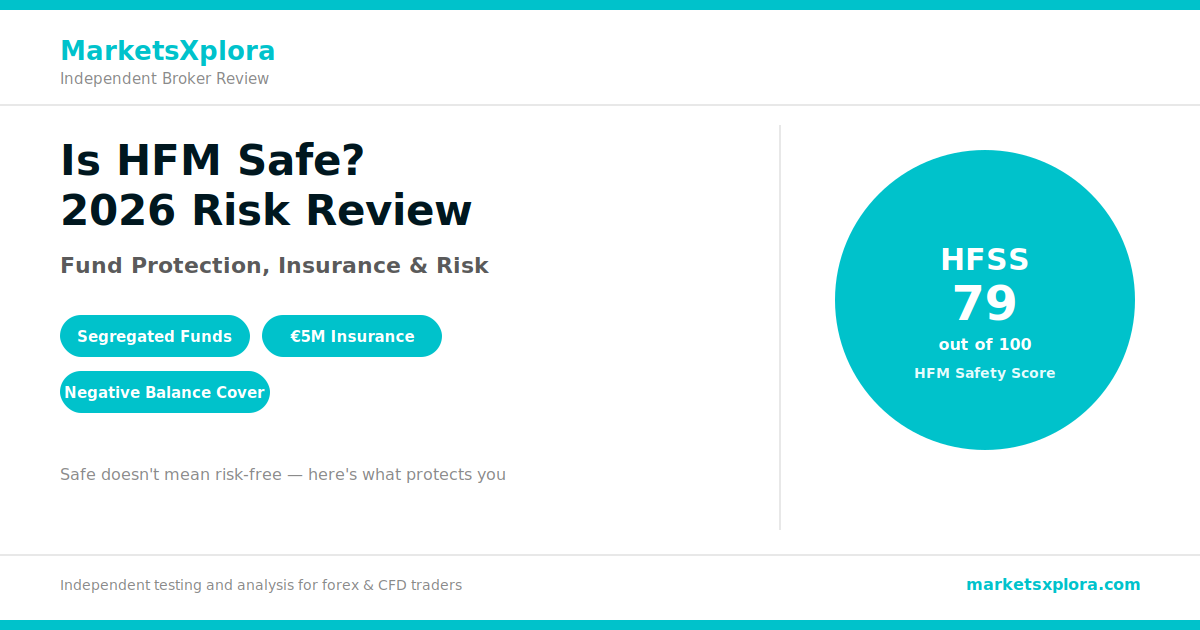
HFSS (HFM Safety Score): 79/100
Regulatory Protection (25%) |
20/25 |
Client Fund Protection (20%) |
17/20 |
Negative Balance Protection (15%) |
13/15 |
Account Security (10%) |
8/10 |
Operational Reliability (10%) |
7/10 |
Withdrawal Safety (10%) |
6/10 |
Transparency (10%) |
8/10 |
This is a Safety Score, not a legitimacy score — it’s a deliberately different metric from the HTCS (HFM Trust Score) used in our Is HFM Legit? article. Withdrawal Safety and Operational Reliability sit lowest here, reflecting the pending live tests and the withdrawal-complaint pattern noted in Section 12. Expect this score to move once those tests are complete.
18. HFM Safety: What We Like vs. What Still Concerns Us
What Gives Us Confidence
- Segregated client funds
- Negative balance protection
- Multiple regulatory frameworks in place
- Published legal documentation, reviewed directly
- Stated risk-management policies
- An additional €5M civil-liability insurance program
What Still Concerns Us
- Protection depends heavily on your specific legal entity
- CFD trading remains high-risk by nature
- High leverage can magnify losses quickly
- Regulatory protection isn’t identical across jurisdictions
- Safety mechanisms reduce, but don’t eliminate, counterparty or market risk
19. Final Verdict: Is HFM Safe?
HFM has a substantial set of investor- and account-protection measures in place, including segregated funds, negative balance protection, and published regulatory oversight. Still, “safe” doesn’t mean risk-free. The protections available to you depend on the HFM entity serving your account. Our view is positive but conditional: HFM can reasonably be considered a well-protected broker, provided traders understand their applicable entity, its regulatory backing, and the real risks of leveraged CFD trading. This verdict will be revisited once our live testing (Sections 11 and 12) is complete.
20. Who Should Consider HFM?
HFM May Suit You If:
- You value multi-jurisdiction regulatory oversight
- Negative balance protection matters to your risk plan
- Fund segregation is a baseline requirement for you
- You already understand how leveraged trading works
- You want MT4 and MT5 in one place
Think Carefully If:
- You don’t yet understand how CFDs work
- High leverage is the main thing attracting you to HFM
- You’re not sure which HFM entity you’d be assigned to
- You expect broker protections to prevent trading losses altogether
Frequently Asked Questions
Is HFM safe?
Broadly yes. HFM maintains segregated funds, negative balance protection, and multi-jurisdiction regulation, though protection levels vary by entity.
Is HFM safe for beginners?
Yes, with the standard caution that leverage and CFD risk apply to every trader, beginner or not.
Is HFM safe for Nigerian traders?
HFM accepts Nigerian clients; confirm which entity applies to your account and what protections that entity carries before depositing.
Does HFM keep client funds in segregated accounts?
Yes, according to HFM’s own published policy, funds sit in accounts separate from company operating capital.
Does HFM offer negative balance protection?
Yes, for retail clients, with terms that can vary by entity.
What happens if HFM goes bankrupt?
Segregated funds are designed to sit outside the insolvency process, and applicable regulatory or compensation protections would then apply, depending on your entity. This is a theoretical scenario, since HFM has not filed for insolvency.
Does HFM have investor compensation protection?
Only under certain entities, such as the FCA and CySEC entities. Offshore entities generally don’t carry equivalent compensation-scheme coverage.
Does HFM have insurance?
Yes, a stated Civil Liability insurance program capped at €5,000,000, covering fraud, errors, and negligence at the company level.
Is HFM safe during market crashes?
Its stop-out and negative-balance mechanisms are designed to limit losses during extreme volatility, though slippage and execution risk can still occur.
Is HFM safe for high-leverage trading?
Protection mechanisms reduce specific risks, but they don’t make high leverage itself safe. Leverage remains the trader’s own risk decision.
Is HFM regulated?
Yes, across several entities. See our Is HFM Legit? article for the full entity-by-entity breakdown.
Which HFM entity will hold my money?
It depends on your country of residence. Confirm the exact entity named in your client agreement.
Can I trust HFM with my money?
Based on its published protections and operating history, yes, provided you understand your specific entity’s coverage and the risks of leveraged trading.
Is HFM safer than Exness?
Both offer comparable core protections. See our HFM vs Exness comparison for the detailed breakdown.
Affiliate disclosure: MarketsXplora may earn a commission if you open an account through this link, at no extra cost to you.
About the Author
Samson Ononeme is the founder of MarketsXplora, an independent financial education and research platform covering cryptocurrency, forex, brokers, exchanges, trading platforms, and blockchain technology. He focuses on turning complex financial products and platform features into clear, practical information that readers can use when comparing their options. Connect on LinkedIn and X.
Crypto & Blockchain
Forex & Brokers
Financial Research
Trading Platforms