





Why You Can Trust This Review
MarketsXplora reviews brokers using a combination of first-hand testing, official regulatory and pricing information, and independent industry data. For this Fusion Markets review, we tested key parts of the client experience and cross-checked important claims rather than relying solely on the broker’s marketing material.
- First-hand testing: We tested the client area, Credit and Debit Cards funding, live chat support, and the overall account experience. We recorded how quickly our deposit reached the trading account and assessed the quality and responsiveness of customer support.
- Trading costs: We reviewed Fusion Markets’ official Zero and Classic pricing for EUR/USD, GBP/USD, gold, and index CFDs, then cross-checked the figures against independent sources. We distinguish between minimum advertised spreads and typical pricing because spreads change with market conditions.
- Execution: We compared Fusion Markets’ published execution figures with Pepperstone and IC Markets, while accounting for differences in how brokers measure execution speed.
- Trust and regulation: We examined the regulatory entities behind Fusion Markets and considered which entity may actually service an international client rather than treating the broker’s strongest license as universal protection.
- Scoring: Our scores consider regulation, fees, platforms, research, support, and our first-hand observations, alongside relevant independent customer feedback.
Bottom line on methodology: This review combines hands-on testing with documentary and independent research, giving readers a more complete picture of Fusion Markets than a review based solely on the broker’s marketing material. Where we have personally tested something, we identify that experience clearly; where we rely on published or third-party information, we say so.
Quick Verdict
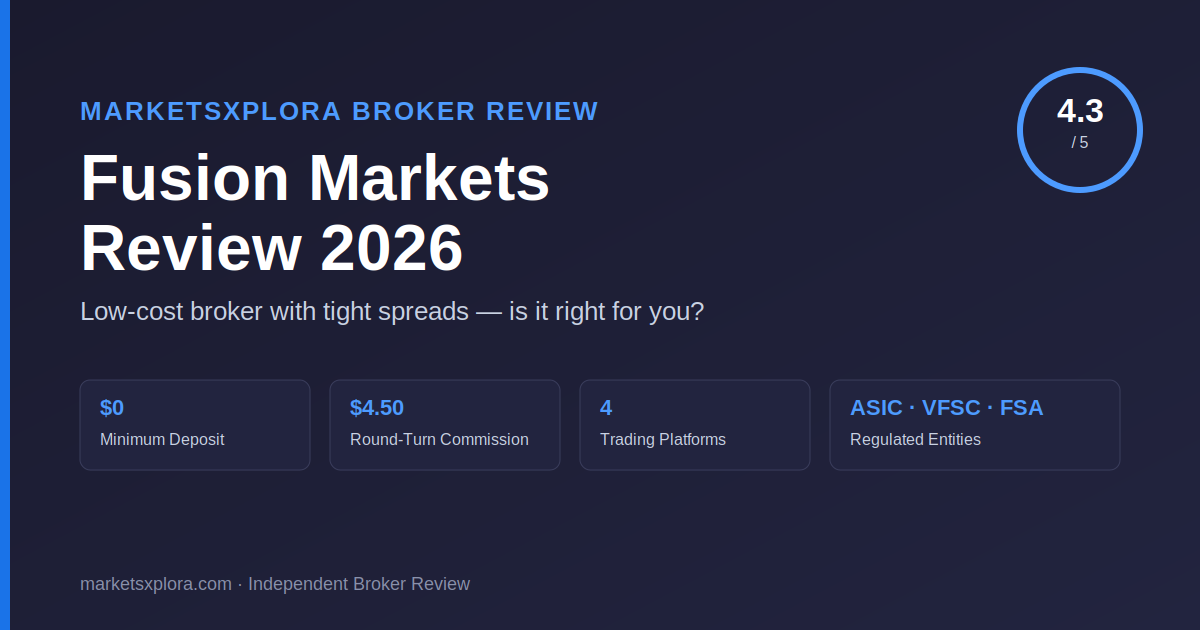
Fusion Markets is a genuinely low-cost, ASIC-regulated forex and CFD broker built for scalpers, algo traders, and cost-conscious active traders — but its educational resources are thin, and international clients typically trade under lighter offshore entities, not the Tier-1 Australian one.
Category |
Score |
Overall Rating |
4.3 / 5 |
Trust Score |
4.0 / 5 |
Fees Score |
4.8 / 5 |
Platforms Score |
4.6 / 5 |
Research Score |
2.8 / 5 |
Support Score |
4.4 / 5 |
Fusion Markets at a Glance
Feature |
Details |
Founded |
2017, with client onboarding beginning in 2019 |
Headquarters |
Melbourne, Australia (Level 10, 627 Chapel St, South Yarra) |
Regulators |
ASIC (Australia), FSA Seychelles, VFSC (Vanuatu) |
Minimum Deposit |
$0 |
Max Leverage |
Up to 1:500 (offshore entities); 1:30 for ASIC retail clients |
Platforms |
MT4, MT5, cTrader, TradingView |
Copy Trading |
Yes (Fusion+, DupliTrade) |
Islamic Account |
Yes (Swap-Free) |
Demo Account |
Yes (30-day expiry) |
Pros
- Extremely low trading costs (raw spreads from 0.0 pips + $4.50 round-turn commission)
- No minimum deposit
- MT4, MT5, cTrader, and TradingView all supported
- Fast withdrawals — 24/7 processing, sub-hour internal turnaround as of 2026
- Copy trading support via Fusion+ and DupliTrade
Cons
- Limited educational resources — no structured academy or courses
- Fewer tradable assets than some competitors (~250+ vs. 1,000+ at broader multi-asset brokers)
- International clients trade under offshore VFSC/FSA Seychelles entities, not the ASIC one
Start Trading with Fusion Markets
Trade Forex and CFDs with a low-cost broker offering tight spreads, competitive commissions, fast execution, and no minimum account size.
Open a Fusion Markets Account →
*Spreads and commissions vary by account type and instrument. Terms and conditions apply.
What Is Fusion Markets?
Fusion Markets is an Australian forex and CFD broker that competes primarily on price. Founded in 2017 and launched to live clients in 2019, the broker built its reputation around ultra-low trading costs, combining raw spreads with some of the lowest commissions in the industry. While newer than established competitors such as IC Markets and Pepperstone, Fusion Markets benefits from the backing of Gleneagle Asset Management, an Australian financial services group that has operated since 2010.
Beyond pricing, Fusion Markets stands out for offering a broad range of trading platforms. Clients can trade through MetaTrader 4, MetaTrader 5, cTrader, and TradingView, giving traders more flexibility than many competitors that limit users to one or two platforms. This combination of low costs and platform choice has helped the broker attract a growing global client base.
Company Background
Who Owns Fusion Markets?
Fusion Markets operates under the ownership of Gleneagle Asset Management, an Australian financial services company established in 2010. The brokerage was launched by a team led by CEO Phil Horner, with the goal of creating a lower-cost alternative to traditional forex brokers.
Years in Business
Although Fusion Markets officially launched in 2017 and began onboarding live clients in 2019, its parent company brings more than a decade of experience in financial services. As a brokerage, Fusion Markets remains younger than industry veterans such as IC Markets and Pepperstone, but it has already established a meaningful presence in the retail trading market.
Industry Reputation
Fusion Markets has earned a strong reputation among retail traders, reflected in thousands of positive customer reviews and high ratings on Trustpilot. Many users highlight the broker’s competitive pricing, responsive support team, and straightforward account management process. Like any large broker, it has also received complaints from some traders, including disputes over trade execution and slippage. For that reason, online reviews should serve as one factor in your evaluation rather than the sole measure of reliability.
Trust Score: 4.0 / 5
Fusion Markets earns solid marks for trust thanks to its ASIC-regulated Australian entity and its use of segregated client funds. However, regulatory protections vary depending on where you live. Many international clients open accounts through the broker’s offshore entities, which offer fewer safeguards than the Australian operation and may not provide negative balance protection.
As a result, Fusion Markets presents a stronger trust profile than many lightly regulated offshore brokers, but it does not offer the same level of global regulatory coverage as some of the industry’s largest multi-jurisdictional competitors. Before opening an account, check which entity will hold your account and what protections apply in your region.
Read also
Is Fusion Markets Safe?
Regulation and Licensing
Fusion Markets doesn’t operate as a single legal entity — it trades through three separate companies, each licensed by a different regulator, and which one you’re actually contracted with depends on where you live.
ASIC Regulation (Australia)
FMGP Trading Group Pty Ltd holds the ASIC license (AFSL 385620), serving Australian residents. ASIC is classified as a Tier 1 regulator — the highest oversight tier in retail forex — and is generally considered the strongest of the three licenses Fusion Markets holds.
FSA Seychelles Regulation
Fusion Markets International Ltd is regulated by the Seychelles FSA under License SD096. This is a Tier 3 regulator with minimal investor protections compared to ASIC.
VFSC Regulation (Vanuatu)
Gleneagle Securities Pty Limited is regulated by the VFSC in Vanuatu (Company No. 40256), another Tier 3 jurisdiction with lighter oversight. Most international clients outside Australia end up onboarded through this entity because it’s the one that offers higher leverage.

Client Fund Protection
Segregated Client Accounts
All three Fusion Markets entities segregate client funds, and client funds are held in segregated trust accounts with reputable banks such as the National Australia Bank.
Negative Balance Protection
This is where the entity you’re registered under actually matters. Negative balance protection is guaranteed only for the Australian ASIC entity — the offshore VFSC and Seychelles-regulated entities do not offer this protection. In practice, that means most non-Australian traders using Fusion Markets do not have a contractual guarantee against losing more than their account balance in extreme volatility events.
Compensation Schemes
The Vanuatu-based offshore entity participates in the Financial Resolution scheme, which protects traders in cases of conflict of interest — though this is not a deposit-insurance-style compensation fund in the way UK FSCS or similar schemes work. ASIC-regulated Australian clients benefit from the broader Australian financial services compensation framework applicable to AFSL holders.
Start Trading with Fusion Markets
Trade Forex and CFDs with a low-cost broker offering tight spreads, competitive commissions, fast execution, and no minimum account size.
Open a Fusion Markets Account →
*Spreads and commissions vary by account type and instrument. Terms and conditions apply.
Account Types
Fusion Markets keeps things deliberately simple: two core live account types, plus a Swap-Free variant and a demo. Both live accounts give you access to the same instruments and platforms with no minimum deposit, so the choice comes down to cost structure, not features.
Zero Account
Key Features
The Zero Account is built for intermediate and advanced traders, offering raw spreads from 0.0 pips across all four supported platforms.
Spreads and Commissions
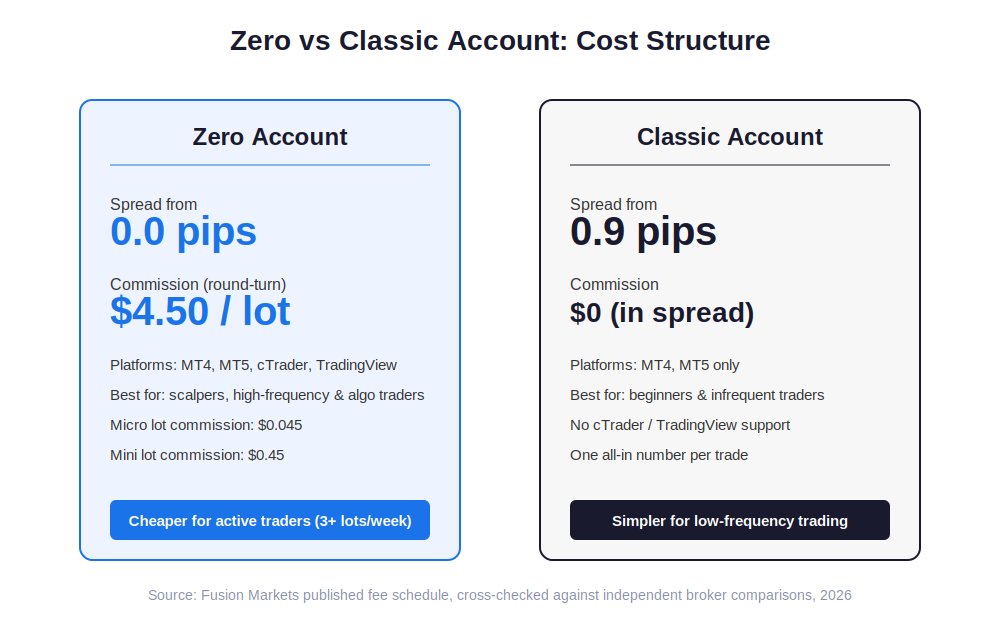
Spreads start from 0.0 pips, complemented by a USD $4.50 round-turn commission ($2.25 per side, charged on both opening and closing a position). On smaller sizes, that works out to $0.45 per mini lot and $0.045 per micro lot.
Who Should Use It?
This account suits cost-focused professionals, scalpers, and high-frequency traders looking to minimize trading expenses. If you trade more than a few lots a week, the raw spread plus low commission structure is usually cheaper overall than Classic.
Classic Account
Key Features
Designed for beginners and traders who prefer simplicity, the Classic Account charges no commission — but it does not work with cTrader or TradingView, since both rely on a commission-based pricing model. Classic is available only on MT4 and MT5.
Spreads
Trading costs are built into slightly wider spreads starting from 0.9 pips on EUR/USD.
Who Should Use It?
Newer traders who prioritize ease of use and don’t want to calculate separate commissions per trade. If you trade infrequently, Classic’s all-in spread pricing is simpler to reason about.
Demo Account
Free, with virtual funds, and available on every platform — though it expires after 30 days, which limits its usefulness as a long-term practice tool alongside a live account.
Islamic Account
The Swap-Free account replaces overnight swaps with an administrative fee after a position is held beyond a set number of days — after seven days, specifically. Minimum trade size is 0.01 lot, and the account carries a 1.4-pip minimum EUR/USD spread, wider than either Zero or Classic. It gives access to over 50 financial instruments.
Which Account Type Is Best?
Active traders and anyone running EAs or scalping strategies should default to Zero — the raw-spread-plus-commission math wins once you’re trading more than a handful of lots weekly. Beginners who want to see one all-in number per trade, and who don’t need cTrader or TradingView, are better served by Classic. Traders who can’t hold swap-bearing positions for religious reasons should use the Swap-Free variant, understanding it comes at a real cost in spread width.
Markets Available
Forex Trading
Major, Minor, and Exotic Pairs
Fusion Markets offers over 90 forex pairs, covering majors such as EUR/USD, minors such as GBP/AUD, and exotic pairs such as USD/ZAR.
Indices
Key global indices are available, including the S&P 500, Nasdaq 100, FTSE 100, and DAX 30.
Commodities
A balanced selection of metals, energy products, and agricultural commodities, including gold, silver, and oil.
Stock CFDs
Exposure to global corporations across technology, finance, and healthcare, including names like Apple and Microsoft — though the broker’s alternative-investment offering is average, with no stock CFDs beyond US-listed names. US Share CFD trading is offered commission-free, versus the $5–$10 per trade many rivals charge.
Cryptocurrency CFDs
CFDs on Bitcoin, Ethereum, Ripple, and other popular cryptocurrencies, with 15+ cryptocurrencies available in total.
Bonds and Other Instruments
Fusion Markets does not market a dedicated bonds offering the way some larger multi-asset brokers do; its range is concentrated in forex, indices, commodities, share CFDs, and crypto CFDs.
Total Number of Markets
Fusion Markets offers more than 250 trading instruments in total across those asset classes — solid for a forex-first broker, but noticeably fewer than multi-asset platforms that list 1,000+ instruments including ETFs and bonds.
Trading Platforms
This is arguably Fusion Markets’ single strongest differentiator: it supports four major trading platforms — MT4, MT5, cTrader, and TradingView — and very few brokers let you pick from the full lineup without switching providers.
MetaTrader 4
Features
The industry-standard retail platform, supported on both the Zero and Classic account types, with full EA (Expert Advisor) support.
Pros and Cons
Pros: Widest EA/indicator ecosystem, familiar to most retail traders, works with Classic pricing. Cons: Dated interface, weaker native backtesting and depth-of-market tools than MT5 or cTrader.
MetaTrader 5
Features
Broader asset coverage and more order types than MT4, also compatible with Classic pricing.
Pros and Cons
Pros: More timeframes, better strategy tester, supports hedging and netting modes. Cons: Smaller EA marketplace than MT4, still not as modern-feeling as cTrader.
cTrader
Features
cTrader only works with commission-based (Zero) pricing, not Classic. Fusion Markets integrates Trading Central signals directly into cTrader, and independent comparisons rank Fusion Markets as a top pick specifically for cTrader users.
Pros and Cons
Pros: Modern UI, strong Level II pricing/depth-of-market, built-in cAlgo for automated strategies, integrated Trading Central signals. Cons: Smaller community/indicator library than MetaTrader, Classic pricing unavailable.
TradingView Integration
Features
Native TradingView chart integration lets you use TradingView’s charting and alerting tools while executing through Fusion Markets’ order book.
Pros and Cons
Pros: Best-in-class charting and social/idea-sharing features, familiar to traders who already live in TradingView. Cons: Execution and account management still happen through Fusion’s infrastructure underneath — TradingView is a front-end, not a full replacement platform.
Mobile Trading Apps
iOS and Android Experience
Free mobile apps are available for both iOS and Android. The MetaTrader 4 app enables account management, trade execution, and analytical tools similar to desktop, while the cTrader app adds advanced charting and push notifications for volatile markets. One independent reviewer described the MT4 mobile experience as “okay” rather than exceptional — functional, not a standout.
Trading Costs
Trading costs are one of Fusion Markets’ biggest strengths. The broker gives traders two main pricing options: the Zero Account, which combines raw spreads with a separate commission, and the Classic Account, which charges no commission but incorporates the broker’s markup into the spread.
At a glance
- Zero Account: Raw spreads from 0.0 pips + $2.25 per side
- Classic Account: No separate commission; costs built into the spread
- Gold (XAU/USD): Spreads from 0.03 pips on the Zero Account
- Index CFDs: $0 separate commission
EUR/USD Spread
EUR/USD is one of Fusion Markets’ most competitively priced instruments. The Zero Account offers raw EUR/USD spreads from 0.0 pips, while the Classic Account averages around 0.9 pips with no separate commission.
Zero Account
- Raw spread: From 0.0 pips
- Commission: $2.25 per side
- Round turn: $4.50 per standard lot
- Typical all-in cost: ~0.45–0.50 pips
Classic Account
- Average spread: ~0.9 pips
- Commission: $0
- Trading costs: Built into the spread
- Pricing: Simple all-inclusive model
For high-volume traders, scalpers, and traders who prioritize the lowest possible spread, the Zero Account generally offers the more competitive pricing structure. The Classic Account may appeal more to traders who prefer to avoid calculating a separate commission.
GBP/USD Spread
GBP/USD follows the same two-account pricing structure. The Zero Account provides raw spreads from 0.0 pips and charges the standard commission, while the Classic Account incorporates its trading costs into the spread.
GBP/USD Pricing
- Zero Account: Spreads from 0.0 pips + $2.25 per side
- Commission: $4.50 round turn per standard lot
- Classic Account: Around 0.9–1.2 pips all-inclusive
- Classic commission: $0
Gold (XAU/USD) Spread
Gold is another area where Fusion Markets offers particularly tight pricing. On the Zero Account, XAU/USD spreads start from 0.03 pips, alongside the standard $2.25-per-side commission.
Gold Trading Conditions
- Zero Account spread: From 0.03 pips
- Commission: $2.25 per side / $4.50 round turn
- Minimum trade size: 0.01 lots
- Maximum leverage: Up to 1:500, depending on jurisdiction and account classification
- Trading availability: 24/5, subject to daily market breaks
Index Spreads
Fusion Markets charges $0 commission on index CFDs. Instead, the broker incorporates its trading costs directly into the variable spread.
US500
S&P 500 index CFD
NAS100
NASDAQ 100 index CFD
HK50
Hang Seng index CFD
Traders can check current minimum and average spreads using Fusion Markets’ online spreads information, while the live bid and ask prices for individual instruments appear directly in supported trading platforms such as MetaTrader, cTrader, and TradingView.
Commissions
Zero Account
The Zero Account charges $2.25 per side per standard lot, equivalent to $4.50 for a complete round turn. This commission structure is one of Fusion Markets’ main attractions for active forex traders.
Classic Account
The Classic Account charges $0 commission. Instead, Fusion Markets incorporates its fee into the spread, giving traders a simpler all-inclusive pricing structure.
Swap Fees
Fusion Markets applies overnight financing charges when traders keep eligible positions open beyond the daily rollover period. Depending on the instrument, position direction, and prevailing rates, the swap can either debit or credit the account.
Non-Trading Fees
Deposit Fees
$0 broker deposit fee
Fusion Markets does not charge its own deposit fee. However, your bank, card issuer, or payment provider may impose separate charges, particularly for international transfers.
Withdrawal Fees
Fusion Markets generally does not charge a broker-side withdrawal fee for supported payment methods. However, intermediary banks or payment providers may still charge their own fees.
Inactivity Fees
No standard inactivity fee
Fusion Markets does not market a regular inactivity fee for simply leaving an account unused. However, traders should check the client agreement for their specific Fusion Markets entity, as terms can vary by jurisdiction.
Fusion Markets Trading Cost Summary
Cost |
Zero Account |
Classic Account |
|---|---|---|
EUR/USD |
From 0.0 pips + commission |
~0.9 pips |
GBP/USD |
From 0.0 pips + commission |
~0.9–1.2 pips |
Gold |
From 0.03 pips + commission |
Spread only |
Forex Commission |
$2.25/side |
$0 |
Index Commission |
$0 |
$0 |
Is Fusion Markets Really Low Cost?
Broadly, yes — on a pure commission-and-spread basis it’s genuinely one of the cheaper ASIC-adjacent brokers on the market, especially for high-frequency traders on the Zero account. But “low cost” isn’t universal: independent testing found its costs beat the industry average across most markets, except stocks, and on a strict total-cost basis (spread plus commission combined), a competitor like IC Markets can still come out cheaper for some pairs despite Fusion’s lower headline commission. The honest takeaway: compare all-in cost per pair, not just the marketed commission number.
Start Trading with Fusion Markets
Trade Forex and CFDs with a low-cost broker offering tight spreads, competitive commissions, fast execution, and no minimum account size.
Open a Fusion Markets Account →
*Spreads and commissions vary by account type and instrument. Terms and conditions apply.
Execution Quality and Trading Conditions
Execution Model
ECN/STP Environment
The Zero account operates on a raw-spread, commission-based model consistent with ECN/STP-style pricing; Classic bundles cost into the spread in a way more typical of STP/market-maker pricing.
Execution Speed
Execution speed matters most to scalpers, active day traders, and traders using Expert Advisors (EAs), because even small delays can affect the price at which an order fills. However, a broker’s advertised execution speed does not guarantee the same result for every trader. Your location, server connection, market conditions, liquidity, and order type can all affect actual execution.
Fusion Markets
~37 ms average reported execution
Low-latency infrastructure aimed at active traders and automated strategies.
Pepperstone
Under 30–72 ms depending on conditions and server location
99%+ reported fill rate.
IC Markets
Under 40 ms once an order reaches its matching engine
Designed with scalpers and algorithmic traders in mind.
Our Assessment
There is no clear winner based on the published figures alone. Fusion Markets’ reported ~37 ms average places it broadly alongside IC Markets’ sub-40 ms figure, while Pepperstone reports a wider range that can fall below 30 ms under certain conditions. All three therefore offer competitive low-latency execution.
Slippage Performance
Most independent reviews describe slippage as broadly in line with industry norms, though it’s worth flagging that at least one forum-documented complaint alleges a significant stop-loss execution discrepancy on a fast-moving candle — an isolated report, not a pattern, but a reminder to test execution on your own instruments before committing size.
Scalping
Explicitly supported and, per day trading-focused reviewers, a genuine strength — Fusion Markets is described as a great broker for day trading given its charting platforms, fast execution, and tight ZERO account spreads.
Algorithmic Trading
EAs are supported on MT4/MT5, and cAlgo automated strategies run on cTrader — full coverage across the platform lineup.
VPS Hosting
Free VPS hosting is provided for low-latency trading to active traders.
Expert Advisors (EAs)
Fully supported on MT4 and MT5, with no broker-side restrictions reported beyond standard fair-use terms.
Deposits and Withdrawals
Available Deposit Methods
Bank Transfer
Bank wire transfers may take one to three business days to process, and international bank transfers can take up to five business days.
Credit and Debit Cards
Credit/debit card deposits are usually instant.
E-Wallets
E-wallet deposits process near-instantly; supported wallets vary by region.
Crypto Funding
Cryptocurrency deposits are supported, though not detailed with the same granularity as fiat methods in the broker’s own materials [verify link — confirm current crypto-funding list on Fusion Markets deposits page].
Withdrawal Methods
Withdrawals are first processed back to the original deposit method under anti-money-laundering rules. Beyond that, supported methods include Interac, PayPal, Jeton, DragonPay, MiFinity, and cryptocurrencies, varying by region. Notably, Skrill and Neteller are accepted for deposits but not for withdrawals — worth knowing before you fund with one of them.
Processing Times
As of August 2026, Fusion Markets processes payments 24/7, including weekends and public holidays, with a median internal withdrawal processing time of under an hour — 45 minutes as of May 2026 data, a 95% reduction from May 2025. That figure reflects internal processing only; final fund availability still depends on payment method, jurisdiction, and third-party provider timelines. Historically, same-day withdrawal was available for requests submitted before 11am AEDT.
Fees
No broker-side withdrawal fee; international wire deposits can incur $20–$30 in third-party charges as noted above.

My Funding Experience
I tested Fusion Markets using the Credit and Debit Cards funding method, and the deposit process was straightforward from the client area. The card deposit was processed almost instantly, with the funds appearing in the trading account within 2 minutes rather than requiring a lengthy processing period. I also found the process easy to follow, with no separate deposit fee charged by Fusion Markets. Based on this experience, I would recommend that Credit and Debit Cards are a practical option when you want funds available in your trading account quickly.
Research and Trading Tools
Trading Central
Fusion Markets provides actionable trading signals from Trading Central, integrated directly into cTrader, covering Analyst Views, Technical Insights, and a Market Buzz AI feature.
Economic Calendar
A standard economic calendar is available as part of the broker’s basic toolset.
Market Analysis
Market Buzz and Analyst Views are integrated into the client dashboard and are useful for surfacing opportunities, though depth is limited compared to brokers with dedicated in-house research teams.
VPS Hosting
Covered above under Execution Quality — free for qualifying active traders.
Fusion+ Copy Trading
Covered in detail in the next section.
Trading Signals
Delivered through the Trading Central integration rather than a proprietary in-house signal service.
Copy Trading
What Is Fusion+?
Fusion Markets’ native copy-trading system, sitting alongside third-party DupliTrade integration for traders who want a different signal-provider ecosystem.
How Fusion+ Works
As long as a follower trades at least 2.5 lots of FX/metals per month, the Fusion+ copy service is free. Falling short of that threshold triggers a $10/month fee to cover hosting costs. Approved Fusion+ “Masters” can charge followers a performance fee of up to 30%.
Benefits
Built directly into the broker’s own infrastructure (lower friction than bolting on a third-party copy platform), free for reasonably active followers, and performance-fee-capped for transparency.
Risks
A 30% performance fee ceiling is on the higher end industry-wide; followers should scrutinize a Master’s track record and drawdown history before allocating, since copy trading inherits full downside exposure to the strategy being copied. The $10/month fee for low-volume followers is a real cost that can erode small accounts.
Is Fusion+ Better Than Competitors?
It’s competitive on cost structure (free tier for active traders) but less mature than dedicated social-trading platforms like eToro’s CopyTrader, which has a larger public track-record ecosystem. Fusion+ is a solid bolt-on for existing Fusion Markets clients rather than a reason to choose the broker on its own.
Customer Support
Contact Methods
Live Chat
24/7 live chat staffed by human agents, not chatbots. Chat agents typically respond within seconds.
help@fusionmarkets.com, or the contact form on the website.
Phone Support
I also checked Fusion Markets’ phone support, which lists the Australian number +61 3 8376 2706 for clients who prefer speaking with a support representative directly. The availability of a published telephone line is useful when an issue is too complicated to resolve through live chat or email. Phone support also gives traders an alternative when they need clarification on account or trading-related matters.
Support Hours
24/7 live chat coverage is the headline claim across most independent sources.
Response Times
Response times are generally fast across all trading sessions, and the live chat team draws consistent praise across Trustpilot and other review platforms, with individual agents frequently mentioned by name.
My Support Experience
I tested Fusion Markets’ live chat support to see how quickly I could get help with a trading-account question. The response was quick, and the support agent provided a direct answer rather than sending me through a long series of automated prompts. I also found the conversation straightforward, with the agent addressing the question clearly and professionally. Overall, the experience gave me confidence that Fusion Markets offers responsive human support when clients need assistance.
Education
This is Fusion Markets’ clearest weak point. The broker does not offer a structured trading academy, in-depth video courses, or beginner-focused learning paths. Available resources are limited to an economic calendar, basic trading calculators, and some blog content. The Trading Central integration partially fills the gap for market analysis, but those tools assume a baseline of existing knowledge rather than teaching from scratch.
Trading Guides / Blog Content
Present but not extensive — functional reference material rather than a learning curriculum.
Video Tutorials / Webinars
Fusion Markets provides official video tutorials, platform guides, and webinar recordings directly through the Fusion Markets YouTube Channel. These resources cover basic forex trading, platform setups (like MT4, MT5, cTrader, and TradingView), and risk management strategies.
How Fusion Markets Compares for Education
Materially behind education-focused brokers like AvaTrade, which run structured academies and regular video content. If education and hand-holding are a priority, this is the single biggest reason to look elsewhere or supplement Fusion Markets with outside learning resources.
How to Open a Fusion Markets Account
What You’ll Need Before Signing Up
- Government-issued ID
- Proof of Address
- Email Address
- Phone Number
- Funding Method
Step 1: Visit Fusion Markets
Go to the official site and start the application.
Step 2: Complete Registration
Provide your email address and create a password, then log into the client portal and go to “Profile” to add personal details like date of birth and residency.
Step 3: Verify Your Identity
Upload a copy of your passport, ID, or driver’s license, plus a bank statement or utility bill for proof of address.
Step 4: Choose an Account Type
Select your account type, leverage size, trading platform, and base currency, then set a security question.
Step 5: Fund Your Account
Choose from the deposit methods above — cards and e-wallets for instant funding, bank transfer if you don’t mind a one-to-five-business-day wait.
Step 6: Start Trading
Once identity is confirmed, login details arrive by email — install your preferred platform and you’re live.
How Long Does Verification Take?
The full online application takes roughly 10–15 minutes to complete, and in at least one independent reviewer’s case the account was approved the same day.

Start Trading with Fusion Markets
Trade Forex and CFDs with a low-cost broker offering tight spreads, competitive commissions, fast execution, and no minimum account size.
Open a Fusion Markets Account →
*Spreads and commissions vary by account type and instrument. Terms and conditions apply.
Fusion Markets vs Competitors
Fusion Markets vs Pepperstone
Feature |
Fusion Markets |
Pepperstone |
Standard/Classic EUR/USD Spread |
From 0.8 pips |
From 1.0 pips |
Raw/Zero EUR/USD Spread |
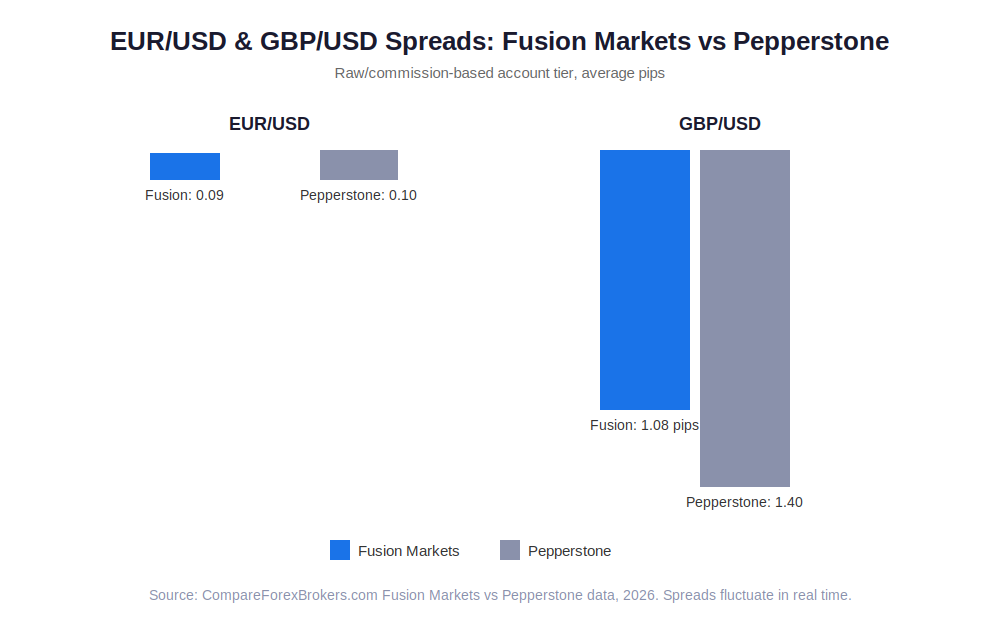
~0.09 pips |
~0.1 pips |
GBP/USD Spread |
1.08 pips |
1.40 pips |
Regulatory Footprint |
ASIC, VFSC, FSA Seychelles |
FCA, ASIC, CySEC, DFSA, SCB, CMA |
Platforms |
MT4, MT5, cTrader, TradingView |
MT4, MT5, cTrader, TradingView |
Withdrawal Methods & Processing Time |
|
|
Which Is Better for Low Spreads?
Fusion Markets, on the data available — it undercuts Pepperstone on both EUR/USD and GBP/USD across comparable account types.
Which Is Better for Beginners?
Roughly a wash on account simplicity, but Pepperstone’s broader regulatory footprint may appeal to beginners who weight jurisdiction coverage heavily.
Which Is Better for Trading Platforms?
Tied — both offer the full MT4/MT5/cTrader/TradingView lineup.
Fusion Markets vs IC Markets
Comparison Table
Feature |
Fusion Markets |
IC Markets |
Founded |
2017 / 2019 |
2007 |
Raw Commission |
$2.25/side ($4.50 round-turn) |
$3.50/side USD, $4.50/side AUD |
Raw EUR/USD Spread Consistency |
Wider/less consistent per independent testing |
Tighter, more consistent (e.g., 0.01–0.02 pips) |
Withdrawal Methods & Processing Time |
|
|
Key Differences
Fusion Markets wins clearly on raw commission cost, but IC Markets maintains tighter and more consistent raw spreads, and on total cost (spread plus commission) IC Markets still comes out cheaper overall for most traders despite the higher headline commission.
Final Verdict
For pure headline commission-chasers, Fusion Markets wins. For traders optimizing true all-in cost per trade, IC Markets currently has the edge based on available spread-consistency data.
Fusion Markets vs FP Markets
Comparison Table
Feature |
Fusion Markets |
FP Markets |
Founded |
2017 / 2019 |
2005 |
Regulation |
ASIC, VFSC, FSA Seychelles |
ASIC (AFSL 286354), CySEC (371/18, EU retail NBP + ICF up to €20,000), FSA Seychelles, FSCA (South Africa), CMA (Kenya) |
Minimum Deposit |
$0 |
AUD $100 (as low as $50 via some methods) |
Raw/ECN Commission |
$2.25/side ($4.50 round-turn) |
$3/side ($6 round-turn) |
Raw/ECN EUR/USD Spread + Commission |
~0.09–0.9 pips (varies by test) |
From 0.0 pips, all-in ≈0.3 pips equivalent |
Standard/Classic EUR/USD Spread |
From 0.9 pips, no commission |
Typical 1.1 pips, no commission |
Platforms |
MT4, MT5, cTrader, TradingView |
MT4, MT5, cTrader, TradingView, plus Iress for direct market access share CFDs |
Total Instruments |
250+ |
10,000+ (via CFDs, boosted heavily by Iress share access) |
Withdrawal Methods & Processing Time |
|
18 withdrawal methods, 30+ currencies, ~24 hr internal processing, no broker withdrawal fee, though some e-wallets (Neteller/Skrill) charge ~1% and Perfect Money/FasaPay ~0.5% |
Withdrawal Methods & Processing Time
Both brokers charge no internal withdrawal fee on core methods, but the details diverge. Fusion Markets’ 2026 upgrade to 24/7 processing with a ~45-minute median internal turnaround is faster on paper than FP Markets’ roughly 24-hour internal processing target. FP Markets compensates with sheer breadth — 18 withdrawal methods across 30+ currencies — but a subset of e-wallet options (Neteller, Skrill) carry a roughly 1% fee, something Fusion Markets’ core methods don’t charge.
Key Differences
FP Markets wins decisively on regulatory breadth (dual Tier-1 ASIC + CySEC, with EU retail clients getting negative balance protection and ICF compensation coverage up to €20,000) and on raw instrument count, largely thanks to Iress giving genuine DMA access to 10,000+ shares across nine exchanges — something Fusion Markets doesn’t offer at all. FP Markets’ Raw account all-in cost lands around 0.3 pips equivalent on EUR/USD, competitive with Fusion’s Zero account, though Fusion’s lower per-side commission still gives it an edge for very high-frequency traders running large monthly volumes. FP Markets requires a $100 minimum deposit against Fusion’s $0, a real consideration for traders starting small.
Final Verdict
Choose FP Markets if you want broader regulatory protection (especially as an EU client), genuine share-market DMA access, or a longer operating track record (two decades vs. Fusion’s six-to-seven years). Choose Fusion Markets if you’re a pure forex/CFD trader who wants the lowest possible per-lot commission and doesn’t need Iress-style equity access, and you’d rather not tie up $100 to open an account.
Fusion Markets vs Eightcap
Comparison Table
Feature |
Fusion Markets |
Eightcap |
Founded |
2017 / 2019 |
2009, Melbourne |
Regulation |
ASIC, VFSC, FSA Seychelles |
ASIC, FCA (UK), CySEC (EU), plus SCB (Bahamas) for international clients |
Minimum Deposit |
$0 |
$100 |
Raw/ECN Commission |
$2.25/side ($4.50 round-turn) |
$3.50/side ($7 round-turn) |
Raw/ECN EUR/USD Spread |
~0.09–0.9 pips (varies by test) |
Around 0.1 pips |
Standard/Classic EUR/USD Spread |
From 0.9 pips, no commission |
Typically 0.4–1.5 pips, no commission |
Platforms |
MT4, MT5, cTrader, TradingView |
MT4, MT5, TradingView — no cTrader |
Total Instruments |
250+ |
800+ |
Negative Balance Protection |
ASIC entity only |
ASIC, CySEC, and FCA retail clients protected; SCB entity clients forfeit some safeguards for higher leverage |
Withdrawal Methods & Processing Time |
24/7, ~45 min median internal, no broker fee |
Same-day if submitted before cutoff, no internal withdrawal fee; total arrival 1–3 business days depending on method (e-wallets fastest, wires slowest) |
Withdrawal Methods & Processing Time
Eightcap processes withdrawal requests the same business day if submitted before its cutoff, with no internal withdrawal fee, and most users receive funds within one to three business days depending on the method — e-wallets fastest, bank wires slowest. That’s respectable, but Fusion Markets’ sub-hour median internal processing with full 24/7 weekend coverage is faster on the “request to internal completion” leg specifically. Both brokers push the “no broker-side fee” model, with third-party costs the main variable.
Key Differences
Eightcap has the stronger regulatory spread for traders who want FCA or CySEC coverage specifically (both carry investor compensation schemes — up to £85,000 under FCA, €20,000 under CySEC — that neither of Fusion Markets’ offshore entities offer), and its 800+ instruments comfortably outnumber Fusion’s 250+. Eightcap’s Raw account commission ($3.50/side, $7 round-turn) is meaningfully higher than Fusion’s ($2.25/side, $4.50 round-turn), though Eightcap counters with TradingView and MT4/MT5 support — it simply doesn’t offer cTrader, which is one of Fusion Markets’ strongest selling points for traders who want a modern DOM-style interface with Trading Central built in. Eightcap requires a $100 minimum deposit versus Fusion’s $0.
Final Verdict
Choose Eightcap if FCA or CySEC regulatory coverage matters to you, you want a wider instrument list, or you’re not fussed about cTrader. Choose Fusion Markets if you want the lowest possible commission on the Zero/Raw-style account, cTrader access, or a $0 entry point rather than tying up $100 upfront.
Best Alternatives to Fusion Markets
Best for Education: AvaTrade — structured academy and video content Fusion Markets lacks. [AvaTrade review]
Best for Advanced Traders: IC Markets — tighter, more consistent raw spreads. [IC Markets review]
Best for Research Tools: Pepperstone — deeper in-house research than Fusion’s Trading Central integration alone. [Pepperstone review]
Best for Copy Trading: Vantage — broader instrument range (1,000+) alongside its copy trading ecosystem. [Vantage review]
Best for Social Trading: eToro — larger public track-record ecosystem for copy trading than Fusion+. [eToro Markets review]
Best Overall Alternative: IC Markets, for traders prioritizing total cost consistency over headline commission numbers.
Start Trading with Fusion Markets
Trade Forex and CFDs with a low-cost broker offering tight spreads, competitive commissions, fast execution, and no minimum account size.
Open a Fusion Markets Account →
*Spreads and commissions vary by account type and instrument. Terms and conditions apply.
Who Should Use Fusion Markets?
✅ Fusion Markets Is Best For
Fusion Markets makes the most sense for traders who prioritize low trading costs, fast execution, and platform flexibility.
- Scalpers looking for tight spreads and low commissions
- Day traders who value competitive execution and pricing
- Algorithmic traders running Expert Advisors and automated strategies
- Cost-conscious forex traders who want to keep transaction costs low
- cTrader users who prefer an alternative to MetaTrader
- TradingView users who want to trade directly through a familiar charting environment
⚠️ Fusion Markets May Not Be Ideal For
The broker’s strengths in low-cost trading do not necessarily make it the best fit for every type of investor.
- Complete beginners who want a large, structured in-house education program
- Traders seeking extensive in-house research and comprehensive market commentary
- Investors wanting thousands of instruments, particularly broad bond and ETF coverage
Final Verdict

Our Rating: 4.3 / 5
What We Like Most
Genuinely low headline trading costs, an unusually complete platform lineup (MT4, MT5, cTrader, TradingView all in one place), no minimum deposit, and fast 24/7 withdrawal processing as of 2026.
What Could Be Improved
Educational resources, more consistent raw-spread pricing versus top-tier rivals like IC Markets, and clearer disclosure to non-Australian clients that they’re trading under Tier 3 offshore entities without negative balance protection.
Is Fusion Markets Worth It?
For active, cost-focused traders who know what they’re doing and want platform flexibility, yes. For beginners who need hand-holding and educational scaffolding, there are better-suited brokers.
Bottom Line
Fusion Markets delivers on its core promise — low costs and platform choice — but it’s a broker for traders who already know how to trade, not one that will teach you along the way.
Frequently Asked Questions
Is Fusion Markets regulated?
Yes. Fusion Markets is regulated by ASIC in Australia, the VFSC in Vanuatu, and the FSA in Seychelles — but the ASIC entity applies only to Australian clients; most international traders are onboarded under the lighter-touch VFSC or FSA Seychelles entities.
Is Fusion Markets good for beginners?
It’s an average broker for beginners — the no-minimum-deposit, free demo, and commission-free Classic account keep pricing simple, but thin educational tools are a real downside for anyone learning to trade.
What is the minimum deposit?
$0 — there is no minimum deposit requirement to open a live account.
Does Fusion Markets offer MT5?
Yes, alongside MT4, cTrader, and TradingView.
Does Fusion Markets offer copy trading?
Yes, through its native Fusion+ system and via DupliTrade integration.
Is Fusion Markets available in my country?
Availability depends on your country of residence and which entity (ASIC, VFSC, or FSA Seychelles) is permitted to onboard you. Check the broker’s current country-eligibility list directly before applying. [add link — Fusion Markets eligibility/terms page]
Are withdrawals free?
Yes on Fusion Markets’ side for supported methods, though banks or payment providers may apply their own charges, and international wire deposits specifically can cost $20–$30.
How long do withdrawals take?
As of 2026, median internal processing time is under an hour (45 minutes as of May 2026 data), with 24/7 processing including weekends — final availability still depends on your payment method and bank.
About the Author
Samson Ononeme is the founder of MarketsXplora, an independent financial education and research platform covering cryptocurrency, forex, brokers, exchanges, trading platforms, and blockchain technology. He focuses on turning complex financial products and platform features into clear, practical information that readers can use when comparing their options.
Crypto & Blockchain
Forex & Brokers
Financial Research
Trading Platforms