





 Samson Ononeme
Founder & Financial Content Strategist, MarketsXplora
12+ years covering forex brokers, prop firms, and crypto exchanges | Reviewed: September 2026
Quick Answer
Most traders don’t need to read the whole article. Here’s the short version.
If You Are… |
Best HFM Account |
|---|---|
Complete Beginner |
Cent |
Small Account Trader |
Cent |
General Retail Trader |
Premium |
Active Trader |
Pro |
High-Volume Professional |
Pro Plus |
Scalper |
Zero |
EA Trader |
Zero |
Copy Trader |
Pro or Premium |
Experienced Trader |
Pro |
High-Leverage Trader |
InfinityXNEW |
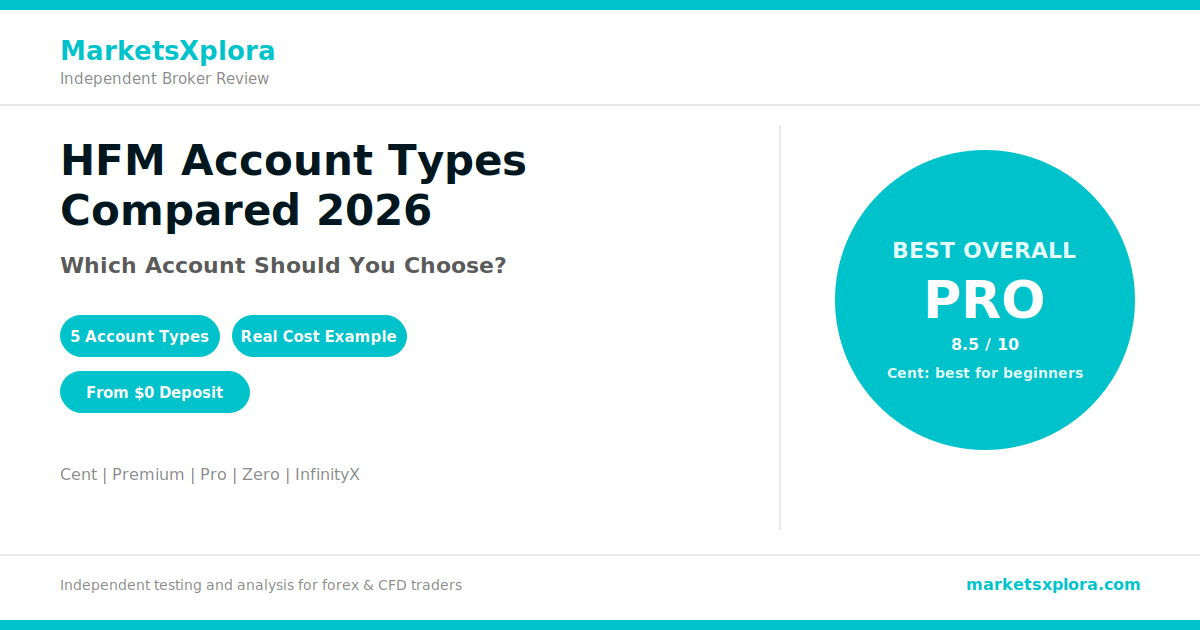
HFM offers six account types, but most traders realistically choose between Cent, Pro, and Zero. The right choice depends less on the advertised headline spread and more on your capital, trading frequency, and strategy. We’ll walk through why below.
HFM Account Types at a Glance
Feature |
Cent |
Premium |
Pro |
Pro Plus |
Zero |
InfinityXNEW |
|---|---|---|---|---|---|---|
Best For |
Beginners |
Casual traders |
Active traders |
High-volume professionals |
Scalpers/EAs |
High-leverage strategies |
Minimum Deposit |
$0 |
$0 |
$50 |
$100 |
$25 |
$250 |
Spreads From |
~1.4 pips |
~1.4 pips |
~0.6 pips |
~0.2 pips |
0.0 pips |
~0.3 pips |
Commission |
None |
None |
None |
None |
From $3/lot/side |
None |
Leverage |
Up to 1:2000* |
Up to 1:2000* |
Up to 1:2000* |
Up to 1:2000* |
Up to 1:2000* |
Unlimited (offshore only) |
Platforms |
MT4/MT5 |
MT4/MT5 |
MT4/MT5 |
MT4/MT5 |
MT4/MT5 |
MT4/MT5 |
Beginner Friendly |
Yes |
Yes |
Somewhat |
No |
No |
No |
Scalping Friendly |
No |
No |
Somewhat |
Yes |
Yes |
Not recommended |
EA Friendly |
Somewhat |
Somewhat |
Yes |
Yes |
Yes |
High risk, expert use only |
*Leverage caps are lower under FCA/CySEC retail rules (1:30) regardless of account type. The 1:2000 figures apply to offshore entities. Confirm exact current figures on HFM’s account comparison page before opening an account, since these details change periodically.
How We Evaluated HFM Account Types
We compared each account across four dimensions, rather than just listing headline spread figures.
- Trading costs: spreads, commissions, and swap costs.
- Accessibility: minimum deposit, lot sizes, and the learning curve involved.
- Trading flexibility: leverage, instruments, and execution model.
- Trader suitability: how each account fits beginners, scalpers, swing traders, EA traders, and copy traders differently.
Understanding the Difference Between HFM Accounts
Many traders assume lower spread automatically means a better account. That assumption is often wrong.
Take a beginner trading with $50. On paper, the Zero account’s near-0-pip spread looks cheaper than Cent’s spread from 1.4 pips. In practice, Zero’s commission structure and standard lot sizing can expose a small account to bigger swings per trade than the Cent account’s reduced contract sizing allows. A wider spread on a smaller position can end up costing less, in real terms, than a tighter spread on a full-size lot. Account choice should follow your capital and strategy first, and the headline spread second.
HFM Cent Account Review

What Is the HFM Cent Account?
The Cent account uses cent-based contract sizing instead of standard lots, so trades are denominated in smaller units. It’s built for traders learning position sizing and risk management with reduced real-money exposure.
Key Features
- Minimum deposit: $0.
- Spreads: from around 1.4 pips, no commission.
- Leverage: up to 1:2000 on offshore entities, capped lower under FCA/CySEC rules.
- Instruments: Forex and Gold only — the narrowest instrument list of any HFM account.
- Lot size structure: cent lots, roughly 100x smaller in real-money terms than a standard lot.
Pros: genuinely free to start, low real-money risk while learning, swap-free option available.
Cons: wider spreads than Pro or Zero, narrower instrument range, not built for scaling up to serious volume.
Who Should Use the Cent Account?
Best for: beginners, first-time traders, small accounts, and anyone testing a new strategy before committing real capital at scale.
Who Should Avoid It?
Professional traders, high-frequency traders, and advanced scalpers, all of whom need standard-lot execution and tighter spreads than Cent is built to offer.
MX Verdict — Cent Account Rating: 8/10 for its intended use case; not designed to compete on cost once you’re trading at volume.
HFM Premium Account Review
What Is the Premium Account?
Premium is HFM’s default retail account. It uses standard lot sizing, charges no separate commission, and prices everything into the spread.
Key Features
- Costs: spreads from around 1.4 pips, no commission.
- Leverage: up to 1:2000 offshore, lower under regulated entities.
- Markets: forex, commodities, indices, shares, and more — HFM’s fullest instrument range.
- Platforms: MT4, MT5, HFM WebTrader, and mobile app.
Pros: $0 minimum deposit, simple all-in pricing, full instrument access.
Cons: spreads run wider than Pro or Zero, which matters once you trade often.
Best For
Casual traders, intermediate traders, and position traders who don’t trade frequently enough for a tighter spread to matter much.
Who Should Avoid It?
Scalpers and very active traders, who will pay materially more in spread cost over time compared with Pro or Zero.
MX Verdict — Premium Account Rating: 7.5/10, a solid, simple default that isn’t optimized for frequent trading.
HFM Pro Account Review

What Is the HFM Pro Account?
Pro is the step up from Premium: tighter spreads, still no commission, and a $50 minimum deposit.
Why Many Traders Prefer It
It combines a lower spread with the simplicity of a single, all-in cost. There’s no separate commission line to track, which some traders find easier to plan around than Zero’s raw-spread-plus-commission model.
Pros: spreads from around 0.6 pips, no commission, straightforward cost structure.
Cons: the $50 minimum, while modest, is still a real step up from Cent and Premium’s $0, and Zero can still work out cheaper at high volume.
Best For
Active traders, experienced traders, and regular forex traders who want lower costs without tracking a separate commission.
Who Should Avoid It?
Tiny accounts and complete beginners, who are better served by Cent’s lower real-money exposure.
MX Verdict — Pro Account Rating: 8.5/10, the strongest all-around balance in HFM’s lineup.
HFM Pro Plus Account Review
What Is the HFM Pro Plus Account?
Pro Plus sits above Pro in HFM’s lineup. It keeps the no-commission, all-in-spread pricing model, but tightens the spread further and asks for a higher minimum deposit in return.
Key Features
- Minimum deposit: $100.
- Costs: spreads from around 0.2 pips, no commission.
- Leverage: up to 1:2000 offshore, lower under regulated entities.
- Execution: market execution, with a swap-free option available on eligible instruments.
Pros: the tightest all-in spread of any no-commission HFM account, still no separate commission to track.
Cons: $100 is the second-highest minimum deposit in HFM’s lineup, and the spread advantage over Pro only pays off if you trade often enough to notice it.
Best For
High-volume traders and professionals who want institutional-style pricing without switching to a commission-based account.
Who Should Avoid It?
Beginners and small accounts — Cent or Premium will teach the same skills for less money at risk.
MX Verdict — Pro Plus Account Rating: 8/10, a genuine step up from Pro for traders who can meet the higher deposit and trade enough to use it.
HFM Zero Account Review
What Is the HFM Zero Account?
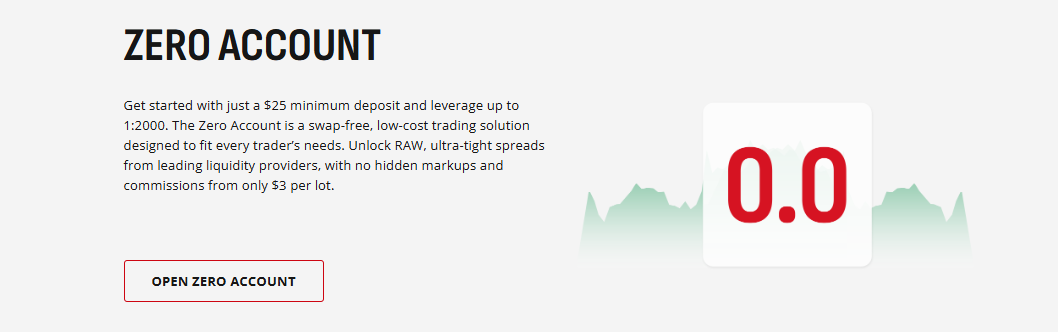
Zero offers raw spreads from 0.0 pips on select forex instruments, priced separately from a per-lot commission. It’s a different pricing model from Pro or Premium, not simply a cheaper version of either.
Key Features
- Raw spreads: from 0.0 pips on major pairs.
- Commission structure: from $3 per lot per side, so $6 round-turn on a standard lot.
- Execution: raw/ECN-style pricing.
- Trading conditions: $25 minimum deposit, up to 1:2000 leverage offshore.
What Does “Zero Spread” Actually Mean?
Zero spread does not mean free trading. The spread and the commission are two separate cost components. A 0.0-pip spread with a $6 round-turn commission on a standard lot is not free — it’s a different way of charging for the same trade. Depending on your instrument and volume, it can end up cheaper or more expensive than Pro.
Pros: genuinely tight raw spreads, transparent commission structure, well-suited to high-frequency strategies.
Cons: commission adds a second cost variable to track, and the account isn’t built with beginners in mind.
Best For
Scalpers, EA traders, and high-volume traders, where the raw-spread-plus-commission model consistently beats a wider all-in spread.
Who Should Avoid It?
Beginners and infrequent traders, who won’t trade enough volume to make the commission structure worthwhile.
MX Verdict — Zero Account Rating: 8/10, excellent for its target user, unnecessary for anyone trading occasionally.
HFM InfinityX Account Review
What Is InfinityX?
InfinityX is HFM’s offshore, high-leverage account. It offers unlimited leverage, spreads from around 0.3 pips, no commission, no swap charges, and a $250 minimum deposit, with a 20% margin-call threshold and a 0% stop-out level.
Key Features
- Unlimited leverage: available only through HFM’s offshore entity, not through FCA/CySEC-regulated entities.
- Instruments: Forex, Metals, Indices, Cryptocurrencies, and Energies — no shares, ETFs, or bonds, unlike Premium, Pro, Pro Plus, and Zero.
- Trading conditions: a materially different margin-call and stop-out structure from HFM’s other five accounts.
- Deposit requirement: $250, the highest across HFM’s lineup.
Risks Traders Should Understand
This is critical: a 0% stop-out level, combined with unlimited leverage, means a fast, violent price move can wipe out an account’s balance before a margin call even has time to trigger. This is a materially higher-risk structure than Cent, Premium, Pro, Pro Plus, or Zero. It should only be used by traders who fully understand margin mechanics under extreme leverage.
Pros: maximum leverage flexibility for specific, deliberate strategies.
Cons: highest deposit requirement, highest risk profile, and offshore-only availability with correspondingly lighter regulatory protection (see our Is HFM Safe? article for the entity-protection breakdown).
Best For
Experienced traders running specific, deliberate high-leverage strategies who fully understand the risks involved.
Who Should Avoid It?
Beginners and under-capitalized traders — this account amplifies both outcomes. The downside can happen faster than you can react to it.
MX Verdict — InfinityX Account Rating: 5.5/10 for the general trader, higher for the narrow group it’s actually built for.
Affiliate disclosure: MarketsXplora may earn a commission if you open an account through this link, at no extra cost to you.
Which HFM Account Has the Lowest Trading Costs?
It depends on your volume. At low volume, Pro Plus’s tight all-in spread is hard to beat without touching a commission line. At high volume, Zero’s raw spread plus commission tends to work out cheaper, since the fixed commission per lot becomes a smaller share of a larger total cost base.
Winner for active traders: Zero, once volume is high enough to offset the commission. Winner for casual traders: Premium, for simplicity over marginal savings. Winner for scalpers: Zero and Pro Plus are close enough to be worth comparing directly for your specific instrument — see the real cost example below.
Which HFM Account Is Best for Beginners?
Cent vs. Premium: Cent’s reduced contract sizing makes early mistakes cheaper in real-money terms, which is exactly what a beginner needs while learning position sizing. Premium is the better move once you’re ready to trade standard lots and want full instrument access. Most beginners should start on Cent and graduate to Premium or Pro as capital and confidence grow.
Which HFM Account Is Best for Small Accounts?
Cent vs. Premium: Cent again wins here, for the same real-money-exposure reason. Cent vs. Zero: Zero’s standard-lot commission structure isn’t built for very small balances, so Cent remains the better fit until your account grows.
Which HFM Account Is Best for Scalping?
Zero vs. Pro Plus vs. Pro: our cost example above found Pro Plus cheaper than Zero on a single standard lot, which makes it worth testing against Zero for your specific instrument and volume rather than assuming Zero automatically wins. Zero still pulls ahead at higher volume, where its near-zero spread outweighs the flat commission. Pro remains workable for less frequent scalping, but Zero and Pro Plus are the two accounts actually built for this style.
Which HFM Account Is Best for Expert Advisors (EAs)?
Pro vs. Pro Plus vs. Zero vs. InfinityX: Zero, Pro Plus, and Pro are all reasonable EA accounts, with Zero typically favored for high-frequency algorithmic strategies and Pro Plus a strong alternative if you’d rather avoid tracking a separate commission line. InfinityX is not recommended for automated strategies unless the EA itself has been built, deliberately, to manage extreme-leverage risk.
Which HFM Account Is Best for Swing Trading?
Premium vs. Pro: both work well, since swing positions are held for days rather than scalped for pips. Pro’s lower spread is a modest advantage; Premium’s simplicity is a reasonable trade-off if you’re not trading often enough for the spread difference to add up.
Which HFM Account Is Best for Copy Trading?
Premium vs. Pro vs. Cent: Premium and Pro both integrate cleanly with HFcopy for standard-size follower accounts. Cent can work for testing a strategy provider with minimal capital before committing more meaningfully through Premium or Pro.
Real Cost Example: 1-Lot EUR/USD Trade
Illustrative figures based on each account’s published spread and commission data, not a live-tested result. A standard lot is 100,000 units, where 1 pip on EUR/USD is worth approximately $10.
Account |
Spread Cost |
Commission |
Estimated Total |
|---|---|---|---|
Premium |
~$14 (1.4 pips) |
$0 |
~$14 |
Pro |
~$6 (0.6 pips) |
$0 |
~$6 |
Pro Plus |
~$2 (0.2 pips) |
$0 |
~$2 |
Zero |
~$0–1 (near 0.0 pips) |
~$6 round-turn |
~$6–7 |
At this trade size, Pro Plus is actually the cheapest of the four — its tight all-in spread beats even Zero once you count Zero’s commission. That only flips at higher volume, where Zero’s near-zero spread starts to matter more than its flat commission. Premium is the most expensive by a wide margin at this size. The gap between Pro and Zero narrows or reverses depending on how many lots you trade, since the fixed commission per lot doesn’t scale up the way a percentage-style spread cost effectively does.
Common Mistakes When Choosing an HFM Account
Choosing Zero because it says “0 spreads”: the commission is still a real cost, and ignoring it understates what you’ll actually pay.
Using InfinityX for the wrong reasons: unlimited leverage is not a shortcut to bigger profits. It’s a tool for a specific, deliberate strategy — misusing it is one of the fastest ways to lose an account.
Ignoring commission costs: a total-cost comparison, not just the headline spread, is what actually determines which account is cheaper for your trading style.
Confusing Pro and Pro Plus: the similar names hide a real difference — Pro Plus’s tighter spread and higher deposit can genuinely change which account is cheaper at your trade size, as the cost example above shows. Check the actual numbers rather than assuming “Plus” just means “better.”
Choosing based only on leverage: higher leverage increases risk as much as it increases opportunity. It shouldn’t be the deciding factor on its own.
Using the same account as another trader: a friend’s Zero account might suit their high-frequency strategy and be a poor fit for your swing-trading approach. Match the account to your own strategy, not someone else’s.
HFM Account Types: Pros & Cons
Pros Across the Lineup
- Genuine $0-deposit options on three of six accounts
- Clear differentiation by trader type, not just marketing labels
- Both spread-only and raw-plus-commission pricing models available
- Swap-free options across most of the lineup
Cons Across the Lineup
- InfinityX’s risk profile is a significant step up from the other five accounts
- Zero’s commission structure adds complexity for traders used to all-in spread pricing
- Pro and Pro Plus are similarly named but priced differently enough to cause confusion
- Six options can feel like more choice than most retail traders actually need
Our Recommended HFM Accounts
Best Overall — HFM Pro: the strongest balance of low spreads, no commission complexity, and reasonable accessibility.
Best for Beginners — HFM Cent: the lowest real-money risk while you learn.
Best for Scalpers — HFM Zero: raw spreads and transparent commission built for high-frequency trading.
- Best for High-Volume, Commission-Averse Traders — HFM Pro Plus: the tightest all-in spread on the lineup, without a separate commission line to track.
- Best for Small Accounts — HFM Cent: the reduced contract sizing directly addresses the small-account risk problem.
- Best for Experienced Traders — HFM Pro: tighter costs without the added tracking of a separate commission line.
Final Verdict: Which HFM Account Should You Choose?
- Choose Cent if you’re new, working with a small account, or testing a strategy before scaling up.
- Choose Premium if you want simplicity, full instrument access, and don’t trade often enough for spread differences to matter much.
- Choose Pro if you trade regularly and want lower costs without a separate commission to track.
- Choose Pro Plus if you trade often enough that Pro’s spread starts to add up, and you can meet the higher $100 deposit.
- Choose Zero if you scalp, run EAs, or trade at high enough volume that raw spread plus commission beats an all-in spread.
- Choose InfinityX if you’re an experienced trader running a deliberate high-leverage strategy and fully understand the risk of a 0% stop-out level.
If most traders asked us to recommend just one HFM account today, the Pro account would likely be the strongest balance of spreads, simplicity, and accessibility, while the Cent account remains the best starting point for beginners. Between them, these two accounts cover the needs of the majority of retail traders.
Affiliate disclosure: MarketsXplora may earn a commission if you open an account through this link, at no extra cost to you.
For the full broker breakdown, see our HFM Review 2026. For the regulatory picture, see Is HFM Legit? and Is HFM Safe?
Frequently Asked Questions
Which HFM account is best?
For most traders, Pro offers the strongest balance of cost and simplicity. Beginners are better served by Cent.
What is the difference between HFM Pro and Zero?
Pro charges a slightly wider spread with no commission. Zero charges a near-zero spread plus a per-lot commission. They land in a similar place at low volume, and Zero pulls ahead at high volume.
Is HFM Cent account good for beginners?
Yes. Its reduced contract sizing keeps real-money risk low while you learn position sizing and strategy.
Does HFM Zero charge commissions?
Yes, from around $3 per lot per side, in addition to its near-zero raw spread.
What is the minimum deposit for HFM Pro?
$50. Pro Plus ($100), Zero ($25), and InfinityX ($250) each carry their own separate minimums — Cent and Premium are the only two accounts with a stated $0 minimum.
What is HFM Pro Plus?
A step up from Pro, with spreads from around 0.2 pips, no commission, and a $100 minimum deposit. It’s built for high-volume traders who want tighter pricing without switching to a commission-based account.
What is the minimum deposit for Pro Plus?
$100 — the second-highest minimum in HFM’s lineup, after InfinityX’s $250.
Which HFM account is best for scalping?
Zero or Pro Plus, depending on your trade size — our cost example found Pro Plus cheaper on a single lot, with Zero pulling ahead at higher volume.
Which HFM account is best for EAs?
Zero, Pro Plus, and Pro all work well; Zero is generally preferred for high-frequency algorithmic strategies.
Which HFM account has the lowest spreads?
Zero, with spreads from 0.0 pips, though the commission needs to be added to get the real cost. Pro Plus (from 0.2 pips, no commission) is often cheaper in practice at typical trade sizes.
What is InfinityX?
HFM’s offshore, high-leverage account, offering unlimited leverage and a 0% stop-out level, with a higher risk profile and a $250 minimum deposit.
Is HFM Premium better than Pro?
Premium is simpler with a wider spread; Pro is cheaper at volume with the same no-commission structure. Pro is the better choice for anyone trading regularly.
What is the difference between HFM Pro and Pro Plus?
Pro Plus tightens the spread from around 0.6 pips to around 0.2 pips, with no commission on either account. The trade-off is a higher minimum deposit — $100 versus Pro’s $50.
About the Author
Samson Ononeme is the founder of MarketsXplora, an independent financial education and research platform covering cryptocurrency, forex, brokers, exchanges, trading platforms, and blockchain technology. He focuses on turning complex financial products and platform features into clear, practical information that readers can use when comparing their options. Connect on LinkedIn and X.
Crypto & Blockchain
Forex & Brokers
Financial Research
Trading Platforms