


By Samson Ononeme | Last updated: July 2026 | Tested hands-on
Quick verdict: The Ledger Nano X was a landmark device when it launched in 2019 — the first hardware wallet to bring Bluetooth and a battery to mainstream crypto storage. In 2026, it is still functional, still supported, and still purchased by buyers who do not know what has changed since. But Ledger’s own lineup has moved significantly past it.
- The Nano Gen5 at $30 more delivers a better chip, the Certified Secure Screen the Nano X lacks, a 2.76-inch touchscreen, more than triple the battery capacity, and NFC.
- The Nano S Plus at $70 less delivers the same EAL6+ chip in a simpler wired form.
- The Nano X sits uncomfortably between them — not cheap enough to be the value choice and not advanced enough to be the security choice.
For existing Nano X owners with a functioning device: no urgent need to replace it. For new buyers in 2026: spend $30 more and buy the Gen5.
Overall rating: 7.2 / 10
Category |
Rating |
|---|---|
Security architecture |
7.5 / 10 |
Design and build quality |
7 / 10 |
Display and interface |
6.5 / 10 |
Connectivity and wireless |
7.5 / 10 |
Value for money |
6.5 / 10 |
Ecosystem and compatibility |
8 / 10 |
Pros:
- Bluetooth 5.0 — genuine wireless signing from iOS and Android
- Full iOS support — sends, signs, and manages from iPhone
- EAL5+ certified Secure Element — no device-level exploit in 7 years
- 2MB app storage — the most of any Ledger device, holds ~20 apps simultaneously
- Full Ledger Wallet ecosystem — staking, swapping, dApps, NFTs, WalletConnect
- USB-C connectivity — compatible with all modern computers
- 5,500+ supported assets
Cons:
- EAL5+ chip — one certification level below the EAL6+ in the Nano Gen5, Flex, and Stax
- No Certified Secure Screen — display not driven by the Secure Element
- Two-button interface on a ~1-inch OLED — dated compared to every current touchscreen alternative
- 100mAh Li-ion battery — smallest in Ledger’s lineup; degrades on older units
- No NFC — no Ledger Recovery Key card support, no FIDO2 Security Key
- No Ledger Recovery Key included in box
- $149 price makes it the hardest value case in Ledger’s current lineup
- Ledger’s data breach history and Recover controversy apply equally here
What Is the Ledger Nano X?
The Ledger Nano X launched in 2019 and fundamentally changed what a hardware wallet could be. Before it, hardware wallets were almost universally wired-only devices — plug in a USB cable, open the desktop app, confirm transactions on a small screen. Useful for serious crypto holders, inaccessible for anyone who wanted to manage their portfolio from a smartphone. 
The Nano X changed that. Bluetooth connectivity and a built-in battery meant you could sign transactions wirelessly from an iPhone or Android device — genuinely useful for the growing number of crypto holders whose primary computing device was a phone, not a laptop.
It sold millions of units. For several years, it was arguably the best-designed hardware wallet for mainstream users. Ledger built a strong iOS and Android app around it, and its combination of wireless convenience and certified security made it the default recommendation for new crypto buyers who wanted more than a wired dongle.
Seven years later, the Nano X is still available on ledger.com at $149. It still works. It still receives firmware updates. This wallet is still the same device it was in 2019 — and that is precisely the problem.
The hardware wallet category has moved. Ledger’s own lineup has moved. The Nano X launched with the most advanced secure element Ledger had ever used. In 2026, it uses a chip one certification level below Ledger’s current standard, lacks the Certified Secure Screen architecture introduced across the entire rest of the lineup, and carries a 100mAh battery that is showing age on units purchased in the early 2020s.
For new buyers, understanding the Nano X means understanding both what made it great and what has overtaken it.
Key specs at a glance:
Specification |
 |
|---|---|
Price |
$149 USD |
Launch |
2019 |
Display |
~1 inch monochromatic OLED |
Resolution |
128×64px |
Interface |
2 physical buttons |
Certified Secure Screen |
No |
Secure Element |
ST33J2M0, CC EAL5+ certified |
Operating system |
Ledger BOLOS (proprietary) |
Connectivity |
USB-C, Bluetooth 5.0 |
NFC |
No |
Battery |
100mAh Li-ion |
App storage |
2MB (~20 apps) |
Weight |
~34 grams |
Supported assets |
5,500+ |
iOS support |
Yes — Full |
Android support |
Yes — Full |
Recovery |
Paper Recovery Sheet (no NFC card) |
Design and Build Quality
The Nano X’s design language is unmistakably pre-touchscreen. It is an elongated plastic stick — 72 × 18.6 × 11.75mm — designed around a traditional Ledger form factor that prioritises compactness over screen real estate. At approximately 34 grams, it is noticeably lighter than the Gen5’s 46 grams and the Flex’s 57.5 grams.
The two physical buttons are embedded on the top edge of the device on either side of the ~1-inch OLED display. The USB-C port sits at the bottom. The overall build quality is solid plastic — functional, durable, and without premium materials or screen protection.
The Nano X is available in multiple colours including Onyx (black) and limited editions through Ledger’s collaborations. The base design has not changed since 2019.
What’s in the Box?
- Nano X device,
- USB-C cable,
- Getting Started guide,
- Recovery Sheet (paper), and
- Three stickers.
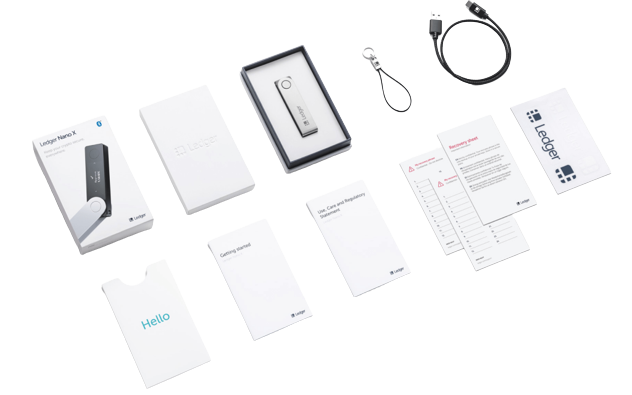
This wallet doesn’t come with a Ledger Recovery Key NFC card. This is meaningful because the Nano X lacks the NFC hardware required by the NFC card.
Build verdict: Functional and durable for its era. Dated in form factor and interface by 2026 standards.
Display and Interface
The Nano X’s ~1-inch OLED display at 128×64 pixels is one of the most limiting aspects of the device in 2026. It is not the smallest display in Ledger’s history — the original Nano S had less — but it is significantly smaller than every touchscreen device that has followed.
What the Display Does Well
The OLED technology is self-illuminating — the display is readable in low-light and dark environments without requiring an external light source. This is a genuine advantage over E-Ink displays (like the Gen5’s) that require ambient light to read.
For simple, infrequent transactions — send Bitcoin to this address, check a balance, receive funds — the display is adequate. The relevant information fits on screen in small enough quantities that the two-button navigation is manageable.
Where the Display Falls Short
For complex operations, the Nano X’s display is a significant friction point. Ethereum contract interactions, token approval screens, DeFi position management, and NFT transaction confirmations generate multiple fields that must be scrolled through screen by screen using the two physical buttons. Long wallet addresses cannot be shown in full — they scroll across the display in segments, requiring careful attention to verify each section.
Transaction Check and Clear Signing — features designed to make transaction content readable and fraud-resistant — are partially available on the Nano X via firmware updates, but the device’s hardware lacks the Certified Secure Screen architecture that makes these features most effective. More on this in Section 5.
The two-button interface requires:
- Left button: scroll backwards / select “no”
- Right button: scroll forwards / select individual option
- Both buttons simultaneously: confirm / select “yes”
For users who have used the Nano X for years, this navigation is second nature. For new buyers in 2026 who are comparing it to touchscreen alternatives, it requires a meaningful adjustment.
Display verdict: Functional for basic use. Increasingly dated for complex DeFi, multi-chain, and NFT use cases that have grown significantly since the device’s 2019 launch.
Security Architecture
The Nano X uses the ST33J2M0 Secure Element — certified at Common Criteria EAL5+ by independent, government-accredited testing laboratories.
EAL5+ is a serious security certification. It is not a beginner-grade chip or a compromise. EAL5+ represents rigorous, independent evaluation of the chip’s resistance to physical and logical attacks, including power analysis, fault injection, and side-channel attacks. The Nano X has run on this chip for seven years with zero successful device-level exploits — a clean track record that few consumer security devices can match.
The EAL5+ vs EAL6+
However, EAL5+ is one certification level below the EAL6+ chip that Ledger has used across its entire current product line — from the $79 Nano S Plus through the $399 Stax. The difference between EAL5 and EAL6 is not trivial: EAL6+ requires formal mathematical proofs of the chip’s security model in addition to the adversarial physical testing required at EAL5+. It represents a more demanding evaluation standard.
For mainstream threat models — protecting crypto from common theft, phishing, and remote attacks — EAL5+ is more than sufficient. For higher-value holdings or institutional-grade threat models, EAL6+ provides a meaningfully stronger certified assurance.
Ledger BOLOS Firmware
The Nano X runs Ledger BOLOS — the same proprietary firmware as every other Ledger device. Application sandboxing isolates each blockchain app from every other. A compromised Ethereum app cannot access Bitcoin keys. The OS is closed-source, with the Secure Element driver under NDA — the same transparency limitations that apply to the entire Ledger lineup.
Ledger Company Trust Record
The Nano X carries the same company trust profile as all Ledger devices. This includes the 2020 e-commerce database breach (272,000 customer records exposed), the 2023 Ledger Connect Kit supply chain attack (malicious JavaScript library, five hours live), the 2023 Ledger Recover controversy (firmware architecture capable of encrypted key export), and the January 2026 Global-e payment partner breach. None of these incidents involved device-level key extraction. All apply equally to every Ledger device.
Security verdict: EAL5+ is legitimate and strong. It is also the lowest-certified chip in Ledger’s current active lineup. At $149 — more than the $79 Nano S Plus with an EAL6+ chip — this is a meaningful value consideration.

Connectivity
Bluetooth 5.0
The Nano X’s Bluetooth functionality was its defining innovation in 2019 and remains its most relevant feature in 2026. Bluetooth 5.0 pairs reliably with iOS 14+ and Android devices, enabling the full Ledger Wallet mobile app experience: portfolio management, sending and receiving, staking, swapping, and dApp connectivity — all wirelessly from a smartphone.
The Gen5 uses Bluetooth 5.2 — a minor update that brings marginal improvements in power efficiency and connection stability. In daily use, Bluetooth 5.0 on the Nano X is functionally equivalent for most users.
iOS support: Full — the Nano X pairs with iPhones via Bluetooth for the complete Ledger Wallet feature set. This remains the most important practical capability the Nano X offers that its closest cheaper competitor (the Nano S Plus at $79) lacks entirely.
USB-C
Full USB-C connectivity to Windows 10/11, macOS, and major Linux distributions. The desktop experience through Ledger Wallet is complete — portfolio management, transaction signing, firmware updates, and app management all work via cable.
Connectivity verdict: Bluetooth 5.0 and full iOS support remain relevant and functional. The Bluetooth version difference (5.0 vs 5.2) is negligible in practice.
Battery
The Nano X has a 100mAh Li-ion battery. This is the smallest battery of any Ledger device that has a battery, and it is a specification that has not aged well.
For context: the Gen5 has 330mAh — more than three times the capacity. The Ledger Flex has 200mAh. The Stax has 200mAh. Even the larger, premium Ledger devices have twice the battery of the Nano X.
The 100mAh battery powers several hours of active signing sessions and weeks of standby. For most signing sessions — a few transactions, occasional DeFi interactions — it will not die mid-use. But it requires more frequent charging than any other battery-equipped Ledger device, and it degrades faster.
Battery verdict: The 100mAh Li-ion is the Nano X’s most dated specification. It was adequate in 2019. In 2026, surrounded by devices with 200–330mAh batteries, it is the weakest battery in the Ledger lineup.
App Storage and Coin Support
The Nano X’s one genuine advantage over its replacement in the lineup is app storage: 2MB versus the Gen5’s 1.5MB. The Nano X can hold approximately 20 blockchain apps simultaneously; the Gen5 holds approximately 10–15.
For users who manage assets across a very large number of chains — 20+ networks in active simultaneous use — the Nano X’s additional storage means fewer app rotations. If you hold assets across Bitcoin, Ethereum, Solana, Cardano, XRP, Tron, Polygon, Arbitrum, Base, Optimism, Avalanche, BNB Smart Chain, Cosmos, Polkadot, Fantom, and more simultaneously, the extra 0.5MB makes a practical difference.
Coin support: The Nano X supports 5,500+ assets — marginally more than the Gen5’s 5,000+ due to its longer market presence and accumulated third-party app support. All major chains are comprehensively covered on both.
Storage verdict: Nano X wins — 2MB versus 1.5MB is the device’s clearest remaining advantage in 2026.
How to Use the Ledger Nano X
So if you finally decide to buy the Nano X, let me show you exactly how I did it my first time. I’ll break this down into simple steps that anyone can follow.
Initial Setup:
- First, charge your Nano X using the provided USB-C cable
- Download Ledger Live from ledger.com/ledger-live on your computer or phone
- Press both buttons on your Nano X to turn it on
- Follow the on-screen instructions to set up your PIN
- Use the buttons to select numbers
- Choose something memorable but not obvious (avoid birthdates!)
- Confirm your PIN by entering it again
Creating Your Recovery Phrase (This is IMPORTANT):
- The device will show your 24 words one by one
- Write them down IN ORDER on the provided recovery sheets
- Triple-check every word – one mistake can lock you out of your funds
- Verify the words when prompted by the device
- This part is like a mini-test to ensure you wrote everything correctly
Connecting to Ledger Live:
- Open Ledger Live on your preferred device
- Choose ‘Get Started’ and ‘I have a Ledger device’
- Select Nano X from the device list
- For mobile: Enable Bluetooth on both devices and pair them
- For desktop: Connect via the USB-C cable
Adding Your First Cryptocurrency:
- In Ledger Live, click the ‘Manager’ tab
- Install the apps for your cryptocurrencies
- Example: Install Bitcoin app if you want to store BTC
- Return to the Portfolio section
- Click ‘Add account’
- Select the cryptocurrency you want to add
- Follow the prompts to create your account
Receiving Crypto:
- Go to your account in Ledger Live
- Click ‘Receive’
- Select the account to receive funds
- Verify the receiving address on your Nano X’s screen
- ALWAYS verify this step – it’s a security feature
- Use this address to receive your crypto
Sending Crypto:
- Select the account you want to send from
- Click ‘Send’
- Enter the recipient’s address
- Input the amount
- Confirm the transaction on your Nano X
- Check all details carefully on the device screen
- Use the buttons to approve
You also have the option of watching the video below a step-by-step guide on how to set up the Ledger Nano X.
Firmware Updates in 2026
The Nano X continues to receive firmware updates from Ledger as of 2026. Clear Signing has been partially added through updates. Transaction Check has been implemented where hardware supports it. Ledger has committed to continued support for the Nano X without specifying an end-of-life date. However, future hardware-dependent features — like the Certified Secure Screen, which requires specific chip-display integration — cannot be added to the Nano X regardless of firmware updates.
Ledger Nano X vs Gen5 vs S Plus vs Flex vs Trezor Safe 5
Nano X vs Ledger Nano Gen5 ($179 — $30 more)

The Ledger Nano Gen5 is the Nano X’s direct successor in Ledger’s lineup and the most important comparison. For $30 more, the Gen5 delivers: EAL6+ versus EAL5+ chip certification, the Certified Secure Screen architecture the Nano X lacks, a 2.76-inch E-Ink touchscreen replacing the ~1-inch two-button OLED, 330mAh LiFePO₄ battery versus 100mAh Li-ion, NFC with a free Ledger Recovery Key card, and Bluetooth 5.2 versus 5.0.
The Nano X wins on one specification: 2MB app storage versus Gen5’s 1.5MB.
Verdict: For new buyers, the Gen5 is the obvious choice at $30 more. The upgrade case is overwhelming.
Nano X vs Ledger Nano S Plus ($79 — $70 less) 
The Nano S Plus at $79 delivers EAL6+ certification (better than the Nano X’s EAL5+), the same 1.5MB app storage, and the same Ledger Wallet ecosystem — without Bluetooth, battery, or iOS signing support.
Verdict: For desktop-only users who do not need wireless, the Nano S Plus at $79 delivers a higher-certified chip for $70 less than the Nano X. The Nano X only wins for users who genuinely need Bluetooth and iOS.
Nano X vs Ledger Flex ($249 — $100 more)
The Ledger Flex adds the EAL6+ chip, the Certified Secure Screen, a 2.84-inch 16-shade E-Ink touchscreen, aluminum frame, Gorilla Glass, and NFC for $100 more.
Verdict: The Flex is a meaningful security and experience upgrade at a meaningful price premium. For users who want to stay in Ledger’s ecosystem with modern hardware, the Flex is a more complete upgrade than the Nano X.
Nano X vs Trezor Safe 5 ($129 — $20 less) 
At $20 less than the Nano X, the Trezor Safe 5 delivers fully open-source EAL6+ firmware, a color touchscreen with haptic feedback, Gorilla Glass protection, Shamir Backup, and 9,000+ coin support. It lacks Bluetooth and has limited iOS signing support.
Verdict: For desktop-first users, the Trezor Safe 5 at $129 is a stronger device than the Nano X at $149 in every security dimension. The Nano X wins only on wireless iOS connectivity.
|
Ledger Nano X |
Ledger Gen5 |
Ledger Nano S Plus |

Trezor Safe 5 |
|
|---|---|---|---|---|
Price |
$149 |
$179 |
$79 |
$129 |
Secure Element |
EAL5+ |
EAL6+ |
EAL6+ |
EAL6+ |
Certified Secure Screen |
No |
Yes |
No |
Yes |
Touchscreen |
No |
Yes (2.76″) |
No |
Yes (1.54″, color) |
Bluetooth |
Yes (5.0) |
Yes (5.2) |
No |
No |
iOS support |
Yes — Full |
Yes — Full |
No |
No |
Battery |
100mAh |
330mAh |
None |
None |
NFC |
No |
Yes |
No |
No |
App storage |
2MB |
1.5MB |
1.5MB |
N/A |
Open-source firmware |
No |
No |
No |
Yes |
Shamir Backup |
No |
No |
No |
Yes |
Who Should — and Should NOT — Buy the Nano X
Buy the Nano X if:
You need iOS wireless signing and have a strict $149 budget that cannot stretch to $179. The Nano X and Gen5 are the only Ledger devices under $250 with full iOS Bluetooth signing support. If $149 is genuinely your ceiling and iOS is a requirement, the Nano X is your option.
You need to manage more than 15 chains simultaneously without app rotation. The Nano X’s 2MB storage holds approximately 20 apps — more than any other Ledger device under $399. For users who actively manage a very large number of chains at once and find app rotation disruptive, the Nano X’s storage advantage is real.
You are an existing Nano X owner buying a second unit. If you already use the Nano X workflow and want an identical backup device at the same price, buying a second Nano X maintains consistency without relearning a new interface.
Do NOT buy the Nano X if:
You are a new buyer who has not already committed to the Nano X. Spend $30 more and buy the Gen5. The security architecture is better in every measurable way — EAL6+ chip, Certified Secure Screen, touchscreen, battery capacity, NFC. There is no scenario where a new buyer choosing between these two should choose the Nano X.
You are a desktop-only user. The Nano X’s Bluetooth premium is wasted if you always sign from a cable-connected computer. The Nano S Plus at $79 gives you the same Ledger Wallet ecosystem, an EAL6+ chip (better than the Nano X’s EAL5+), and saves you $70.
You want the Certified Secure Screen. The Nano X cannot have it — ever. It is a hardware architecture constraint. If transaction-level security against display manipulation matters for your use case, the Nano X is not the device. The Gen5, Flex, Nano S Plus, or Stax all have it.
Your existing Nano X battery has degraded. At this point, the upgrade to a Gen5 at $30 more is clearly the right move. You get 330mAh of LiFePO₄ replacing 100mAh of degraded Li-ion, plus every other improvement listed above.
You are considering the Nano X because it is familiar or well-reviewed. Most highly-rated Nano X reviews were written between 2019 and 2023. They reflect the device’s standing in its era, not its standing against the 2026 lineup. The device that earned those ratings no longer occupies the position it held then.
Final Verdict
The Ledger Nano X is a device that earned its reputation honestly. In 2019, it brought wireless signing to hardware wallets and opened self-custody to a generation of mobile-first crypto holders. For several years it was the best answer to the question “what hardware wallet should I buy?”
In 2026, that question has a different answer.
The Nano X uses a chip one certification level below the rest of Ledger’s active lineup. And it costs $149.
For new buyers in 2026 deciding between the Nano X and anything else: spend $30 more and buy the Gen5. The Nano X’s value case does not survive that comparison.
Final Rating: 7.2 / 10 — a strong device for 2019 that time and Ledger’s own product roadmap have passed by.
Reviewed in July 2026 by Samson Ononeme, founder of MarketsXplora. Specifications verified against Ledger’s official product pages. Security architecture details cross-referenced with CC EAL5+ and EAL6+ certification documentation, Ledger Academy technical documentation, and independent security research. This review is updated quarterly. For a full comparison of the Nano X’s direct replacement, see our Ledger Nano Gen5 Review and Ledger Nano Gen5 vs Ledger Nano X.
About the Author
Samson Ononeme is a crypto investor, blockchain writer, and content strategist with 12 years of experience in the cryptocurrency and Web3 space. He is the founder of MarketsXplora, an independent platform covering crypto security, hardware wallets, and digital asset investing. His work has been published across EarnForex, Kryptomoney, Cryptorunner, and AtoZ Markets. Samson assessed the Ledger Nano X through direct hands-on testing alongside a comprehensive review of Ledger’s technical documentation, security certifications, firmware update history, and comparative device testing across the full 2026 Ledger and Trezor product lineups.
FAQ
Is the Ledger Nano X still good in 2026?
Yes. But is it the best choice for most buyers? No! The Nano X works, receives firmware updates, and has a clean 7-year track record with zero successful device-level exploits. But it uses an EAL5+ chip one level below Ledger’s current EAL6+ standard. It lacks the Certified Secure Screen architecture present on every other current Ledger device. Nano X carries a 100mAh battery that ages poorly, and has a two-button interface in an era of touchscreen signing. Obviously, the Gen5 supersedes it in every relevant dimension.
Should I buy a Ledger Nano X or Ledger Nano Gen5?
Gen5 — for virtually all buyers. The $30 premium delivers EAL6+ versus EAL5+ chip certification, the Certified Secure Screen the Nano X lacks entirely, a 2.76-inch touchscreen replacing two buttons and a ~1-inch display, 330mAh versus 100mAh battery, and NFC with a free Recovery Key card. The Nano X wins only on app storage (2MB vs 1.5MB). If managing 20+ chains simultaneously without app rotation is a specific requirement, the Nano X’s storage is worth considering. Otherwise, buy the Gen5.
Is the Ledger Nano X safe?
Yes — with the same nuances that apply to all Ledger devices. The EAL5+ Secure Element has never been successfully exploited to steal funds from a properly configured device. The Ledger company’s data breach history (2020, 2023, 2026) involves customer infrastructure, not device hardware.
What is the difference between the Ledger Nano X and Ledger Nano S Plus?
The Nano X adds Bluetooth, a 100mAh battery, full iOS signing support, and 2MB app storage over the Nano S Plus’s 1.5MB — for $70 more. The Nano S Plus uses a better-certified EAL6+ chip versus the Nano X’s EAL5+. For desktop-only users, the Nano S Plus is the stronger value. For iOS and wireless users, the Nano X’s Bluetooth justifies the premium.
How long does the Ledger Nano X battery last?
When new: several hours of active use and weeks in standby. The 100mAh Li-ion battery is adequate for typical signing sessions. Older units (purchased 2019–2022) have experienced measurable Li-ion capacity degradation after years of charge cycles. If your Nano X no longer holds charge as well as it once did, the battery is not user-replaceable and the practical solution is an upgrade.