



By Samson Ononeme, Founder & Financial Content Strategist, MarketsXplora
Last updated: September 2026.
Note on scope: This review covers Binance.com, the international platform. US residents cannot legally access this exchange — see our dedicated Binance.US Review, Is Binance.US Legit?, Is Binance.US Safe?, and Binance.US vs. Binance (Global) coverage instead. UAE residents are routed to the locally licensed Binance FZE entity — see our separate Binance UAE Review and Is Binance Legal in the UAE? for that market specifically.
Quick Answer
Binance remains the world’s largest crypto exchange by volume and users — 300+ million registered accounts, $34 trillion in 2025 product volume, and roughly a third of global spot and derivatives flow. It offers the deepest liquidity, the widest asset selection (600+ cryptocurrencies), and the broadest product suite of any major exchange: spot, margin, futures, options, staking, launchpad, copy trading, an NFT marketplace, and its own Web3 wallet. Fees are competitive at 0.10% spot / 0.02%–0.05% futures, reducible via BNB token discounts. But Binance’s regulatory picture in 2026 has been genuinely mixed. The exchange became the first to secure a full ADGM licence in Abu Dhabi in December 2025, yet it also lost its bid for an EU MiCA licence, forcing it to suspend services to EU users from July 1, 2026 — a major development that we cover in detail below. Binance also remains unavailable to US residents, who are directed to the separate Binance.US platform instead. If you’re outside the US and EU and want maximum liquidity and product range, Binance remains the default choice; if you’re in the EU, it currently isn’t a legal option at all.
Binance Review: A Quick Glance
Category |
Details |
|---|---|
Operator |
Binance Holdings Ltd. (Cayman Islands), plus regional subsidiaries |
Founded |
2017, by Changpeng “CZ” Zhao |
CEO |
Richard Teng (since November 2023) |
Registered users |
300+ million, ~180,000 new signups/day |
Assets supported |
600+ cryptocurrencies, 1,500+ trading pairs |
Spot trading fee (base) |
0.10% maker / 0.10% taker, down to ~0.075% with 25% BNB discount |
Futures fee (base) |
0.02% maker / 0.05% taker, down to 0.02%/0.04% at VIP 9 |
Products |
Spot, margin, futures (USDT-M & COIN-M), options, staking/Earn, launchpad, copy trading, NFT marketplace, Binance Pay, Binance Card, Web3 wallet |
Regulatory footprint |
Full licences in Dubai (VARA), Abu Dhabi (FSRA/ADGM), Japan, India, Indonesia, Thailand, Bahrain, Kazakhstan, Australia, and others |
US availability |
Not available — geo-blocked; US residents use Binance.US instead |
EU availability |
Suspended from July 1, 2026 after Binance failed to secure a MiCA licence |
Security fund |
SAFU, reportedly $1 billion+, now partly held in Bitcoin |
What Is Binance?
Binance is the world’s largest cryptocurrency exchange by trading volume and registered users, founded in 2017 by Changpeng “CZ” Zhao. It ended 2025 with more than 300 million registered accounts and $34 trillion in lifetime product trading volume, and Q1 2026 derivatives volume alone reached $4.90 trillion — more than the combined volumes of OKX and Bybit. On most days in 2025, nearly half of global Bitcoin and Ethereum trading volume passed through Binance, the highest single-venue concentration in the industry.
The platform offers two interface modes — a simplified “Lite” mode for beginners and a full “Pro” trading view with order books, charting, and advanced order types — spanning spot trading, margin, futures, options, staking, an NFT marketplace, a token launchpad, copy trading, and Binance’s own Web3 wallet and payment products. This breadth is one of Binance’s biggest advantages over the competitors covered later in this review. No other major exchange currently matches its combination of deep liquidity and such a broad range of products.
A Turbulent Regulatory History, and a Pivotal 2026
Binance’s compliance story has moved in both directions at once this year, and understanding it is essential before you decide whether to use the platform.
The DOJ Settlement and Leadership Change
In November 2023, Binance and CZ pleaded guilty to federal anti-money laundering and sanctions violations in the United States, agreeing to a $4.32 billion penalty — confirmed on the Justice Department’s own case page. CZ stepped down as CEO as part of the resolution, and Richard Teng, previously Binance’s global head of regional markets, took over. A separate SEC civil lawsuit filed in 2023 was voluntarily dismissed with prejudice in May 2025 as part of the agency’s broader shift away from enforcement-first crypto policy.

December 2025: A Landmark Win in Abu Dhabi
On December 7, 2025, Binance secured a genuinely significant regulatory achievement: the Financial Services Regulatory Authority (FSRA) of Abu Dhabi Global Market approved full authorisation of Binance.com across exchange, clearing, and broker-dealer functions, confirmed in ADGM’s own official announcement. This made Binance the first crypto exchange to operate a complete regulated market infrastructure stack — venue, clearing, custody, and settlement — within ADGM, running through three separately licensed entities. Combined with its existing full VARA licence in Dubai (held by the separate Binance FZE entity — see our Binance UAE Review), this gives Binance one of the most credible regulatory footprints of any exchange in the Gulf region.
July 2026: Locked Out of the European Union
Just seven months later, Binance suffered its most significant regulatory setback since the DOJ settlement. The EU’s Markets in Crypto-Assets Regulation (MiCA) required every exchange serving EU customers to hold a Crypto-Asset Service Provider (CASP) licence from a national regulator by July 1, 2026, with one licence granting passporting rights across the entire bloc. Binance applied through Greece’s Hellenic Capital Market Commission in January 2026 — but on June 24, 2026, with reports circulating that Greek regulators were preparing to reject the application over “fit and proper” concerns tied to Binance’s AML history and CZ’s continued majority ownership, Binance withdrew the application rather than accept a formal rejection.
With no licence secured anywhere in the bloc by the deadline, the European Securities and Markets Authority (ESMA) issued a public statement on June 23, 2026 directing all unauthorised providers to immediately halt onboarding, marketing, and new client relationships, confirmed in ESMA’s own public statement. Binance notified EU customers directly that new orders, deposits, sign-ups, and Earn/staking products would stop from July 1, 2026, while withdrawals remain open and existing funds stay accessible. Of more than 3,000 crypto firms that operated in Europe, only around 210 secured full MiCA authorisation — a roughly 7% pass rate — with Coinbase, Kraken, OKX, Crypto.com, and Bybit among those that cleared the bar. Binance has said it intends to pursue licensing in another EU member state (reportedly France) and return in the coming months, but as of this review it does not appear on ESMA’s interim MiCA register.
Editorial Note
This is a genuinely live situation. Binance has framed the withdrawal as a strategic choice rather than a defeat, and has publicly committed to re-applying in another jurisdiction. If you’re reading this from an EU member state, check ESMA’s official register directly for Binance’s current authorisation status before assuming anything in this section still holds — regulatory situations like this can change within weeks.
February 2026: Compliance Staff Dismissals and a Senate Inquiry
Separately, on February 13, 2026, Fortune reported that Binance had dismissed at least five compliance investigators — several with law-enforcement backgrounds — after they flagged nearly $1 billion in Tether (USDT) transactions on the Tron network linked to Iranian entities between March 2024 and August 2025. CEO Richard Teng publicly disputed the characterization, stating that no sanctions violations were found in an internal review and that no investigator was dismissed for raising compliance concerns. The matter escalated when US Senator Richard Blumenthal opened a formal Senate subcommittee inquiry, citing an expanded figure of $1.7 billion linked to both Iran-connected entities and Russian shadow-fleet activity, confirmed in Senator Blumenthal’s own press release. This matter remains open as of this review.
Licensing Footprint: Where Binance Actually Operates
Binance’s regulatory position varies dramatically by country, and “is Binance available where I live” doesn’t have one universal answer. As of mid-2026:
Region |
Status |
|---|---|
United States |
Not available. Geo-blocked; US residents must use the separate, differently regulated Binance.US platform |
European Union |
Suspended from July 1, 2026 pending a new MiCA licence application |
UAE (Dubai) |
Fully licensed via Binance FZE (VARA VASP licence) |
UAE (Abu Dhabi) |
Fully licensed via three ADGM-regulated entities (FSRA) |
Japan |
Fully licensed via Binance Japan KK (JFSA) |
India |
Registered as a reporting entity with FIU-IND |
Indonesia |
Licensed via the Tokocrypto subsidiary (Bappebti) |
Thailand |
Licensed via the Gulf Binance joint venture |
Australia |
Registered via InvestbyBit (trading as Binance Australia), AUSTRAC |
Bahrain, Kazakhstan |
Fully licensed (CBB and AFSA respectively) |
Binance has publicly signaled it is pursuing further licensing expansion across Asia-Pacific, including advanced negotiations in South Korea. Availability elsewhere in the world varies by local regulation and should be confirmed directly before signing up.
Fees
Binance’s base spot trading fee is 0.10% for both maker and taker orders — a flat rate for unverified/standard accounts, before any discounts. Holding BNB (Binance’s native token) and enabling fee payment in BNB cuts that by 25%, down to approximately 0.075%. Volume-based VIP tiers layer on top: VIP 1 (roughly $1,000,000 in 30-day spot volume, or 25 BNB held) brings the maker rate down further, scaling all the way to VIP 9’s 0.02% maker / 0.04% taker for accounts trading over $2 billion a month — a tier realistically relevant only to institutional desks.
Fee Type |
Rate |
|---|---|
Spot trading (base, VIP 0) |
0.10% maker / 0.10% taker |
Spot trading (with BNB discount) |
~0.075% maker / 0.075% taker |
Futures (USDT-M/COIN-M, base) |
0.02% maker / 0.05% taker |
Futures (VIP 9, top tier) |
0.02% maker / 0.04% taker |
Withdrawal (crypto) |
Network fee, varies by asset and congestion — shown before confirming |
Monthly/inactivity fee |
None |
Products and Trading Options
This is where Binance’s scale shows up most clearly. Beyond spot trading, the platform offers:
- Margin and futures: USDT-margined and coin-margined perpetual and dated futures contracts, with leverage available (subject to regional restrictions and risk controls)
- Options: European-style vanilla options on major assets
- Earn/staking: Flexible and locked savings products, on-chain staking for proof-of-stake assets, and structured yield products
- Launchpad: Early access to new token listings for eligible users
- Copy trading: Automatically mirror the positions of selected traders
- NFT marketplace: Buy, sell, and mint NFTs directly on-platform
- Binance Pay and Binance Card: Crypto payment and card-spending infrastructure, availability varies by region
- Binance Web3 Wallet: A self-custody wallet integrated directly into the Binance app
No single competitor in this review matches all of these simultaneously — the closest is Bybit, which has genuine depth in derivatives and copy trading but a narrower Earn/staking suite, and OKX, not covered in this comparison but worth noting as another full-suite competitor.
How to Get Started on Binance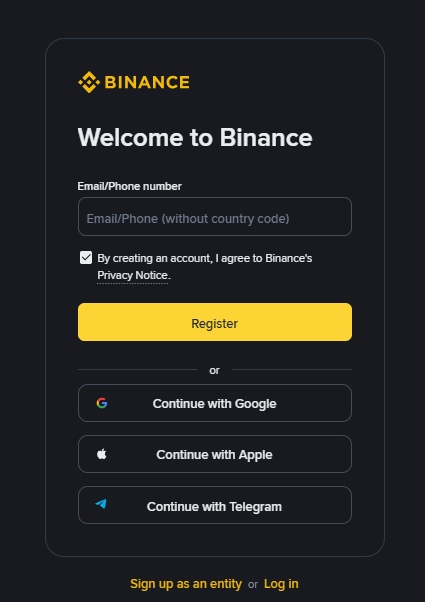
- Confirm Binance is legally available in your country. Check current status directly — this is not available to US residents, and is suspended for EU residents as of July 2026.
- Create an account and verify your email or phone number. Standard signup with a strong, unique password.
- Complete identity verification (KYC). Requirements vary by jurisdiction and account tier; basic verification typically requires a government-issued ID and a short liveness check.
- Enable security features before funding. Two-factor authentication via an authenticator app, an anti-phishing code, and withdrawal address whitelisting should all be turned on first.
- Fund your account. Options vary by region: bank transfer, card, P2P trading, or crypto deposit.
- Choose your interface. Binance Lite for a simplified buy/sell experience, or Binance Pro for full order-book trading, charting, and advanced order types.
Start Trading with Binance
Buy, sell, and trade hundreds of cryptocurrencies on one of the world’s largest crypto exchanges, trusted by millions of users globally.
✓ Hundreds of Cryptocurrencies | ✓ Deep Market Liquidity | ✓ Advanced Trading Tools | ✓ Up to $100 Sign-Up Rewards*
*Rewards are subject to eligibility requirements and promotional terms.
Security and Transparency
Binance holds the large majority of user funds in cold storage and backs the platform with the Secure Asset Fund for Users (SAFU), an insurance reserve reportedly exceeding $1 billion, funded by a share of trading fee revenue since 2018. Binance publishes Proof of Reserves using a Merkle-tree system that lets users cryptographically verify that their individual balances appear in the published data. However, as with several exchanges in this comparison, Binance has not always followed a strict quarterly publication schedule. It is more accurate to describe its reporting as regular rather than tied to a fixed calendar.
Binance’s hack history includes a 2019 breach (roughly 7,000 BTC, about $40 million at the time) and an indirect connection to the 2022 BNB Chain bridge exploit. Both predate the current compliance leadership and neither has recurred since. More recently, Binance has begun converting a portion of the SAFU fund into Bitcoin — a decision that changes the fund’s composition and, by extension, its value stability during market downturns, worth knowing if the fund’s stated dollar value matters to your risk assessment.
Binance BTCS Score: 79/100
MarketsXplora’s Blockchain/Crypto Trust Score (BTCS) evaluates exchanges across weighted pillars covering regulatory standing, security, fees, product depth, and liquidity.

Pillar |
Weight |
Score |
Notes |
|---|---|---|---|
Regulatory Standing |
25% |
15/25 |
Landmark ADGM win offset by the EU MiCA lockout and ongoing Senate inquiry |
Security & Transparency |
20% |
16/20 |
SAFU fund and Merkle-tree Proof of Reserves; clean recent hack record |
Fee Competitiveness |
20% |
16/20 |
Competitive but not the cheapest headline rate in this comparison |
Product Depth |
15% |
15/15 |
Full suite: spot, margin, futures, options, staking, launchpad, NFTs, Pay, Card, Web3 wallet |
Liquidity & Market Share |
20% |
19/20 |
Largest exchange globally by a wide margin on both spot and derivatives volume |
Total BTCS Score: 79/100 — “Dominant but Regulatorily Uneven”
Binance’s scale and product depth are unmatched in this comparison, and its security infrastructure is mature. The score is capped primarily by 2026’s split regulatory picture — a genuine institutional-grade win in Abu Dhabi sitting alongside a real, ongoing lockout in one of the world’s largest regulated crypto markets.
Binance vs. Coinbase vs. Bybit vs. Bitget vs. Kraken
All five platforms are legitimate, widely used exchanges — this comparison is about fit, not legitimacy.
Exchange |
Spot Fee (base) |
Assets |
MiCA (EU) Status |
Derivatives |
|---|---|---|---|---|
 |
0.10% / 0.10% |
600+ |
Not licensed — suspended from July 2026 |
Full suite: futures, options, margin |
 |
Standard app: high; Advanced Trade: ~0.05–0.60% tiered |
250+ |
Licensed |
Limited, via Coinbase Derivatives |
 |
0.10% / 0.10% |
700+ |
Licensed (via bybit.eu) |
Deep futures/options; spot-only on the EU entity |
 |
0.10% / 0.10%, down to 0.08% with BGB |
600+ |
Pending, not yet confirmed as of this review |
Futures, large copy-trading network |
 |
0.16% / 0.26% (Kraken Pro base tier) |
300+ |
Licensed — leads euro-denominated spot market share |
Futures, margin |

Withdrawal Methods & Processing Time
Exchange |
Fiat Withdrawal |
Crypto Withdrawal |
|---|---|---|
|
Bank transfer, typically 1–3 business days; varies by region |
Network fee only, often under 1 hour for BTC/ETH |
|
Free ACH/SEPA, 1–3 business days; instant card withdrawal for a fee |
Network fee, varies with congestion |
|
Varies by region and fiat rail |
No deposit fee; withdrawal fee varies by coin/network |
|
Varies by region and fiat rail |
Network fee, varies by coin |
|
Generally free ACH; wire same-day for a fee |
Network fee, congestion-dependent |
Watch This
Fiat withdrawal rails vary enormously by country on every platform in this comparison — always confirm the specific method and timeline available in your region before assuming a figure above applies to you. As with any exchange, confirm the receiving network matches the sending network before withdrawing crypto; a mismatch typically means permanent loss of funds.
Where Binance Wins, and Where It Doesn’t
✔ Binance’s Strengths
- Largest liquidity pool of any exchange, on both spot and derivatives
- Widest asset selection among the five exchanges compared here
- Most complete product suite — the only platform with staking, launchpad, NFTs, Pay, Card, and a Web3 wallet all under one account
- Genuine regulatory upgrade in Abu Dhabi, the first exchange to reach that ADGM milestone
- Competitive fees, especially with the BNB discount active
✘ Binance’s Weaknesses
- Not legally available to US residents under any circumstances (Binance.US is a separate, more limited product)
- Suspended for EU residents as of July 1, 2026, after failing to secure a MiCA licence — a live, unresolved situation
- Ongoing Senate inquiry into compliance-staff dismissals and Iran/Russia-linked transaction flagging
- Corporate history includes a $4.32 billion DOJ settlement and founder guilty plea, even though current leadership and compliance posture have changed materially since
- SAFU fund’s partial conversion to Bitcoin introduces value volatility that a fixed-dollar reserve wouldn’t have
Start Trading with Binance
Buy, sell, and trade hundreds of cryptocurrencies on one of the world’s largest crypto exchanges, trusted by millions of users globally.
✓ Hundreds of Cryptocurrencies | ✓ Deep Market Liquidity | ✓ Advanced Trading Tools | ✓ Up to $100 Sign-Up Rewards*
*Rewards are subject to eligibility requirements and promotional terms.
Bottom Line
Binance’s scale is not in question — it is the largest, most liquid, and most complete crypto exchange in the world, and for traders outside the US and EU, that combination is genuinely hard for any competitor to match. The honest complication is regulatory: 2026 delivered both Binance’s strongest-ever compliance credential (the ADGM licence) and its most consequential setback (the EU lockout) within the same seven months, and the Senate inquiry into Iran/Russia-linked transactions remains open. None of this makes Binance illegitimate — its DOJ settlement is resolved, its SEC case is dismissed, and it operates fully licensed across a wide swath of the world. But it does mean “is Binance the right exchange for me” now depends heavily on where you live in a way it didn’t a year ago. Check current availability and licensing status in your specific country directly before funding an account.
Frequently Asked Questions
Is Binance available in the US?
No. Binance.com is geo-blocked to US residents. US-based traders must use the separate, differently regulated Binance.US platform — see our full Binance.US Review for details.
Is Binance still available in the EU?
Not as of July 1, 2026. Binance failed to secure a MiCA licence by the EU’s transitional deadline and has suspended new orders, deposits, sign-ups, and Earn/staking products for EU residents. Withdrawals remain open. Binance has said it intends to reapply in another EU member state.
Is Binance safe to use?
Binance holds the majority of user funds in cold storage, publishes Proof of Reserves, and maintains the SAFU insurance fund. It has not disclosed a direct hack since 2019. Its main risk factors in 2026 are regulatory rather than technical — the EU lockout and the ongoing Senate inquiry into compliance practices.
What are Binance’s trading fees?
Spot trading starts at 0.10% maker and taker, reducible to around 0.075% with the BNB fee discount. Futures start at 0.02% maker / 0.05% taker, falling further at higher VIP volume tiers.
How does Binance compare to Coinbase, Bybit, Bitget, and Kraken?
Binance offers the deepest liquidity, widest asset selection, and broadest product suite of the five. Coinbase offers the strongest public-company transparency and full MiCA licensing. Bybit and Kraken are both MiCA-licensed with competitive derivatives (Bybit) and transparency (Kraken) credentials. Bitget offers the most aggressive fee discounting via its BGB token but has not yet confirmed MiCA authorization.
Did Binance’s founder go to prison?
Changpeng Zhao pleaded guilty in November 2023 to a single federal charge related to anti-money laundering violations as part of Binance’s $4.32 billion DOJ settlement and stepped down as CEO. Richard Teng has served as CEO since.
About the author
Samson Ononeme is the founder of MarketsXplora, an independent financial education and research platform covering cryptocurrency, forex, brokers, exchanges, trading platforms, and blockchain technology. He has more than 12 years of experience in financial content, with bylines at EarnForex, Kryptomoney, Cryptorunner, and AtoZ Markets. He turns complex financial products into clear, practical information that readers can use when they compare their options. Connect on LinkedIn and X.
Editorial disclosure: Based on public regulatory filings and statements from the SEC, DOJ, ADGM, and ESMA, Binance’s own official announcements, and reporting from Reuters, CoinDesk, Fortune, and other financial press as of August 2026. Fees, licensing status, and regional availability change frequently and vary significantly by country — verify current terms directly on binance.com and against your local regulator’s register before making decisions. Not financial or legal advice.