


Comparing Tangem vs. Trezor Model One? If you are new to crypto wallets, you probably just want the safest and easiest way to store your crypto without complication. This guide keeps things simple. We will walk you through both wallets side-by-side—how they work, who they’re best for, and what to expect—so you can confidently pick the one that feels right for you in 2026.
Tangem vs. Trezor Model One: Quick Comparison
So how do you decide which one’s better for your crypto lifestyle? Let’s start with a side-by-side comparison to quickly spot the key differences.
|
|
|
Device Type |
NFC card, no screen |
USB device with screen and buttons |
Setup Time |
1–3 minutes via mobile app |
~10 minutes via desktop + seed setup |
Private Key Storage |
Generated and stored inside secure chip |
Derived from a seed phrase |
Recovery Method |
Backup with extra cards or optional seed |
Seed phrase only (12 or 24 words) |
Supported Coins |
6,000+ tokens |
5,500+ |
App Experience |
Mobile-first (iOS & Android) |
Desktop-first (Trezor Suite) |
Security Certification |
EAL6+, tamper-proof chip |
Open-source firmware, CE & RoHS certified |
Battery |
None (no charging needed) |
None (USB-powered when connected) |
Price |
From $54.90 (2 cards), $69.90 (3 cards) |
$49 flat |

What is Tangem Wallet?

Tangem is a hardware wallet made in Switzerland, first launched in 2018, offering a sleek and radically different approach to crypto security. Unlike traditional cold wallets with screens and buttons, Tangem looks and feels like a bank card—but it’s packed with advanced security tech. You simply tap it on your smartphone (thanks to NFC), and your private keys never leave the chip inside.
It’s a cold wallet, meaning your assets stay completely offline and out of reach from hackers—unlike hot wallets, which stay connected to the internet and are more vulnerable to malware and phishing. Tangem’s simplicity and portability have made it especially appealing for beginners, and it now comes in multiple colors like black, green, orange, and blue. Want a closer look at how Tangem actually works? Check out the extensive Tangem wallet review for the full scoop.
What is Trezor Model One?

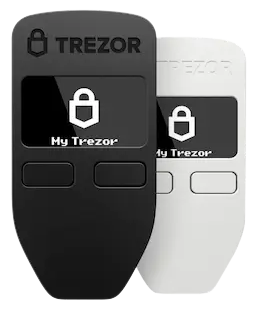
Trezor Model One is a hardware wallet made in the Czech Republic, launched in 2014, and widely known as the world’s first commercial cold wallet. It connects via USB and features a small monochrome screen with two buttons, giving users full physical control over their crypto transactions.
Like Tangem, it stores your private keys offline, making it far more secure than hot wallets that live on your phone or computer. While the Model One remains a trusted and budget-friendly choice in 2025, it doesn’t support newer coins like ADA, SOL, or XRP—which are covered in newer models like the Trezor Safe 3 and Trezor Model T. Available in black and white, the Model One keeps things simple and sturdy. Curious whether it’s still a solid pick despite newer models? Dive into the full Trezor Model One review to learn more.
Now that you’ve seen how the two wallets stack up side-by-side, the next question is: Who exactly are these wallets built for? Knowing your own crypto habits—whether you check charts on your phone or prefer managing your coins in front of a laptop—will make your decision a lot clearer.
Tangem vs Trezor Model One: Who Are These Wallets For?
If you’re the kind of user who lives on your smartphone, doesn’t want to memorize or write down recovery phrases, and prefers crypto tools that just work—Tangem is made for you. It’s sleek, portable, and has no screen, no buttons, and no battery. You simply tap your Tangem card (or ring) on your phone, and you’re in. It’s a perfect match for everyday users, on-the-go investors, and even beginners who want strong security without technical hassle.
On the flip side, Trezor Model One appeals to those who appreciate the classic, time-tested cold storage approach. It’s ideal for users who want to manually confirm each transaction on a physical screen, generate a seed phrase for recovery, and manage their coins using a desktop interface. If you’re more privacy-conscious, enjoy full control over every step, or plan to store long-term holdings without needing mobile access—Trezor might suit you better.

Tangem vs Trezor Model One: Setup and Ease of Use
When it comes to getting started, Tangem makes things almost effortless. You do not need a computer, cables, or technical knowledge. Just install the Tangem app on your smartphone, tap the card using NFC, and you’re done in about 3 minutes. There’s no software to install beyond the app, no firmware to update, and no seed phrase to write down—unless you want to. It’s designed to be as plug-and-play as crypto security gets.
Trezor Model One, on the other hand, follows a more traditional cold wallet setup. You’ll connect the device to your computer using a USB cable, then go through the setup using the Trezor Suite desktop app.

The process takes a little longer—typically around 10 minutes—and includes generating and writing down a 12- or 24-word seed phrase. For complete beginners, this might feel a bit intimidating, but Trezor does guide you step-by-step.
Bottom line: Tangem wins on speed and simplicity, especially if you are on mobile. But if you’re someone who values physical buttons and screen confirmation during setup, Trezor’s process gives you that added sense of traditional security.
Tangem vs Trezor Model One: Security
Security is where these two wallets take completely different paths—but both are built with serious protection in mind.
Tangem uses a secure chip certified at EAL6+, the same level of security used in biometric passports and military-grade IDs. Your private key is generated inside the chip during activation, never leaves the card, and can not be extracted—even by Tangem. There’s no screen to fake, no data stored on your phone, and nothing ever connects to the internet. Plus, if you want extra protection, you can enable access codes or even use biometric unlocking.
Trezor Model One takes the opposite route: full transparency. Its firmware is completely open-source, allowing anyone to audit the code. All transactions are confirmed physically using the device’s screen and buttons—so you know what you’re signing every time. While it lacks the ultra-high chip certification that Tangem boasts, it’s built around the principle that if it can be inspected and verified, it can be trusted.
So which approach is better? That depends on your philosophy. Tangem emphasizes non-extractable, tamper-resistant tech, while Trezor relies on open design and manual verification. Both are highly secure—just in different ways.
Recovery Options
This is where Tangem’s simplicity and flexibility really stand out.
With Tangem, you can recover access using multiple backup cards. A 2-card or 3-card set works like identical keys—lose one, and the others still unlock your wallet. You also have the option to generate or import a traditional seed phrase if that’s your preference, but it’s not required. This is ideal for users who don’t want to deal with paper backups or are worried about losing a recovery phrase.
Trezor, meanwhile, sticks to the standard BIP39 seed phrase method. When you first set it up, it gives you a 12- or 24-word recovery phrase. That phrase is your lifeline—lose it, and there’s no way to recover your crypto. While this method has been trusted for over a decade, it does require discipline. You have to store it somewhere safe, and ideally, offline.
So here’s the trade-off: Tangem gives you hardware-based recovery without writing anything down, while Trezor gives you complete compatibility with other wallets—but puts the backup responsibility entirely on you.

Supported Coins & Ecosystem
Let’s talk about one of the biggest deciding factors for many users: what coins can you actually store?
Tangem supports over 6,000 cryptocurrencies, including major assets like Bitcoin, Ethereum, USDT, and a huge range of altcoins and tokens. Thanks to its integration with multiple providers, Tangem also lets you buy, sell, swap, and even stake many of those assets directly through the app. Whether you’re into blue-chip tokens or exploring niche DeFi projects, Tangem has you covered.
By contrast, Trezor Model One supports thousands of coins—but with notable exceptions. At the time of writing, it does not support XRP, Solana (SOL), Cardano (ADA), or Monero (XMR), which might be a dealbreaker for some users. Trezor Suite, its official desktop app, supports a wide range of tokens, and for unsupported ones, you can often connect to third-party wallets like MetaMask or Electrum—but that adds complexity.
So if broad coin compatibility is important to your portfolio—especially for mobile-friendly DeFi users—Tangem clearly wins here. But if you primarily deal with Bitcoin and Ethereum and want maximum control through a desktop interface, Trezor Model One still gets the job done.
Device Design & Durability
These two wallets couldn’t look more different—and the design says a lot about the experience they offer.
Tangem is as thin as a credit card. It’s waterproof, dustproof, heat-resistant, and has no moving parts. It’s built to survive rough conditions, making it ideal for anyone who wants to carry their wallet in a pocket, backpack, or even a sock drawer without worry. The Tangem Ring version adds a cool wearable twist, giving users a truly hands-free backup option.
Trezor Model One, on the other hand, is a compact plastic device with a small screen and two tactile buttons. It feels a bit like a USB security key with a display. It’s lightweight and durable for daily use but not waterproof or dustproof, and its buttons and screen are physical parts that could wear out over many years of heavy use. That said, it’s built to handle over 200,000 button presses and is CE and RoHS certified for quality.
So it comes down to how (and where) you plan to use your wallet. If you want something minimalist and ultra-portable with no cables or screens, Tangem fits right into your everyday carry. If you prefer a traditional look and screen-based confirmation, Trezor’s hands-on approach gives you tactile peace of mind.
Tangem vs Trezor Model One: App Experience
The software that powers your wallet matters just as much as the device itself—and here, the contrast is clear.

Tangem is mobile-first by design. The Tangem app, available on iOS and Android, is beautifully simple. You just tap your card to the back of your phone, and your portfolio loads instantly. From there, you can track prices, analyze tokens, swap coins, stake assets, and even buy or sell crypto—all from your phone. There’s no desktop version (yet), so it’s best suited for users who are comfortable doing everything from a smartphone.
Trezor Model One, in contrast, is tightly integrated with the Trezor Suite desktop app. It’s a robust tool that allows you to manage coins, track your portfolio, enable privacy features like Tor, and even adjust advanced settings like coin control. It feels more like a “power user” dashboard. You can connect Trezor to some third-party mobile wallets, but the full experience is definitely built for desktop.
So the app question is simple: Do you want to manage your crypto in your pocket or on your PC?
Tangem gives you a seamless mobile-only experience. Trezor gives you deeper control—but it comes with the need to sit down at a computer.
Trezor Model One vs Tangem: Pricing
Price is often the first filter many buyers apply—and in this case, both wallets are relatively affordable. But value? That’s where the real difference lies.
Trezor Model One is one of the most budget-friendly cold wallets on the market at $49. For that price, you get the device, a USB-A cable, recovery cards, and access to the Trezor Suite app. It’s a great entry point into self-custody for those who prefer screen-based wallets and don’t need advanced altcoin support.
Tangem, on the other hand, starts at $54.90 for a 2-card set and $69.90 for 3 cards, with the extra cards acting as hardware backups. While the price is slightly higher, you’re getting multiple access points to your wallet, no battery to worry about, EAL6+ certified chip security, and 25 years of durability. There’s also the Tangem Ring bundle at $160, which combines wearable convenience with backup security.
So while Trezor wins on upfront cost, Tangem arguably delivers more value long-term—especially if you like the idea of backup cards, mobility, and a no-maintenance experience.
Pros and Cons
Tangem Wallet — Pros & Cons
✅ Pros
- Extremely easy setup (under 3 minutes via mobile)
- No cables, no screen, no battery—just tap and go
- On-chip private key generation (non-extractable)
- EAL6+ certified chip security
- Optional seed phrase or seedless recovery with backup cards
- Supports over 6,000 cryptocurrencies including XRP, ADA, SOL, etc.
- Ultra-portable, waterproof, and durable (25-year lifespan)
- App includes buying, selling, staking, and real-time tracking
- Works offline—ideal for travel or emergency use
❌ Cons
- No built-in screen for on-device transaction confirmation
- Mobile-only (no desktop app)
- Less transparency—firmware is audited but not fully open-source
- Recovery relies on physical cards unless you opt for a seed phrase
- Limited to phones with NFC support
Trezor Model One — Pros & Cons
✅ Pros
- Proven track record (10+ years on the market)
- Full control with screen-based transaction verification
- Open-source firmware and transparent design
- PIN and optional passphrase protection for added security
- Integrates with Trezor Suite and third-party wallets
- Compact, lightweight, and USB-powered (no charging)
- Standard seed phrase recovery (widely compatible)
- Great value at just $49
❌ Cons
- Does not support several major coins like XRP, ADA, SOL, or XMR
- Setup process is longer and involves seed phrase backup
- Not waterproof or dustproof
- Desktop-first experience—not ideal for mobile-only users
- Slightly dated hardware design compared to newer wallets
What Are Reddit Users Saying About Tangem and Trezor Model One?
On Reddit, many users still trust the Trezor Model One — even after years of use. One long-time user by the name Zombie4141 said,
“I’ve had mine since 2017… it’s the easiest hardware wallet to set up and use.”

Another by the username @-johoe added that while the Model One may not get as many feature updates anymore, it still receives essential security updates, making it a safe choice for holding Bitcoin and other supported coins.
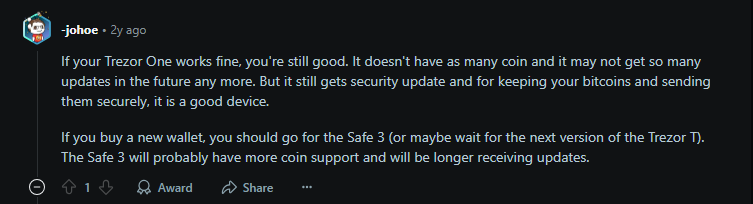
Some, however, mentioned that Trezor Safe 3 or newer models like the Trezor Safe 5 are worth considering for better coin support and long-term update compatibility.
Tangem, on the other hand, drew praise from newer users looking for simplicity and mobile-first convenience. One user @Excellent_Wall4716 who owns multiple wallets, including Ledger and Trezor, claimed:
“Tangem is the easiest to use for both hodling and trading… I only need my phone.” Another said, “It’s the best wallet I’ve used so far — and I’ve tried them all since 2014.”

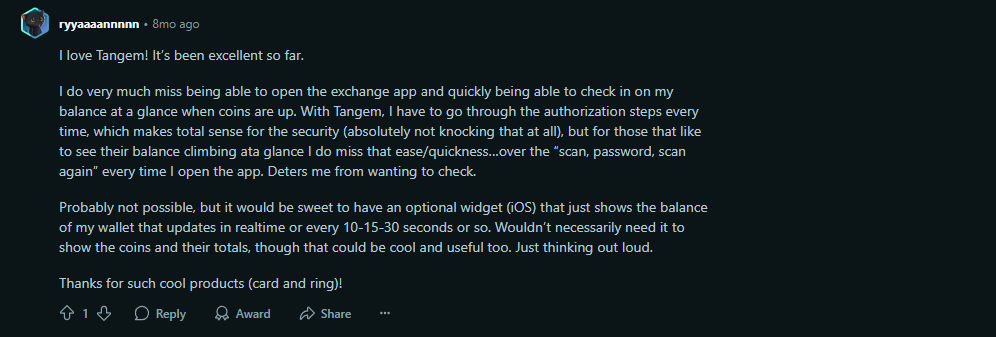
That said, Tangem is not perfect for everyone. Several users noted that needing to scan the card every time to view balances can feel tedious. One even wished for a simple iOS widget to view wallet value at a glance. Still, many see this extra step as a fair trade-off for increased security.
Some seasoned users, though, caution against using Tangem for deep cold storage. As one put it, it’s great for beginners and frequent spenders, but may not be ideal for long-term storage with no interaction.

Overall, Reddit sentiment shows that Trezor Model One remains a solid, battle-tested device, while Tangem is winning over mobile-first users who value simplicity, portability, and ease of use — especially those just entering the world of crypto wallets.
Trezor Model One or Tangem: Which Wallet Should You Choose?
As you have seen so far in this comparison, both Tangem and Trezor Model One are excellent choices. They are built for very different types of users.
So if you are looking for a wallet that’s simple, mobile, and maintenance-free, Tangem is the modern, hassle-free option. It’s ideal for beginners, travelers, and anyone who prefers to manage crypto on their phone without dealing with seed phrases, wires, or software installations. Its support for thousands of coins (including XRP, SOL, and ADA), rugged card design, and optional ring accessory make it a standout for on-the-go self-custody.
On the other hand, if you prefer traditional cold storage with full control and screen-confirmed transactions, Trezor Model One is the tried-and-tested choice. It’s better suited for users who are comfortable with seed phrases, want transparency through open-source firmware, and like having a physical screen to verify every action. It’s not the flashiest wallet, but it’s reliable, secure, and deeply respected in the crypto community.
✅ Where and How to Buy Tangem or Trezor Model One
So, you’ve made your choice — now let’s make sure you buy it the right way.
🔐 If You’re Buying the Trezor Model One
Always purchase directly from the official Trezor website. Why? Because it’s the only way to guarantee you’re getting a genuine, untampered device. Buying from resellers or third-party marketplaces puts your crypto at serious risk — even if the box looks sealed.
Trezor’s site offers free shipping to the U.S., with options for fast and tracked delivery worldwide. Here’s what to expect:
- 🇺🇸 United States: Free standard shipping (3 business days), or pay $25 for expedited 2-day delivery.
- 🇬🇧 UK: Just $5.51 for either standard or expedited delivery — both take 2 business days.
- 🇦🇺 Australia: $13.53 for UPS (5 days) or $29.40 for DHL Express (4 days).
- 🇳🇬 Nigeria: DHL Express delivers in 5–7 business days for around $30.
You can pay with PayPal, GPay, Apple Pay, cards, and even with Bitcoin or other crypto — which is perfect for crypto-first buyers.
📦 Buy Trezor Model One from the Official Website »
If You’re Buying the Tangem Wallet
You can grab the Tangem Wallet straight from the official Tangem website, where you’ll get fast, global shipping and the latest version of the wallet with full warranty and updates.
Delivery is quick:
- 🇺🇸 USA: 1–3 business days
- 🇬🇧 UK: 1–2 business days
- 🇦🇺 Australia: 7–11 business days
Even better? You can use our exclusive promo code:
🎉 Use code MARKETSXPLORA at checkout to get 10% OFF your Tangem Wallet.
This discount works whether you’re buying a 3-pack, the new Tangem Ring, or accessories. It’s the best deal if you’re ready to make the switch to card-based cold storage.
🛒 Buy Tangem Wallet with 10% OFF →
Final Thoughts
Choosing between the Tangem Wallet and the Trezor Model One ultimately comes down to how you plan to interact with your crypto. One offers sleek, mobile-first convenience, while the other delivers time-tested security through a more traditional setup.
Both wallets serve their purpose well, and neither is the “wrong” choice. Whether you’re just starting out or tightening your security game, you’re taking the right step by going with a cold wallet. The key is to choose the one that matches your habits, not just your budget.
Whichever way you lean, the most important thing is this: you’re in control of your crypto — and that’s what truly matters.
Related ↓
Frequently Asked Questions
- Is Tangem Wallet or Trezor Model One safe to use?
Yes, both wallets are safe — but they use different approaches. Tangem stores your private keys securely inside a chip on the card and never exposes them. Trezor Model One keeps your keys offline and requires physical confirmation via its buttons. Both are cold wallets, meaning your crypto is protected from online hacks.
- What’s the difference between Tangem and Trezor Model One?
Tangem is a card-based wallet with no screen, while Trezor Model One has a physical screen and buttons. Tangem uses NFC and mobile apps, while Trezor connects via USB. Tangem doesn’t require a recovery seed; Trezor does. They both store crypto securely offline but take different paths to do it.
- Is Trezor Model One better than Tangem Wallet?
Not necessarily — it depends on your needs. Trezor Model One offers screen-based transaction review and supports more wallet integrations, while Tangem is simpler, more portable, and doesn’t rely on recovery phrases. Beginners may prefer Tangem’s ease, while advanced users might value Trezor’s flexibility.
- What coins does the Tangem Wallet support?
Tangem supports over 6,000 coins and tokens, including Bitcoin, Ethereum, Solana, BNB, MATIC, XRP, and most ERC-20 tokens. It’s ideal for users with a diverse portfolio, especially those interested in newer or mobile-first chains.
- What happens if I lose my Tangem card?
If you’ve activated 2 or 3 backup cards, you can simply use another one to access your wallet — no recovery seed needed. If you lose all your cards, your assets are permanently lost. That’s why setting up backups is critical.
- What happens if I lose my Trezor Model One?
You can recover your wallet using the 24-word recovery seed you wrote down during setup. Just enter it into a new Trezor device or compatible wallet. If you didn’t save your recovery phrase, your funds can’t be recovered.
- Can I use both wallets together?
Yes, many users do. You can store long-term holdings on one (e.g., Tangem for mobile backup-free storage), and use the other (e.g., Trezor for staking or interacting with dApps) for more advanced tasks. Each serves a different purpose based on your strategy.