


By Samson Ononeme, Founder & Financial Content Strategist at MarketsXplora — 12+ years covering forex brokers, prop trading firms, and crypto/Web3 markets. Bylines at EarnForex, Kryptomoney, Cryptorunner, and AtoZ Markets.
Last updated: August 2026
Part of our Binance.US coverage: For a full standalone breakdown of the US platform, see our Binance.US Review, Is Binance.US Legit?, and Is Binance.US Safe? articles, or compare it directly against other US exchanges in Binance.US vs. Coinbase, Binance.US vs. Kraken, and our three-way comparison.
Quick Answer
Binance.US and Binance (the global platform at Binance.com) are two legally separate companies that share a brand, not one exchange with a regional switch. Binance.US is operated by BAM Trading Services, Inc., a US-incorporated company built specifically to serve American residents under state money transmitter law. Global Binance is operated by Binance Holdings Ltd., a Cayman Islands company licensed across dozens of international jurisdictions, and it is legally closed to US residents — the platform geo-blocks US IP addresses and requires non-US residency at KYC. If you’re a US resident, Binance.US is your only legal way to access the Binance brand; using global Binance via a VPN or falsified residency would violate both platforms’ terms of service and, depending on circumstances, US law. The two platforms differ sharply in product depth: global Binance offers 500+ assets, futures, margin, options, and copy trading, while Binance.US is a smaller, spot-only exchange with roughly 150–190 assets and none of the leveraged products.
Binance.US vs. Binance: At a Glance
Category |
 |
 |
|---|---|---|
Operating company |
BAM Trading Services, Inc. (US) |
Binance Holdings Ltd. (Cayman Islands) |
Founded |
2019 |
2017 |
CEO |
Stephen Gregory (since March 2026) |
Richard Teng (since November 2023) |
Primary regulators |
US state money transmitter licenses + FinCEN |
VARA (Dubai), FSRA (Abu Dhabi), JFSA (Japan), and licenses across France, Italy, Spain, Poland, El Salvador, and others |
US resident access |
Legal in ~39 supported states/territories |
Geo-blocked; not legal for US residents |
Assets supported |
~150–190 |
500+ |
Spot trading fee (base tier) |
0% maker / 0.01% taker on Tier 0 USD pairs |
0.10% maker / 0.10% taker base rate, reducible via BNB holdings |
Futures / margin / options |
Not available |
All available |
Staking |
Not currently live |
Available on a wide range of assets |
Proof of reserves |
Not independently published for the US entity |
Published on a roughly quarterly cadence via Merkle-tree construction |
Insurance fund |
No dedicated fund |
SAFU fund, reportedly over $1 billion, currently being converted into Bitcoin |
Major regulatory/legal history |
SEC suit dismissed with prejudice, May 2025; not a defendant in the 2023 DOJ criminal case |
SEC suit dismissed with prejudice, May 2025; Binance and CZ pleaded guilty in 2023 to AML/sanctions violations, $4.32 billion DOJ settlement; ongoing DOJ compliance monitor |
Same Brand, Two Different Companies
The single most important thing to understand about “Binance vs. Binance.US” is that this isn’t a comparison of one exchange’s two modes — it’s a comparison of two separately incorporated, separately regulated companies that share branding, a founding history, and some underlying technology, but operate independently today. Binance.US was created in 2019, structured specifically to give the Binance brand a compliant path into the US retail market, distinct from the global exchange that Binance Holdings Ltd. operates everywhere else.
This split exists because US securities and money transmitter law made it impractical for the same entity serving the rest of the world to also serve US residents directly. Binance.US operates under its own management, its own state licenses, and — since 2019 — its own leadership team, which has changed independently of global Binance’s executive changes. For the full detail on Binance.US’s corporate structure and legal standing specifically, see Is Binance.US Legit?.
Is Binance Available in the US?
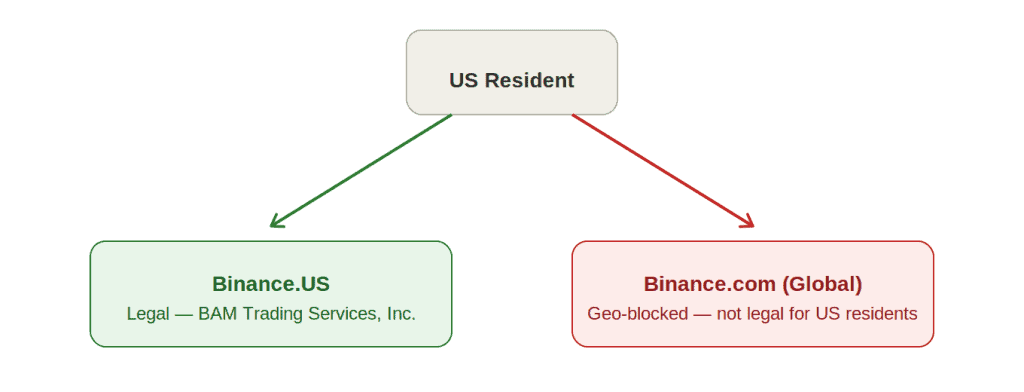
No — not the global platform. Binance.com geo-blocks US IP addresses and requires KYC applicants to confirm non-US residency, so the global exchange is not a legal option for American residents regardless of how it’s accessed. Binance.US is the only sanctioned way for US residents to use a Binance-branded exchange. Attempting to circumvent the geo-block via a VPN or by misrepresenting residency at KYC violates the platform’s terms of service and can carry legal and account-security risks of its own, separate from any question of Binance.US’s suitability as an alternative.
Editorial Note
A lot of “Binance” content circulating online — asset counts, fee comparisons, security features — describes the global platform that US residents cannot legally use. When researching Binance as a US resident, the only comparison that matters practically is against Binance.US specifically, not the global exchange’s marketing materials.
Product Range: A Wide Gap
Global Binance is a full-service exchange: 500+ supported assets, spot and margin trading, futures with leverage, options, copy trading, staking across a broad range of tokens, and an NFT marketplace. Binance.US offers none of the leveraged products and a meaningfully smaller asset list — roughly 150–190 coins, spot markets only, no staking currently live. This isn’t a Binance.US shortcoming so much as a structural consequence of US regulation: derivatives and margin products carry additional registration requirements domestically that most US-facing exchanges, not just Binance.US, avoid by simply not offering them.
Product |
Binance.US |
Binance (Global) |
|---|---|---|
Spot trading |
Yes |
Yes |
Futures / leverage |
No |
Yes |
Margin trading |
No |
Yes |
Options |
No |
Yes |
Staking |
Not currently live |
Available |
Copy trading |
No |
Yes |
Fees: Binance.US Is Now the Cheaper Headline Rate
This is a genuinely counterintuitive result for anyone assuming the smaller, more restricted platform would also be the more expensive one. Since Binance.US’s April 2026 fee overhaul, its flat 0% maker / 0.01% taker rate on major USD pairs actually undercuts global Binance’s standard base rate of 0.10% maker / 0.10% taker (reducible with BNB token discounts). For a US resident comparing the two platforms on cost alone — setting aside that global Binance isn’t a legal option anyway — Binance.US now wins on headline spot pricing for major-pair trades.
Withdrawal Methods & Processing Time
Method |
Binance.US |
Binance (Global) |
|---|---|---|
Bank transfer (ACH/wire equivalent) |
Free ACH; 1–3 business days. Wire available, fee applies, same-day |
Varies by region and local banking rail; not applicable to US residents |
Crypto withdrawal (BTC/ETH) |
Network fee only; often under 1 hour |
Network fee only; often under 1 hour |
Crypto withdrawal (Solana, Polygon, etc.) |
Near-instant |
Near-instant |
Watch This
Because US residents cannot legally hold a global Binance account, moving funds between Binance.US and Binance.com is not a normal, supported action for a US-based user — the two platforms don’t share balances or offer a direct internal transfer path for US customers. Always confirm the receiving network matches the sending network on any crypto withdrawal, regardless of platform.
Is Binance.US Legit?
Yes. Binance.US is a legitimately registered US business, operated by BAM Trading Services, Inc. under FinCEN registration (NMLS ID 1906829) and state money transmitter licenses across most of the country. Its most serious legal challenge — the 2023 SEC lawsuit alleging unregistered securities activity — was voluntarily dismissed with prejudice in May 2025, confirmed in the SEC’s own litigation release, permanently closing that matter. Binance.US was not a defendant in the separate 2023 DOJ criminal case that resulted in global Binance’s $4.32 billion settlement, detailed on the Justice Department’s own case page. For the full breakdown of Binance.US’s licensing, corporate structure, and litigation history, see our dedicated article, Is Binance.US Legit?
Is Binance.US Safe?
Binance.US has not disclosed a hack resulting in customer fund losses since launching in 2019, holds the majority of customer crypto in offline cold storage, and supports standard account security tools — two-factor authentication, withdrawal whitelisting, and anti-phishing codes. Where it lags global Binance specifically is on documented financial backstops: Binance.US does not maintain its own dedicated, publicly quantified insurance fund comparable to global Binance’s SAFU fund, and does not currently publish an independently audited, entity-specific Proof of Reserves report. FDIC pass-through coverage on USD cash balances is conditional and has changed multiple times since 2019. Full detail on custody, insurance, and account security is covered in our dedicated article, Is Binance.US Safe?
Editorial Note
Global Binance’s own transparency record isn’t without its own recent scrutiny. On February 13, 2026, Fortune reported that Binance had dismissed at least five compliance investigators — several with law-enforcement backgrounds — after they flagged nearly $1 billion in Tether (USDT) transactions on the Tron network linked to Iranian entities between March 2024 and August 2025. Binance disputed the report directly; CEO Richard Teng stated publicly that no sanctions violations were found in an internal review and that no investigator was dismissed for raising compliance concerns. The matter has since escalated beyond the initial dispute: US Senator Richard Blumenthal opened a formal Senate subcommittee inquiry, citing an expanded figure of $1.7 billion linked to both Iran-connected entities and Russian shadow-fleet activity, and requested Binance’s internal records by March 6, 2026, per Senator Blumenthal’s own press release. Separately, Binance has begun converting a portion of its SAFU insurance fund into Bitcoin, a decision that changes the fund’s composition and, by extension, its value stability during market downturns. None of this directly involves Binance.US, which was not named in either matter, but it’s directly relevant context for anyone weighing “Binance” trust broadly, and this is an active, evolving story worth checking for updates before publishing.
Does Binance.US Report to the IRS?
Yes. Binance.US issues IRS Form 1099-DA to US customers with taxable activity, starting with the 2025 tax year. This is a standard requirement for US-based digital asset brokers and is one of the clearer, most concrete indicators that Binance.US operates as a compliant domestic business rather than an offshore platform outside US tax reporting obligations. Note that the 2025 tax year form reports gross proceeds only, without cost basis — a first-year limitation across the industry, not specific to Binance.US — so importing your full transaction history into tax software is worth doing for accurate filing. Global Binance, as a platform not legally serving US residents, does not issue US tax forms.
✔ Choose Binance.US If
- You’re a US resident — this is your only legal way to access the Binance brand
- You want low fees on major-pair spot trading
- You want US tax reporting (Form 1099-DA) handled for you
✘ Global Binance Is Not an Option If
- You are a US resident — the platform is legally closed to you, regardless of its broader asset selection or product range
Bottom Line
For US residents, this comparison has a practical answer built in: Binance.US is the only legal Binance-branded option, so the real question isn’t “which is better” but “what am I giving up by using the compliant US version.” The honest answer is: meaningful product depth — no futures, margin, options, or staking, and a smaller asset list — in exchange for now-competitive fees on major pairs and the compliance benefits of a company that reports to the IRS and operates under resolved US litigation. Global Binance offers the deeper product suite and stronger documented transparency practices, but it simply isn’t available to you legally as a US resident, which settles the comparison for most readers of this article.
Binance.US
Best suited to users who prioritize low trading fees and a broad selection of supported cryptocurrencies. Availability and services can vary by state.
Frequently Asked Questions
Is Binance.US legit?
Yes. Binance.US is operated by BAM Trading Services, Inc., a US-registered company under FinCEN and state money transmitter licensing. Its 2023 SEC lawsuit was voluntarily dismissed with prejudice in May 2025, and it was not a party to global Binance’s separate $4.32 billion DOJ criminal settlement. See our full article, Is Binance.US Legit?, for the complete breakdown.
Is Binance available in the US?
No. The global Binance.com platform geo-blocks US IP addresses and requires non-US residency at KYC. Binance.US is the only legal way for US residents to access the Binance brand.
Is Binance.US safe?
Binance.US has not disclosed a hack resulting in customer fund losses since 2019, holds customer crypto in cold storage, and offers standard account security tools. It does not, however, maintain a dedicated insurance fund comparable to global Binance’s SAFU fund, and does not currently publish an independently audited, entity-specific Proof of Reserves report. See our full article, Is Binance.US Safe?, for details.
Does Binance.US report to the IRS?
Yes. Binance.US issues IRS Form 1099-DA to customers with taxable activity, starting with the 2025 tax year. Global Binance, which does not legally serve US residents, does not issue US tax forms.
Can US residents open a global Binance account?
No, not legally. Global Binance blocks US IP addresses and requires confirmation of non-US residency during identity verification. Circumventing this restriction violates the platform’s terms of service.
Why does Binance.US have fewer coins and no futures trading?
Binance.US was structured specifically to operate under US money transmitter law, which does not extend to leveraged derivatives products the way it applies to spot trading. Offering futures, margin, and options domestically would require additional registrations that Binance.US, like most US-facing exchanges, has not pursued, which is why its product range is narrower than the global platform’s.
Editorial disclosure: Based on publicly available regulatory filings, company disclosures, and reporting from Reuters, CoinDesk, Fortune, and other financial press as of August 2026. Fees, state availability, and product offerings change frequently — verify current terms directly on each platform before making decisions. Not financial or legal advice.