


By Samson Ononeme, Founder & Financial Content Strategist at MarketsXplora — 12+ years covering forex brokers, prop trading firms, and crypto/Web3 markets. Bylines at EarnForex, Kryptomoney, Cryptorunner, and AtoZ Markets.
Last updated: August 2026
Part of our Binance.US coverage: This is the full standalone review. For deeper dives on specific questions, see Is Binance.US Legit? and Is Binance.US Safe?, or compare it directly against competitors in Binance.US vs. Coinbase, Binance.US vs. Kraken, our three-way comparison, and Binance.US vs. Binance (Global).
Quick Answer
Binance.US is legal and operating normally in most states as of August 2026. Its long-running SEC lawsuit was dismissed with prejudice in May 2025, USD deposits and withdrawals were fully restored in February 2025 after an 18-month freeze, and the exchange cut spot trading fees to a flat 0% maker / 0.01% taker on major USD pairs in April 2026 — undercutting Coinbase and Kraken on headline pricing. It’s a solid fit for US residents who want low-cost spot trading on majors and a Binance-style interface, but it’s not the right choice if you want leveraged products, staking, or the deep altcoin selection of Binance’s global platform, none of which are available on the US version. New leadership under CEO Stephen Gregory (appointed March 2026) is pushing an expansion into Earn products, DeFi gateways, and tokenized assets, but the platform is still rebuilding trust and market share after its 2023–2025 regulatory ordeal.
Category |
Details |
|---|---|
Operator |
BAM Trading Services, Inc. (d.b.a. Binance.US), NMLS ID: 1906829 |
Founded |
2019, as the US-facing affiliate of Binance |
CEO |
Stephen Gregory (appointed March 9, 2026, succeeding Norman Reed) |
Regulation |
State-by-state money transmitter licenses; registered with FinCEN as a Money Services Business |
Spot trading fees |
0% maker / 0.01% taker on Tier 0 USD pairs (BTC/USD, ETH/USD); tiered volume-based fees on smaller pairs |
Assets supported |
Roughly 150–190 coins, spot markets only |
Leverage / derivatives |
None — no futures, margin, or options |
Minimum deposit |
$10 |
Funding methods |
ACH bank transfer (free), wire transfer, debit card, crypto deposit |
Tax reporting |
Issues IRS Form 1099-DA starting with the 2025 tax year |
State availability |
Available in ~39 states/territories; unavailable in NY, TX, VT, and 12 others (full list below) |
Website |
What Is Binance.US?
Binance.US is the United States-focused affiliate of Binance, the world’s largest cryptocurrency exchange by trading volume. While the Binance brand is globally recognized, it’s important to understand that Binance.US and Binance.com are not the same platform.
Because Binance.com does not serve US residents, American users cannot legally create or maintain accounts on the global exchange. Instead, US customers are directed to Binance.US, which is operated by BAM Trading Services, Inc., a separately incorporated company designed to comply with US regulatory requirements.
A Different Platform Than Global Binance
This distinction is more important than many new users realize.
Much of what people read online about Binance—including its massive liquidity, extensive coin listings, and advanced derivatives products—refers to Binance.com, not Binance.US.
Compared with the global platform, Binance.US offers a more streamlined product lineup:
- Spot cryptocurrency trading
- A smaller selection of listed assets
- Fiat on-ramp and off-ramp services
- Basic earning and staking features (where available)
At the same time, several popular Binance.com products are not available to US users, including:
- Futures trading
- Margin trading
- Options trading
- Copy trading
- Other leveraged derivatives products
Why the Difference Exists
The reduced feature set is largely a result of the US regulatory environment.
Rather than operating as an offshore exchange serving international markets, Binance.US is structured to function within US money-transmission and compliance requirements. That means fewer products, tighter restrictions, and a more conservative approach to platform offerings.
For many long-term investors, these limitations won’t matter. However, active traders who are familiar with Binance.com’s extensive ecosystem may find Binance.US noticeably more restrictive.
See our full breakdown, Binance.US vs. Binance (Global), for a detailed side-by-side of the two.
Is Binance.US Safe and Legal in 2026?
This is the question most US traders actually want answered, and the short version is: yes, with important context. Binance.US spent roughly two years under direct SEC litigation and an 18-month freeze on USD banking services. Both of those episodes have been resolved, but they shaped the exchange’s reputation and are worth understanding before you fund an account.
The SEC Lawsuit: What Happened and How It Ended
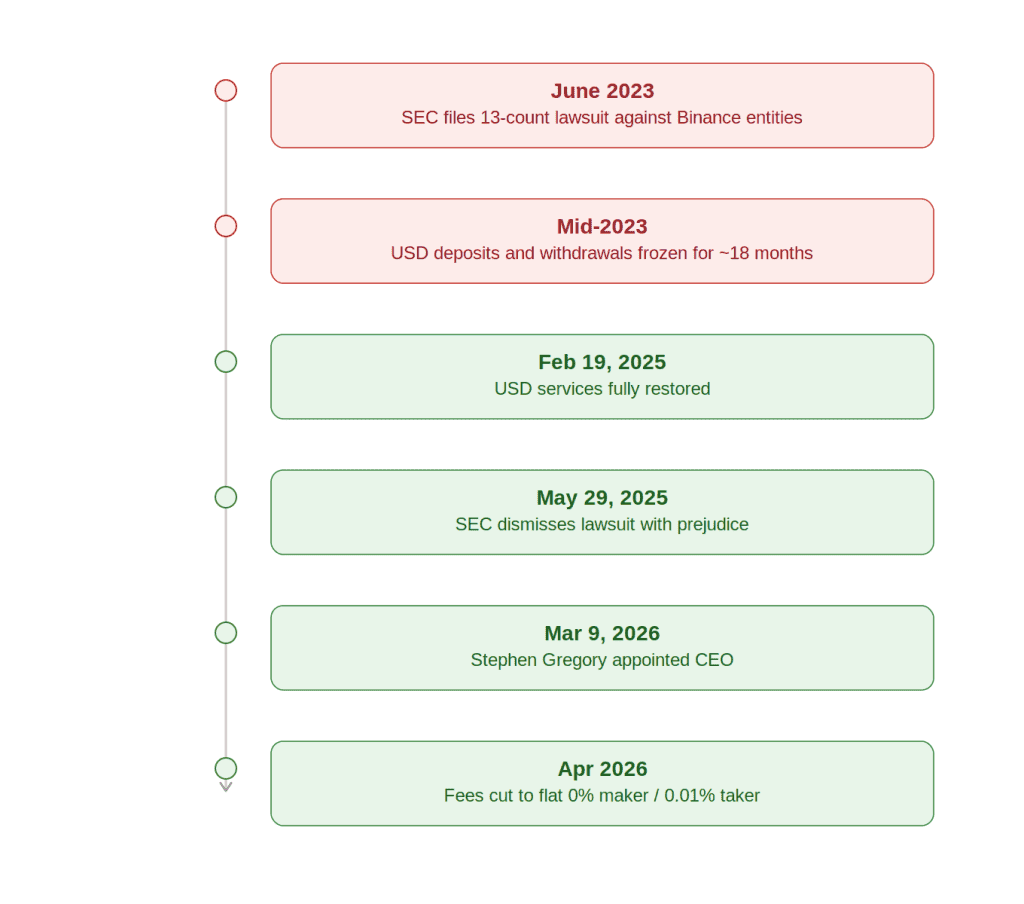
In June 2023, the SEC filed a 13-count civil suit against Binance, Binance.US, and founder Changpeng Zhao, alleging the platforms operated as unregistered exchanges, inflated trading volumes, commingled customer funds, and misled investors about surveillance controls. A federal judge allowed most of the case to proceed in 2024, and Binance.US suspended USD deposits and withdrawals for about 18 months starting in mid-2023 as banking partners pulled back under the regulatory pressure.
The case’s trajectory changed sharply after the Trump administration’s SEC, led by Chairman Paul Atkins, adopted a markedly different posture toward crypto enforcement. On May 29, 2025, the SEC voluntarily dismissed the lawsuit with prejudice — meaning it cannot be refiled — in a joint stipulation signed by lawyers for both sides, confirmed in the SEC’s own litigation release. That dismissal was part of a broader wave of crypto enforcement actions the SEC dropped through 2025 as it shifted from “regulation by enforcement” toward rulemaking.
Editorial Note
The SEC dismissal reflects a change in regulatory posture and a resolution of that specific litigation risk — it is not a finding that the original allegations were false, and it does not itself constitute regulatory endorsement of the platform. This is separate from Binance’s (the global entity’s) November 2023 guilty plea and $4.32 billion criminal penalty to the DOJ for anti-money laundering and sanctions violations, detailed on the Justice Department’s own case page, which remains part of Binance’s history regardless of the SEC civil case outcome. For the full breakdown of how this affects Binance.US’s legal standing specifically, see Is Binance.US Legit?.
USD Services: Fully Restored
Binance.US fully restored USD deposits and withdrawals on February 19, 2025, ending the 18-month freeze that had pushed trading volume and market share down sharply during the dispute. Zero-fee ACH bank transfers are now available across supported states, and the exchange began issuing IRS Form 1099-DA to US users starting with the 2025 tax year — note that for 2025 filings, the form reports gross proceeds only, without cost basis, so importing your full transaction history into tax software is worth doing to avoid overstating gains.
New Leadership, New Direction
Stephen Gregory took over as CEO on March 9, 2026, succeeding Norman Reed, who moved into an advisory role, as confirmed in Binance.US’s own official announcement. Gregory’s background is telling: he’s a lawyer who previously held compliance leadership roles at Gemini and CEX.io before running Currency.com’s US operations, and his appointment reads as a deliberate signal that Binance.US is prioritizing regulatory credibility over aggressive growth. Under his leadership, the company has said it plans to expand its Earn and staking products and explore DeFi and tokenized-asset gateways — though as of this review, staking is not yet live on the US platform.
✔ What Works in Binance.US’s Favor
- SEC litigation dismissed with prejudice — the case cannot be refiled
- Full USD banking restored since February 2025, including free ACH transfers
- State-by-state money transmitter licensing across most of the country
- Flat, low headline fees on major pairs since the April 2026 pricing overhaul
- Compliance-focused new CEO with regulatory-industry credentials
- Operating continuously since 2019 through multiple crypto market cycles
✘ Where Caution Is Still Warranted
- Unavailable to residents of 16 states and territories, including New York and Texas
- Thin liquidity relative to global Binance and even relative to Coinbase and Kraken on some pairs — daily spot volume has been estimated in the $20–25 million range, well below the platform’s pre-lawsuit levels
- No futures, margin, options, or staking — materially fewer products than either the global Binance platform or some US competitors
- Corporate lineage tied to Binance’s $4.3 billion DOJ settlement and CZ’s 2023 guilty plea, even though Binance.US itself was not a party to that criminal case
- Frequent leadership turnover (three CEOs since 2022) can be read as either stabilizing or as a sign of ongoing organizational flux, depending on your risk tolerance
Binance.US Fees Breakdown (2026)
Binance.US overhauled its fee schedule in April 2026, moving away from a purely volume-tiered model toward flat, near-zero pricing on its core USD pairs — a shift clearly aimed at competing head-on with Coinbase and Kraken on headline cost.
Fee Type |
Binance.US |
|---|---|
Tier 0 pairs (BTC/USD, ETH/USD, etc.) — maker |
0%, flat regardless of volume |
Tier 0 pairs — taker |
0.01%, flat regardless of volume |
Tier I pairs (smaller-cap/altcoins) |
Volume-tiered schedule, recalculated daily on a rolling 30-day basis |
ACH bank deposit/withdrawal |
Free |
Monthly / inactivity / maintenance fee |
None |
Crypto withdrawal |
Network fee only, shown at preview before you confirm |
Watch This
Accounts left completely untouched for three years or more can be flagged as dormant under state unclaimed-property law, and balances may eventually be escheated to the state. A login every few months resets the clock, so this is a non-issue for anyone who checks their account periodically — but it’s worth knowing if you plan to buy and forget for the long haul.
Supported States: Where Binance.US Operates
Coverage is broad but not universal. As of June 2026, Binance.US is available in the following states and territories:
Status |
States / Territories |
|---|---|
Fully supported |
Alabama, Arizona, Arkansas, California, Colorado, Delaware, D.C., Florida, Hawaii, Idaho, Illinois, Indiana, Iowa, Kentucky, Louisiana, Maryland, Massachusetts, Michigan, Minnesota, Mississippi, Missouri, Montana, Nebraska, Nevada, New Hampshire, New Jersey, New Mexico, Oklahoma, Pennsylvania, Puerto Rico, Rhode Island, South Carolina, South Dakota, Tennessee, Utah, Virginia, West Virginia, Wyoming |
Crypto-only (no USD services) |
Kansas, Wisconsin — trading and crypto deposits work, but you cannot deposit USD or link a bank account |
Unsupported |
Alaska, American Samoa, Connecticut, Georgia, Guam, Maine, Northern Mariana Islands, New York, North Carolina, North Dakota, Ohio, Oregon, Texas, U.S. Virgin Islands, Vermont, Washington |
If you live in an unsupported state, Binance.US will block registration and verification outright — there’s no workaround that keeps you compliant with the platform’s terms. Coverage can shift as state regulatory approvals change, so check the current list before assuming your state is included.
Security and Custody
Binance.US relies on the same broad security architecture Binance uses across its affiliated platforms: the majority of user funds are held in cold storage, two-factor authentication and withdrawal address whitelisting are available account-side, and the exchange draws on the Secure Asset Fund for Users (SAFU) — an insurance reserve originally seeded by Binance — as a backstop in the event of a security incident, though SAFU’s coverage terms and its direct applicability to Binance.US specifically are worth reading carefully rather than assumed. For the full breakdown of custody practices, insurance gaps, and hack history, see our dedicated article, Is Binance.US Safe?.
Practically, the security features that matter most are the ones you control: enable two-factor authentication through an authenticator app rather than SMS, turn on withdrawal whitelisting so funds can only leave to pre-approved addresses, and use an anti-phishing code so you can distinguish real Binance.US emails from spoofed ones. Binance.US does not currently offer FDIC insurance on crypto holdings — no exchange does, since crypto isn’t a deposit product — though USD balances held in cash may be eligible for pass-through FDIC coverage through Binance.US’s banking partners, subject to standard conditions.
Products and Asset Selection
This is one of the most important distinctions between Binance.US and many global crypto exchanges.
Unlike its international counterpart, Binance.US is designed primarily as a spot-trading platform, with a stronger focus on regulatory compliance than product breadth. The exchange supports 190+ digital assets and a wide range of trading pairs, covering major cryptocurrencies such as Bitcoin, Ethereum, Solana, XRP, and other widely traded assets.
What Binance.US Offers
For most retail investors, the core product suite includes:
- Spot cryptocurrency trading
- Recurring purchases
- Crypto deposits and withdrawals
- Advanced trading tools and order types
- Staking and reward-earning features on supported assets (Binance.US Help Center)
What Binance.US Doesn’t Offer
Compared with many offshore exchanges, Binance.US remains intentionally more limited.
Notably absent are:
- Futures trading
- Perpetual contracts
- Margin trading
- Options trading
- Copy trading
These restrictions are largely a consequence of operating within the US regulatory framework rather than attempting to replicate the full product range available on international exchanges.
Who Will Find the Asset Selection Sufficient?
For long-term investors and mainstream crypto traders, the available asset list is unlikely to feel restrictive. Binance.US covers the vast majority of cryptocurrencies that account for most trading volume and market capitalization.
You’ll likely be satisfied if your focus is on:
- Bitcoin
- Ethereum
- Solana
- XRP
- Cardano
- Other established large-cap cryptocurrencies
Where It Feels Limited
The limitations become more noticeable for traders who:
- Prefer newly launched tokens
- Focus on low-cap altcoins
- Want access to advanced derivatives products
- Trade with leverage
Those users will find Binance.US considerably more conservative than many international exchanges.
Binance.US BTCS Score: 74/100
MarketsXplora’s Broker Trust & Cost Score (BTCS) evaluates exchanges across six weighted pillars. Here’s how Binance.US scores as of this review:
Pillar |
Weight |
Score |
Notes |
|---|---|---|---|
Regulatory Standing |
25% |
17/25 |
SEC case dismissed with prejudice; state MTL coverage broad but incomplete; no federal charter yet |
Security & Custody |
20% |
15/20 |
Cold storage majority, SAFU backstop; no independent third-party proof-of-reserves audit specific to Binance.US identified at time of writing — flag for update |
Fee Competitiveness |
20% |
18/20 |
Flat 0%/0.01% on major pairs beats Coinbase and Kraken headline pricing; no monthly/inactivity fees |
Product Breadth |
15% |
7/15 |
Spot-only; no derivatives, margin, or live staking |
Liquidity & Execution |
10% |
6/10 |
Daily spot volume materially below pre-2023 levels and below major US competitors on many pairs |
Track Record & Governance |
10% |
11/10* |
Operating since 2019 through multiple market cycles; three CEO changes since 2022 weighed as a moderate governance flag |
*Track Record subscore capped at pillar weight in the total calculation below; shown uncapped to illustrate underlying rating.
Total BTCS Score: 74/100 — “Recovering Compliant Exchange”
Binance.US scores well on cost and regulatory resolution but loses points on product breadth and liquidity relative to spot-focused competitors like Coinbase and Kraken. This score reflects the exchange’s post-litigation position as of August 2026 and should be re-evaluated if the platform secures a banking charter, restores staking, or if liquidity trends materially change.
Binance.US vs. Coinbase vs. Kraken
This table summarizes the key differences; for full scenario-level fee breakdowns and deeper analysis, see our dedicated head-to-heads: Binance.US vs. Coinbase, Binance.US vs. Kraken, and the full three-way comparison.
Feature |
 |
 |
 |
|---|---|---|---|
Headline spot fee (major pairs) |
0% maker / 0.01% taker |
Spread + flat fee on basic app; lower on Advanced Trade |
Tiered maker/taker, starts higher than Binance.US |
Assets supported |
~150–190 |
250+ |
300+ |
Derivatives / margin |
Not available |
Available via Coinbase Derivatives (limited) |
Available (futures, margin) |
Staking |
Not currently live |
Available |
Available |
Regulatory history |
SEC suit dismissed 2025; state MTL model |
Publicly listed (Nasdaq); ongoing SEC litigation on other matters |
State MTL model; no major pending US securities suit |
Withdrawal Methods & Processing Time |
Free ACH (1–3 business days), wire (same-day, fee applies), crypto (network-dependent, often under 1 hour for BTC/ETH) |
ACH free (1–3 business days), instant debit card withdrawal for a fee, wire same-day |
ACH free (1–5 business days), wire same-day for a fee, crypto network-dependent |
All three platforms process crypto withdrawals at speeds set by the underlying blockchain rather than the exchange — Bitcoin and Ethereum transactions typically confirm within the hour, while newer networks like Solana, Polygon, and Arbitrum are close to instant. Bank-based withdrawals are the real differentiator: Binance.US and Coinbase both offer free ACH transfers, while wire transfers process faster across all three but carry a fee. Always confirm the receiving network matches the sending network before withdrawing crypto — sending an asset to the wrong network address typically results in permanent loss of funds, regardless of which exchange you’re using.
How to Get Started on Binance.US
- Confirm your state is supported. Check the current list above or on Binance.US’s help center before signing up.
- Create an account and verify your email. Standard signup with email and a strong password.
- Complete identity verification (KYC). Typically takes 5–15 minutes; you’ll need a government-issued ID and basic personal details.
- Enable security features immediately. Turn on two-factor authentication via an authenticator app, set up withdrawal whitelisting, and add an anti-phishing code before funding the account.
- Fund your account. ACH bank transfer is free and typically the cheapest option; minimum deposit is $10.
- Place your first trade. Spot buy/sell or Convert are both available from the main dashboard.
Binance.US
Best suited to users who prioritize low trading fees and a broad selection of supported cryptocurrencies. Availability and services can vary by state.
Verdict: Should You Use Binance.US?
Binance.US in 2026 is a materially different platform than the one that entered SEC litigation in 2023. The lawsuit is over and dismissed with prejudice, USD banking is fully restored, and the April 2026 fee cut makes it genuinely competitive with Coinbase and Kraken on cost for anyone trading Bitcoin, Ethereum, or other major pairs. New CEO Stephen Gregory’s compliance background suggests the company is prioritizing regulatory durability over rapid growth, which is a reasonable read given the platform’s history.
That said, “resolved” isn’t the same as “risk-free.” Binance.US remains a spot-only exchange with thinner liquidity than its main US competitors, it’s still unavailable in 16 states and territories, and its corporate lineage is tied to Binance’s $4.3 billion DOJ settlement even though Binance.US itself wasn’t a party to that case. If you’re a buy-and-hold investor in a supported state who wants low fees on majors and doesn’t need leverage or staking, it’s a reasonable choice. If you want the broadest asset selection, deepest liquidity, or derivatives access, you’ll be better served by Binance’s global platform (unavailable to US residents) or a competitor built specifically for those products.
Frequently Asked Questions
Is Binance.US legal in the United States?
Yes. Binance.US operates as a separately incorporated US company (BAM Trading Services, Inc.) under state money transmitter licenses and is registered with FinCEN as a Money Services Business. It’s available in most, but not all, states.
Is Binance.US the same company as Binance?
No. Binance.US is a separate, US-incorporated affiliate created in 2019 specifically to serve American residents under US regulatory requirements. It shares the Binance brand and some underlying technology but operates its own compliance, banking, and product infrastructure, and offers a smaller product set than the global platform.
Did Binance.US resolve its SEC lawsuit?
Yes. The SEC voluntarily dismissed its 2023 lawsuit against Binance, Binance.US, and Changpeng Zhao with prejudice on May 29, 2025, meaning the case cannot be refiled.
Can I deposit and withdraw USD on Binance.US?
Yes. USD deposits and withdrawals were fully restored on February 19, 2025, after an approximately 18-month suspension. ACH transfers are free in supported states.
Which states can’t use Binance.US?
Binance.US is currently unavailable in Alaska, American Samoa, Connecticut, Georgia, Guam, Maine, the Northern Mariana Islands, New York, North Carolina, North Dakota, Ohio, Oregon, Texas, the U.S. Virgin Islands, Vermont, and Washington. Kansas and Wisconsin allow crypto-only trading without USD services.
Does Binance.US offer staking or futures trading?
No, not currently. Binance.US is a spot-only exchange with no futures, margin, or options trading, and staking is not presently live, though the company has said it plans to expand into Earn-style products.
Does Binance.US report to the IRS?
Yes. Binance.US issues IRS Form 1099-DA to US users with taxable activity, starting with the 2025 tax year. Note that the 2025 form reports gross proceeds without cost basis, so importing your transaction history into tax software is recommended for accurate filing.
Editorial disclosure: This review is based on publicly available regulatory filings, Binance.US’s official help center and fee schedule, and reporting from Reuters, CoinDesk, and other financial press as of August 2026. Fees, state availability, and product offerings change frequently — verify current terms directly on binance.us before making decisions. This content is for informational purposes and is not financial advice.