

If you’ve narrowed your choices to XM vs IC Markets, you’re already comparing two of the best brokers in the industry. Still, one offers easier access for beginners while the other focuses on professional-grade trading conditions.
Here’s a side-by-side look to help you decide where to start.
IC Markets vs XM: A Side-by-Side Comparison
IC Markets |
XM |
|
|---|---|---|
Regulation |
ASIC, CySEC, SCB, FSA |
FSC, CySEC, ASIC, DFSA |
Minimum Deposit |
$200 |
$5 |
Spreads From |
0.0 pips (Raw Spread) |
0.6 pips (Standard) |
Commission |
$7 per lot (round turn) |
No commission (Standard) |
Trading Platforms |
MT4, MT5, cTrader |
MT4, MT5 |
Instruments |
2,250+ |
1,000+ |
Max Leverage |
1:500 (International) |
1:1000 (International) |
Customer Support |
24/5 multilingual |
24/5 in 30+ languages |
Trustpilot Rating |
4.5/5 (47,000+ reviews) |
4.2/5 (13,000+ reviews) |
Welcome Bonus |
None |
Up to $500 |
Regulation and Security
When comparing XM and IC Markets on regulatory oversight, both brokers maintain multi-jurisdictional licenses, but they approach client protection from different angles.
IC Markets Regulatory Licenses:
- ASIC (Australia) – License #335692, considered Tier-1 regulation with strict capital requirements and annual audits
- CySEC (Cyprus) – License #362/18, providing coverage for EU traders under MiFID II directives
- FSA (Seychelles) – License #SD018, offering higher leverage options for international clients
- SCB (Bahamas) – License #SIA-F212, servicing clients outside Australian and European jurisdictions
- Maintains over $10 million in operating capital across regulated entities
XM Regulatory Licenses:
- FSC (Belize) – License #000261/309, serving international clients with flexible leverage
- CySEC (Cyprus) – License #120/10, one of the earliest forex licenses issued by this regulator
- ASIC (Australia) – License #443670, providing services to Australian residents
- DFSA (Dubai) – Category 2 license, serving Middle Eastern clients
- Operates through multiple legal entities: Trading Point Holdings Ltd, Trading Point of Financial Instruments Ltd, and XM Global Limited
Client Fund Protection: IC Markets vs XM
Client fund protection is one of the clearest indicators of a broker’s trustworthiness. Both IC Markets and XM maintain strong safeguards, but their protection levels vary depending on where clients are registered.
IC Markets:
IC Markets upholds rigorous fund safety standards, combining top-tier banking relationships with robust compensation schemes.
Highlights:
-
Segregated Accounts: Client money is kept separate from company funds in AA-rated banks, including National Australia Bank and Westpac.
-
Compensation Coverage:
-
Australia: Clients are protected by the Financial Ombudsman Service (FOS) with coverage up to AUD $1 million.
-
Europe: Clients under CySEC regulation benefit from the Investor Compensation Fund (ICF) covering up to €20,000.
-
-
Negative Balance Protection: Applies across all account types, ensuring traders can’t lose more than their deposits.
-
Insurance Coverage: Protected by professional indemnity insurance up to $50 million for potential claims.
IC Markets’ combination of strong banking partnerships, high-value insurance, and multi-region protection gives traders a solid sense of security.
XM
XM offers solid fund protection under its EU and AU entities, though coverage varies for international clients.
Highlights:
-
Segregated Accounts: Client deposits are held separately with Barclays Bank and Standard Chartered, ensuring separation from operational capital.
-
Compensation Coverage:
-
EU clients: Protected by the Investor Compensation Fund (ICF) for up to €20,000 per person.
-
Belize clients: Registered under XM Global, which does not provide ICF or FSCS coverage.
-
-
Negative Balance Protection: Automatically closes positions before accounts go negative, protecting traders from debt.
-
Financial Strength: Parent company Trading Point Holdings reported over $380 million in group capital (2024) — a strong indicator of financial stability.
XM’s strong European oversight inspires confidence, though clients under offshore entities should note the absence of compensation coverage.
Quick Comparison: Client Fund Protection
IC Markets |
XM |
|
|---|---|---|
Segregated Accounts |
Yes — NAB, Westpac (AA-rated) |
Yes — Barclays, Standard Chartered |
Compensation Coverage (Australia) |
FOS up to AUD $1,000,000 |
ASIC entity, coverage not specified |
Compensation Coverage (EU) |
ICF up to €20,000 |
ICF up to €20,000 |
Offshore Entity Protection |
Not applicable |
No ICF or FSCS protection (XM Global) |
Negative Balance Protection |
Yes |
Yes |
Professional Indemnity Insurance |
$50 million coverage |
Not specified |
Financial Strength |
Regularly audited; insured |
$380 million group capital (2024) |
🏆 Winner: IC Markets – While both brokers offer solid protection, IC Markets edges ahead with Tier-1 ASIC regulation as its primary license, higher-tier banking partners (AA-rated), and a clearer fund segregation structure. The $50 million professional indemnity insurance provides an additional safety layer not matched by XM.
Trading Platforms and Tools
Platform technology separates casual traders from professionals, and the IC Markets versus XM comparison reveals distinct approaches to trading infrastructure.
Platform Options: IC Markets vs XM
Feature / Platform |
IC Markets |
XM |
|---|---|---|
MetaTrader 4 |
Full MT4 with 30+ indicators, unlimited charts, and Expert Advisor (EA) support |
Standard MT4 with full EA support and custom indicators |
MetaTrader 5 |
Multi-asset MT5 with 21 timeframes, 38 indicators, and depth of market |
Multi-asset MT5 with hedging/netting and built-in economic calendar |
cTrader |
Advanced ECN platform with Level II pricing, 26 indicators, cAlgo automation, and one-click trading |
Not available (limited to MetaTrader platforms only) |
Mobile App |
MT4, MT5, and cTrader mobile apps on iOS and Android |
Proprietary XM App for iOS/Android with biometric login and push notifications |
Web Access |
WebTrader for all platforms (MT4, MT5, cTrader) |
WebTrader for MT4 and MT5 with cross-device sync |
Execution Type |
True ECN execution with sub-10 ms latency (NY4 Equinix servers) |
STP/ECN-style execution depending on account type |
VPS Hosting |
Free VPS for accounts over $5,000 or 30+ lots/month |
Available via partner services (not provided directly) |
Platform Fees |
None |
None |
Trading Tools & Features
Feature |
IC Markets |
XM |
|---|---|---|
Charting Tools |
9 timeframes (MT4), 21 timeframes (MT5), 26 timeframes (cTrader) |
9 timeframes (MT4), 21 timeframes (MT5) |
Technical Indicators |
30+ built-in (MT4), 38+ (MT5), 70+ (cTrader) |
30+ built-in (MT4), 38+ (MT5) |
Algo Trading |
Full EA support, cAlgo, MQL4/MQL5 |
Full EA support, MQL4/MQL5 |
Mobile Trading |
Native apps with full functionality |
Native apps plus proprietary XM app |
VPS Hosting |
Free with qualifying accounts |
Available via third-party (charged) |
Copy Trading |
cTrader Copy (commission-based) |
No native copy trading |
API Access |
FIX API available |
Limited API access |
One-Click Trading |
Yes, all platforms |
Yes, MT4/MT5 only |
Market Depth |
Level II on cTrader |
Not available |
🏆 Winner: IC Markets – The inclusion of cTrader gives IC Markets a decisive advantage for traders seeking advanced order types, depth of market visibility, and superior charting. The free VPS hosting for active traders and sub-10ms execution speeds make it the clear choice for serious traders, while XM’s platform offerings remain adequate but not exceptional.
Account Types and Minimum Deposit
Account accessibility often determines whether you can even start trading with a broker, making the XM vs IC Markets comparison on entry requirements crucial for budget-conscious traders.
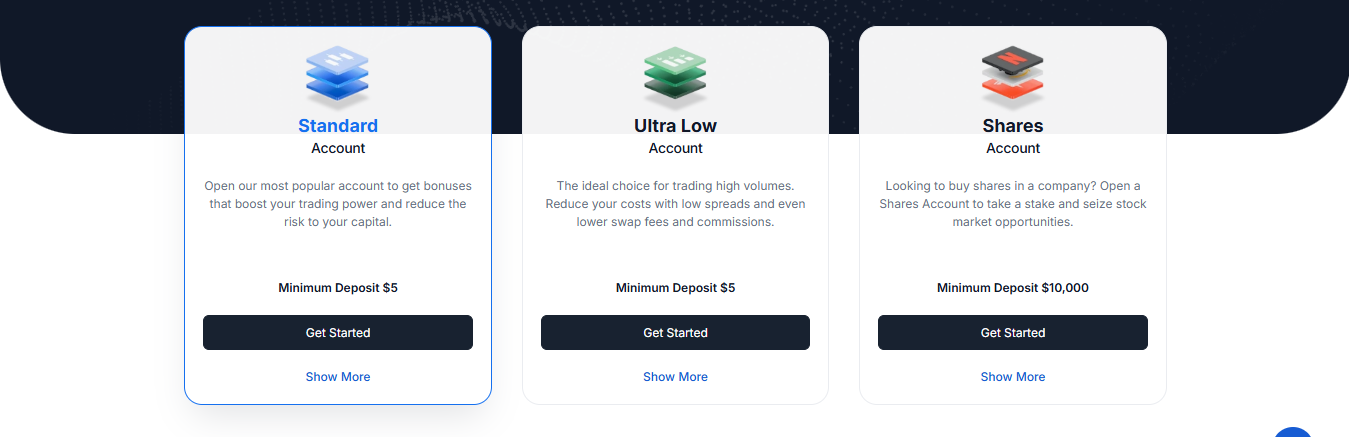
Account Tiers Compared
Account Feature |
IC Markets Raw Spread |
IC Markets Standard |
XM Standard |
XM Ultra Low |
XM Shares |
|---|---|---|---|---|---|
Minimum Deposit |
$200 |
$200 |
$5 |
$5 |
$10,000 |
Spreads From |
0.0 pips |
1.0 pips |
1.6 pips |
0.8 pips |
Variable |
Commission |
$7 per lot (round turn) |
No commission |
No commission |
No commission |
Commission per trade |
Base Currency |
USD, EUR, GBP, AUD, NZD, CAD, SGD, CHF, HKD, JPY |
Same as Raw |
USD, EUR, GBP, JPY |
Same as Standard |
USD |
Lot Sizes |
0.01 – 100 lots |
0.01 – 100 lots |
0.01 – 50 lots |
0.01 – 50 lots |
1 share minimum |
Instruments |
2,250+ |
2,250+ |
Forex, Metals, Indices, Crypto, Stocks, Commodities |
Forex, Metals, Indices, Crypto, Stocks, Commodities |
Shares only |
Swap-Free Option |
Available on request |
Available on request |
Available |
Available |
Not available |
Demo Account |
Unlimited |
Unlimited |
Unlimited |
Unlimited |
Unlimited |
Platforms |
MT4, MT5, cTrader |
MT4, MT5, cTrader |
MT4, MT5 |
MT4, MT5 |
MT5 |
Bonus Eligibility |
No bonuses |
No bonuses |
Eligible |
Not eligible |
Not eligible |
Maximum Leverage |
500:1 |
500:1 |
1000:1 |
1000:1 |
1:1 |
Additional Account Considerations: IC Markets vs XM
Account flexibility often determines how easily traders can start, scale, or specialize their strategies. IC Markets focuses on professional-grade conditions with universal access, while XM lowers entry barriers for new traders through micro trading options and small minimum deposits.
IC Markets
This broker keeps its account structure simple yet powerful, offering equal conditions to all clients regardless of deposit size.
Highlights:
-
Minimum Deposit: $200 across all accounts — accessible, but aimed at traders with some starting capital.
-
Account Types:
-
Raw Spread Account: Ultra-tight spreads with commission per lot.
-
Standard Account: Commission-free trading with slightly wider spreads.
-
-
Market Access: Both accounts unlock the full 2,250+ instruments from the first day.
-
Equal Treatment: A $200 account gets the same pricing, execution speed, and liquidity as a $100,000 account.
-
Islamic (Swap-Free) Accounts: Available by request after verifying religious eligibility.
-
Professional Account (EU only): Offers up to 1:500 leverage if clients meet two of three MiFID II criteria:
-
€500,000+ portfolio,
-
40+ significant trades per quarter, or
-
Financial industry experience.
-
IC Markets’ structure rewards experience and professionalism rather than deposit size, appealing to active traders who value consistency and transparency.
XM
XM stands out for its accessibility and range, offering low-cost trading options for beginners and specialized accounts for professionals.
Highlights:
Minimum Deposit: Just $5 for Standard and Ultra Low accounts, making XM one of the most affordable regulated brokers.
Account Types:
-
Standard Account: Ideal for regular traders seeking commission-free trading and access to all major markets.
-
Ultra Low Account: Designed for active traders; features tighter spreads and reduced swap fees, with no commission.
-
Shares Account: Tailored for stock investors; requires a $10,000 minimum deposit and offers direct share trading at 1:1 leverage.
Trading Conditions:
All accounts support negative balance protection, hedging, and Islamic (swap-free) options.
Bonuses:
Bonuses apply to eligible accounts depending on region, but profit withdrawals remain unrestricted.
XM’s low deposit requirement, flexible account structure, and transparent pricing make it a practical choice for traders at every level.
Trading Costs
Trading costs determine your break-even point on every trade and directly impact profitability, especially for active traders. The IC Markets vs XM cost comparison reveals dramatically different pricing models:
Spreads and Commissions
Instrument |
IC Markets Raw Spread |
IC Markets Raw Total Cost* |
IC Markets Standard |
XM Standard |
XM Ultra Low |
XM Ultra Total Cost* |
|---|---|---|---|---|---|---|
EUR/USD |
0.0-0.1 pips |
0.7-0.8 pips |
1.0 pips |
0.7 pips |
0.1 pips |
0.8 pips |
GBP/USD |
0.2-0.4 pips |
0.9-1.1 pips |
1.2 pips |
0.9 pips |
0.3 pips |
1.0 pips |
USD/JPY |
0.1-0.2 pips |
0.8-0.9 pips |
1.1 pips |
0.8 pips |
0.2 pips |
0.9 pips |
AUD/USD |
0.1-0.3 pips |
0.8-1.0 pips |
1.2 pips |
0.9 pips |
0.3 pips |
1.0 pips |
Gold (XAU/USD) |
0.8-1.2 pips |
1.5-1.9 pips |
2.0 pips |
3.0 pips |
1.5 pips |
2.2 pips |
US30 (Dow) |
1.0 points |
1.7 points |
2.5 points |
3.0 points |
2.0 points |
2.7 points |
BTC/USD |
10-20 pips |
17-27 pips |
35 pips |
50 pips |
28 pips |
35 pips |
EUR/GBP |
0.3-0.5 pips |
1.0-1.2 pips |
1.5 pips |
1.2 pips |
0.5 pips |
1.2 pips |
*Total cost includes commission converted to pips ($7 per lot = ~0.7 pips on majors; $3.50 per lot = ~0.35 pips)
Cost Analysis by Trading Style:
For traders executing 100 lots monthly on EUR/USD, IC Markets Raw Spread costs approximately $770 in total fees (0.1 pip spread + $7 commission × 100 lots), while XM Standard costs $700 (0.7 pip spread × 100 lots). However, on less liquid pairs like EUR/GBP, IC Markets maintains its tight 0.3-0.5 pip raw spread plus commission (total ~1.0-1.2 pips) compared to XM’s 1.2 pip standard spread, creating virtual parity.
The real cost difference emerges in exotic pairs and commodities. IC Markets’ Raw Spread account typically offers 30-40% tighter spreads on gold, silver, and oil compared to XM Standard. For example, gold spreads during London session average 1.2 pips on IC Markets versus 3.0 pips on XM Standard—a $180 difference per 10 lots traded.
Hidden Fees to Watch
IC Markets:
- No inactivity fees – Account remains active indefinitely without trading
- No deposit fees – All deposit methods processed without charge
- Withdrawal fees – Free for bank wire (first withdrawal monthly), $10 for subsequent bank wires; no fees for credit/debit cards or e-wallets
- Currency conversion – 0.5% markup on non-base currency deposits (e.g., depositing EUR into USD account)
- Swap rates – Competitive rates typically 20-30% better than industry average; triple swap on Wednesdays
- Data fees – No platform or market data fees
XM:
- Inactivity fee – No fees regardless of account dormancy
- No deposit fees – All methods processed free of charge
- No withdrawal fees – Zero fees on all withdrawal methods including bank wire
- Currency conversion – 0.3-0.5% markup on cross-currency transactions
- Swap rates – Standard industry rates, less competitive than IC Markets on major pairs
- Bonus terms – Welcome bonus locked until generating 3x trading volume in micro lots; withdrawing before meeting requirements forfeits bonus
Cost Example for Active Scalper:
A scalper trading 200 lots monthly on EUR/USD:
- IC Markets Raw: (0.1 pip × 200 lots) + ($7 × 200) = $1,420 total cost
- XM Standard: 0.7 pips × 200 lots = $1,400 total cost
- XM Ultra Low: (0.1 pip × 200 lots) + ($3.50 × 200) = $720 total cost
XM’s Ultra Low account actually delivers 49% lower costs than IC Markets Raw for high-volume traders on major pairs, though IC Markets maintains advantages on less-liquid instruments where its ECN infrastructure provides tighter institutional spreads.
🏆 Winner: Tie (Context-Dependent) – IC Markets wins for traders focused on exotic pairs, commodities, and indices where raw spreads matter most. XM wins for high-volume scalpers trading majors who benefit from the Ultra Low account’s 50% lower commission structure.
Available Instruments
Between IC Markets and XM, both provide broad market access—but IC Markets clearly leads in range, depth, and execution quality across nearly every asset class.
Forex Pairs
IC Markets:
-
61 forex pairs, including majors, minors, and rare exotics like USD/CNH, USD/SEK, and EUR/TRY.
-
True ECN execution with zero dealing desk interference.
-
Competitive swap rates—some pairs (like AUD/TRY and EUR/ZAR) even offer positive carry.
-
Early Sunday open at 22:00 GMT, giving traders a head start.
XM:
-
55 pairs—covers all majors and most minors, but lacks several exotics such as USD/CNH and USD/SEK.
-
Execution strong on majors, though spreads widen slightly during news events.
-
Swap rates competitive but generally 10–15% less favorable than IC Markets.
Indices
IC Markets:
-
26 indices covering global and regional markets, including US30, NAS100, GER40, CHINA50, and INDIA50.
-
Spreads from 0.6 points (US30) and 0.7 (NAS100).
-
Offers both cash and futures indices, giving flexibility in rollover strategies.
-
Extended trading hours, with some indices available 24/5.
XM:
-
24 indices covering major regions but missing niche ones like CHINA50 and INDIA50.
-
US30 spreads: ~3.0 points (Standard), ~2.0 (Ultra Low)—wider than IC Markets.
-
Cash indices only (no futures option).
-
Similar dividend adjustment method to IC Markets.
Commodities
IC Markets:
-
26 commodities including metals, energies, and softs (coffee, sugar, cocoa, wheat, corn, soybeans).
-
Gold spreads from 0.8 pips—among the industry’s lowest.
-
Supports both spot and futures commodities.
-
Rare inclusion: Copper (HG).
XM:
-
Only 8 commodities—mainly metals and energies (no agriculture).
-
Gold spreads around 3.0 pips on Standard accounts.
-
Spot-only trading with limited diversification.
₿ Cryptocurrencies
IC Markets:
-
21 crypto pairs including BTC, ETH, LTC, XRP, ADA, DOT, LINK, XLM, UNI.
-
Spreads: BTC/USD from 10–20 pips, leverage up to 1:5.
-
24/7 crypto trading.
-
Competitive swaps despite volatility.
XM:
-
5 crypto pairs only—BTC, ETH, LTC, XRP, BCH.
-
BTC/USD spreads ~50 pips (2.5–5× wider than IC Markets).
-
Leverage up to 1:250, but limited choice and liquidity.
Stocks & ETFs

IC Markets:
-
2,100+ stock CFDs from US, UK, EU, and Australia.
-
Popular names: Apple, Tesla, Amazon, Microsoft, Google, plus thousands of mid-caps.
-
Commissions:
-
US: $0.02/share (min $2)
-
UK: 0.10% (min £10)
-
EU: 0.10% (min €10)
-
-
150+ ETFs (SPY, QQQ, sector ETFs).
XM:
-
1,300+ stocks mainly from US and EU (no AU exposure).
-
Commission-free, but spreads are wider (e.g., AAPL = $0.15 spread).
-
Lacks ETFs—users rely on indices instead.
Quick Comparison: Market Coverage
Asset Class |
IC Markets |
XM |
|---|---|---|
Forex Pairs |
61 (majors, minors, exotics) |
55 (majors & minors) |
Indices |
26 (cash & futures) |
24 (cash only) |
Commodities |
26 (metals, energies, softs) |
8 (metals, energies only) |
Cryptocurrencies |
21 pairs |
5 pairs |
Stocks |
2,100+ (US, UK, EU, AU) |
1,300+ (US & EU only) |
ETFs |
150+ |
None |
Market Hours |
Extended / 24/7 for crypto |
Standard hours + 24/7 crypto |
🏆 Winner: IC Markets – The instrument advantage is overwhelming: 2,250+ markets versus XM’s 1,000+, representing more than double the trading opportunities.
Leverage and Margin
Both brokers offer leverage that varies dramatically based on your regulatory jurisdiction, account type, and the instruments you trade.
Leverage Limits by Region and Account Type
Region/Entity |
IC Markets Max Leverage |
XM Max Leverage |
|---|---|---|
ASIC (Australia) – Retail |
1:30 (majors), 1:20 (non-majors), 1:10 (commodities), 1:5 (stocks), 1:2 (crypto) |
1:30 (majors), 1:20 (non-majors), 1:10 (commodities), 1:5 (stocks), 1:2 (crypto) |
CySEC (EU) – Retail |
1:30 (majors), 1:20 (non-majors), 1:10 (commodities), 1:5 (stocks), 1:2 (crypto) |
1:30 (majors), 1:20 (non-majors), 1:10 (commodities), 1:5 (stocks), 1:2 (crypto) |
ASIC – Professional |
1:500 |
1:400 |
CySEC – Professional |
1:500 |
1:400 |
FSA Seychelles (IC Markets) |
1:500 (all instruments) |
N/A |
FSC Belize (XM Global) |
N/A |
1:1000 (forex), 1:500 (gold), 1:100 (indices), 1:50 (energies), 1:20 (stocks), 1:2 (crypto) |
Tiered Leverage by Balance |
No balance-based restrictions |
Reduces to 1:200 above $20,000, 1:100 above $100,000 |
Detailed Leverage Analysis
Leverage determines how much market exposure you can control relative to your deposited capital—and both IC Markets and XM take distinctly different approaches. While IC Markets emphasizes consistency and transparency, XM focuses on flexibility and accessibility—especially for small traders.
IC Markets
-
Uniform 1:500 leverage for all clients under the Seychelles entity (FSA)—whether your account is $500 or $500,000.
-
Creates predictable margin requirements, ensuring your leverage doesn’t change as your account grows.
-
Professional clients under ASIC or CySEC can access up to 1:500 leverage only after meeting two of three eligibility criteria:
-
Financial portfolio exceeding €500,000
-
40+ significant trades per quarter
-
Proven financial industry experience
-
-
No ad-hoc leverage reductions during volatile markets—though margin temporarily rises 200% before major economic releases (e.g., NFP or CPI).
-
Ideal for: professional and algorithmic traders who rely on consistent, high leverage without surprises.
XM
-
Maximum leverage of 1:1000 offered under XM Global Limited (Belize)—a strong appeal for small-account traders seeking higher capital efficiency.
-
Dynamic leverage adjustment based on account equity:
-
≤ $20,000: up to 1:1000
-
$20,001–$100,000: up to 1:200
-
> $100,000: capped at 1:100
-
-
This structure helps limit risk but can disrupt strategy consistency—a growing account faces reduced leverage and higher margin requirements.
-
Leverage reductions also apply during extraordinary volatility (e.g., geopolitical shocks, pandemic events) to minimize negative balance risks.
-
Ideal for: small-cap traders, scalpers, and beginners using tight stop strategies.
Leverage by Instrument Comparison:
Instrument |
IC Markets (Seychelles) |
XM (Belize) |
IC Markets (ASIC/CySEC) |
XM (CySEC) |
|---|---|---|---|---|
Major Forex |
1:500 |
1:1000 |
1:30 |
1:30 |
Minor Forex |
1:500 |
1:1000 |
1:20 |
1:20 |
Exotic Forex |
1:500 |
1:1000 |
1:20 |
1:20 |
Gold |
1:500 |
1:500 |
1:10 |
1:10 |
Silver |
1:500 |
1:400 |
1:10 |
1:10 |
Oil |
1:500 |
1:100 |
1:10 |
1:10 |
Indices |
1:500 |
1:100-200 |
1:20 |
1:20 |
Stocks |
1:20 |
1:20 |
1:5 |
1:5 |
Crypto |
1:5 |
1:2-5 |
1:2 |
1:2 |
Margin Call and Stop Out Levels:
Both brokers implement margin call warnings and automatic stop-out to prevent negative balances. IC Markets issues margin call warnings at 100% margin level and begins closing positions at 50% margin level (stops out least profitable positions first). XM triggers margin calls at 50% and stops out positions at 20%—a significantly more aggressive approach giving traders less buffer before forced liquidation. This means XM traders face position closures sooner during adverse price movements, even though XM advertises higher maximum leverage.
Example:
Trading 1 standard lot EUR/USD ($100,000 position):
- IC Markets (1:500): Requires $200 margin
- XM (1:1000): Requires $100 margin
- Both under ASIC (1:30): Requires $3,333 margin
The 1:1000 leverage sounds impressive but actually provides minimal practical advantage over 1:500 for most traders. A $10,000 account can control $10 million at 1:1000 or $5 million at 1:500—both represent excessive leverage likely to result in account blowout. The real leverage benefit appears for undercapitalized traders: a $500 account can properly trade 0.1 lots with 1:1000 ($50 margin) but faces tight constraints at 1:500 ($100 margin).
🏆 Winner: XM (International Accounts Only) – XM’s 1:1000 maximum leverage beats IC Markets’ 1:500 for international clients seeking maximum capital efficiency, though both figures exceed what prudent risk management would typically utilize.
Deposits and Withdrawals
XM and IC Markets support multiple payment methods, but processing speeds, fee structures, and regional availability create distinct advantages depending on your location and banking preferences.
Payment Methods
Method |
 |
 |
|---|---|---|
Bank Wire Transfer |
Fee: $0 (first monthly), $10 thereafter Min: $200 Processing: 1–5 business days |
Fee: $0 Min: $5 Processing: 2–5 business days |
Credit/Debit Card |
Visa, Mastercard Fee: $0 Min: $200 Processing: Instant deposits, 1–3 days withdrawals |
Visa, Mastercard, Maestro Fee: $0 Min: $5 Processing: Instant deposits, 24 hours withdrawals |
Skrill |
Fee: $0 Min: $200 Processing: Instant both ways |
Fee: $0 Min: $5 Processing: Instant both ways |
Neteller |
Fee: $0 Min: $200 Processing: Instant both ways |
Fee: $0 Min: $5 Processing: Instant both ways |
PayPal |
Not supported |
Not supported |
PayTrust88 |
Available for Asian clients Fee: $0 Processing: Instant |
Not available |
FasaPay |
Available for Indonesian clients Fee: $0 Processing: Instant |
Not available |
Crypto (BTC, ETH, USDT) |
Not supported |
Not supported |
UnionPay |
Available for Chinese clients Fee: $0 Processing: 1–2 days |
Available Fee: $0 Processing: 1–2 days |
Local Bank Transfer |
Available in 40+ countries Processing varies by region |
Available in 50+ countries Processing varies by region |
Perfect Money |
Fee: $0 Processing: Instant |
Not available |
Sticpay |
Available for Asian clients Fee: $0 Processing: Instant |
Not available |
Processing Times and Procedures
Both IC Markets and XM process payments swiftly, but their speed, policies, and regional support differ significantly.
IC Markets:
Deposit Processing
-
Instant funding for e-wallets (Skrill, Neteller, PayTrust88) and cards once payment processors confirm receipt.
-
Bank wires: 1–5 business days depending on intermediary banks and your country.
-
Verification: ID and address proof required before first deposit — typically reviewed within 24 hours.
-
Accepted base currencies (10+): USD, EUR, GBP, AUD, NZD, CAD, SGD, CHF, HKD, JPY.
-
Deposits in non-base currencies incur a 0.5% conversion markup.
Withdrawal Processing
-
Strict same-source policy for AML compliance: funds return to the original deposit method.
-
Example: If you deposited $1,000 via card and $500 via Skrill, the first $1,000 in withdrawals must go back to the card.
-
-
Bank wires: Processed within 1–2 business days; first withdrawal each month is free, then $10 per wire.
-
E-wallets: Processed within 24 hours, always fee-free.
-
Holding policy: 30-day lock on wire and card deposits before withdrawing via alternative methods.
-
Minimum withdrawal: $50 for bank wires; no minimum for e-wallets.
Regional Support
-
Asia-Pacific: Access to PayTrust88, FasaPay, Sticpay, Perfect Money.
-
Australia: NPP (New Payments Platform) transfers settle in under 60 seconds.
-
Europe: SEPA transfers complete within 1 business day.
-
Middle East & Africa: Local bank transfer support, though limited options for African regions.
XM:
Deposit Processing
-
Instant funding for cards and e-wallets — usually confirmed within 30 seconds.
-
Bank wires: 2–5 business days, depending on local banks.
-
Verification: Typically completed in 1–2 hours during business hours — faster than IC Markets.
-
Accepted currencies: All major ones; automatic conversion with only 0.3–0.5% markup, slightly cheaper than IC Markets.
Withdrawal Processing
-
Same-source policy applies, ensuring compliance with anti-money laundering rules.
-
Card withdrawals: Completed within 24 hours, much faster than IC Markets’ 1–3 days.
-
E-wallets: Process within minutes to 24 hours.
-
Bank wires: 2–5 business days after processing.
-
Bonuses: While bonus credit can’t be withdrawn, profits and deposits can, without forfeiting bonus balance (if maintaining 30% equity ratio).
-
Fees: XM charges no withdrawal fees on any method or frequency.
-
Minimums: $5 for e-wallets, $50 for bank wires.
-
Availability: Processes withdrawals 7 days per week, unlike IC Markets (weekdays only).
Regional Support
-
Africa & Latin America: Extensive local partnerships across 50+ countries.
-
Nigeria: Direct local deposits via GTBank, Zenith Bank, and others — no conversion fees.
-
Brazil: Boleto and BRL bank transfers supported.
-
Middle East: AED deposits supported via Dubai banks under XM’s DFSA license.
Quick Comparison
|
|
|
|---|---|---|
Deposit Speed (Cards/E-wallets) |
Instant (after processor confirmation) |
Instant (within 30 seconds) |
Bank Wire Deposits |
1–5 business days |
2–5 business days |
Verification Time |
~24 hours |
1–2 hours |
Currency Conversion Markup |
0.5% |
0.3–0.5% |
Withdrawal Processing (Cards) |
1–3 business days |
Within 24 hours |
E-wallet Withdrawals |
Within 24 hours |
Minutes to 24 hours |
Bank Wire Withdrawals |
1–2 business days (broker side) |
2–5 business days |
Withdrawal Fees |
Free first wire/month, then $10 |
Always free |
Processing Days |
Weekdays only |
7 days/week |
Regional Options |
Asia-Pacific strong |
Africa & Latin America strong |
🏆 Winner: XM – The $5 minimum deposit crushes IC Markets’ $200 requirement for accessibility, while zero withdrawal fees on all methods beat IC Markets’ $10 bank wire charges. XM’s faster card and e-wallet withdrawal processing (24 hours vs 1-3 days) provides better liquidity access.
Customer Support
The IC Markets vs XM support comparison reveals different philosophies: IC Markets prioritizes depth of technical expertise, while XM focuses on multilingual accessibility and response volume capacity.
Support Comparison
|
|
|
|---|---|---|
Availability |
24/5 (Sunday 22:00 GMT – Friday 22:00 GMT) |
24/5 (Sunday 22:00 GMT – Friday 22:00 GMT) |
Live Chat |
Yes, 24/5 with average 2-minute response time |
Yes, 24/5 with average 1-minute response time |
Phone Support |
Yes, 11 international numbers including AU, UK, EU, Asia toll-free |
Yes, 30+ international numbers covering more regions |
Email Support |
support@icmarkets.com – 4-8 hour response time |
support@xm.com – 2-4 hour response time |
Languages |
12 languages (English, Chinese, Spanish, Arabic, Thai, Vietnamese, Indonesian, Korean, Japanese, Hindi, Malay, Portuguese) |
30+ languages including rare options like Swahili, Farsi, Turkish, Polish |
Local Offices |
4 offices (Sydney, Limassol, Nassau, Seychelles) |
17 offices globally including Cyprus, Australia, Dubai, Belize, and regional hubs |
Social Media |
||
Dedicated Account Manager |
Available for accounts with $50,000+ |
Available for accounts with $100,000+ |
Technical Support |
Separate technical team for platform issues |
Integrated support handling all issues |
Educational Webinars |
Weekly webinars for active clients |
Daily webinars in multiple languages |
🏆 Winner: XM – The combination of faster response times (1 minute vs 2-3 minutes live chat, 2-4 hours vs 4-8 hours email), superior multilingual coverage (30+ vs 12 languages), and broader regional accessibility (17 offices vs 4) gives XM the edge for most traders.
Education and Research
The XM vs IC Markets comparison on education reveals dramatically different philosophies. IC Markets focuses on providing strong trading infrastructure for self-directed traders, while XM invests heavily in developing trader knowledge through structured learning, research tools, and live mentorship.
IC Markets Educational Resources
-
Trading Guides: About 40 articles covering forex fundamentals, technical and risk basics. Professionally written but generic—similar to what’s freely available across major finance sites.
-
Video Tutorials: Around 15–20 short videos explaining MT4, MT5, and cTrader usage. Clear production, but only covers basic operations—no advanced trading or strategy development.
-
Webinars: Weekly sessions hosted by third-party analysts. Content ranges from market outlooks to technical reviews, but timing favors Asia-Pacific time zones, limiting global accessibility. No structured learning series.
-
Market Analysis: Daily/weekly updates offering solid but standard insights into major pairs and economic events. No proprietary indicators or in-house trade ideas.
-
Trading Calculators: Full suite of pip, margin, profit, Fibonacci, pivot point, and position size calculators—accurate and user-friendly.
-
Economic Calendar: Standard ForexFactory feed integration showing major events. Functional but lacks educational context or analysis.
-
Beginner Resources: Minimal “Getting Started” guide for account setup and funding. No structured course or progression path.
-
Advanced Materials: Almost nonexistent—no algorithmic trading courses, backtesting, or portfolio management guides.
What’s Missing
-
No trading competitions or community engagement.
-
No mentorship or certification programs.
-
Feels more like a compliance checkbox than a genuine learning ecosystem.
XM Educational Resources
-
XM Education Center: Over 200 structured articles split into Beginner, Intermediate, and Advanced levels. Covers everything from market basics to trading psychology and strategy implementation. Includes interactive quizzes—a feature IC Markets lacks.
-
Video Tutorials: More than 100 videos ranging from 5-minute quick tips to 30-minute in-depth lessons. Organized by skill level and trading topic with consistently high production quality.
-
Webinars: Daily, multilingual sessions led by in-house analysts, not freelancers. Topics cover market analysis, trading psychology, and strategy application. Archived recordings allow anytime learning.
-
Structured Programs: Includes themed webinar series such as “10 Days of Trading” and a full 8-week “Learn to Trade” course with assignments and certificates—rare among forex brokers.
-
One-on-One Coaching: Personalized coaching for active clients to review performance, identify errors, and improve execution. Available in 20+ languages—completely absent from IC Markets.
-
Market Research: Professional-grade daily and weekly reports from XM’s internal research team, plus video outlooks from senior analysts. Rich macro and micro-level insight.
-
Trading Signals: Free Telegram channel sharing trade setups with defined entry, stop loss, and take-profit points—supporting practical learning.
-
Economic Calendar: Enhanced, color-coded event tracker with educational explanations about why events matter and typical market reactions.
-
Calculators & Tools: Same tools as IC Markets plus a currency converter and combined calculator for multi-step calculations.
-
Trading Central Integration: Free institutional-level research platform with pattern recognition, trade setups, and expert commentary—normally paid software.
-
Demo Competitions: Regular $50K–$100K demo contests offering up to $20K prizes, encouraging risk-free learning with real incentives.
-
Seminars & Events: In-person educational seminars across 40+ countries—rare post-COVID continuation.
Advanced Materials
-
Algorithmic trading tutorials (MQL4/MQL5), backtesting and optimization guides.
-
Behavioral finance and trading psychology content matching paid course depth.
🏆 Winner: XM
XM dominates educational value, offering one of the most complete learning ecosystems among retail brokers. Its tiered structure, interactive lessons, and personalized coaching transform education from an afterthought into a client retention engine.
Trustpilot Reviews
Trustpilot reviews reveal that both IC Markets and XM maintain strong reputations and rank within the top 20% of forex brokers on Trustpilot.
Trustpilot Score |
Total Reviews (as of Oct 2025) |
1-Star Reviews (%) |
Overall Reputation |
|
|---|---|---|---|---|
|
⭐ 4.5 / 5 |
7,842 |
5% |
Among the top-rated brokers with high client satisfaction and strong service reliability |
|
⭐ 4.2 / 5 |
13,147 |
6% |
Well-regarded globally, praised for accessibility and support, though some users note mixed experiences with withdrawals |
🏆 Winner: IC Markets (Slight Edge) – The 4.5 versus 4.2 rating, higher percentage of 5-star reviews (79% vs 73%), and more technically sophisticated positive feedback give IC Markets a narrow advantage.
Final Verdict: Which Should You Choose, IC Markets or XM
The IC Markets versus XM comparison reveals two excellent brokers serving different trader segments, making the “better” choice entirely dependent on your experience level, trading style, and priorities.
Choose IC Markets If:
-
You’re an experienced trader who values execution speed, tight spreads, and professional-grade trading conditions over beginner-friendly extras. The $200 minimum deposit quickly pays off in performance quality.
-
You scalp or day trade actively (20+ trades weekly), saving an estimated $100–$500+ per month with IC Markets’ 0.0–0.4 pip raw spreads, easily offsetting the higher initial deposit.
-
You prefer the cTrader platform for its advanced order types, depth of market visibility, and algorithmic support through cAlgo—a powerful edge unavailable on XM’s MetaTrader-only setup.
-
You want access to broader markets, including agricultural commodities (coffee, sugar, cocoa, wheat), altcoins beyond the top 5, and mid-cap stocks, leveraging IC Markets’ 2,250+ instruments versus XM’s ~1,000.
-
You manage larger balances ($5,000+) and appreciate perks like free VPS hosting for low-latency connections and consistent 1:500 leverage regardless of account growth.
Choose XM If:
- You’re a beginner who needs comprehensive learning support—structured courses, daily webinars, one-on-one coaching, and multilingual assistance. XM’s educational ecosystem delivers what many pay hundreds for elsewhere.
- You’re starting with limited capital ($5–$200) and want to begin trading immediately. XM’s $5 minimum deposit and micro-lot trading (0.01 lots) make real trading accessible without saving up.
- You’re a low-volume trader (fewer than 10 trades weekly), where XM’s 0.7 pip EUR/USD spread costs roughly $70 monthly per 10 lots—virtually the same as IC Markets after commissions.
- You prioritize payment convenience, with instant deposits, 24-hour card withdrawals, zero withdrawal fees, and local payment options across Africa, Latin America, and Asia.
- You like bonus incentives, such as welcome and loyalty bonuses that add up to $500 extra trading capital—ideal if you plan to trade actively and meet the 3× volume requirement.
Compare also!
Eightcap vs IC Markets (2025): We Tested Both—Here’s What We Found
Forex.com vs Eightcap: Which Broker Wins in 2025?
Exness vs HFM: Which Forex Broker Is Better For You In 2025?
Octa vs Exness: Read This Before Choosing Your Forex Broker
❓ Frequently Asked Questions
Are IC Markets and XM regulated and safe to trade with?
Yes. Both are well-regulated and considered safe. IC Markets is licensed by ASIC (Australia), CySEC (Cyprus), FSA (Seychelles), and SCB (Bahamas). XM is licensed by ASIC, CySEC, DFSA (Dubai), and FSC (Belize). Both segregate client funds, provide negative balance protection, and undergo external audits. IC Markets has stronger banking partners and $50 million insurance, while XM has broader global coverage and strong financial backing.
Which broker has lower trading costs — XM or IC Markets?
IC Markets generally offers lower costs for most instruments, especially gold, indices, and exotic pairs. XM’s Ultra Low account can be cheaper for high-volume traders focusing on major forex pairs. For everyday trading, IC Markets tends to provide better overall value, while XM suits scalpers trading large volumes.
Which one can I start with less money — IC Markets or XM?
XM is far more accessible with a $5 minimum deposit compared to IC Markets’ $200. XM also offers micro-lot trading and bonuses that help small accounts get started. IC Markets is better suited for traders starting with at least $500–$1,000 who want stronger trading conditions.
Which trading platform is better for beginners — XM or IC Markets?
XM is easier for beginners, offering a simpler app, built-in education, and quick customer support. IC Markets provides more advanced tools like cTrader and faster execution, which are better for experienced traders. Beginners usually learn faster with XM, while professionals often prefer IC Markets.
Who makes deposits and withdrawals easier — IC Markets or XM?
XM is faster and more convenient for most users. It allows $5 deposits, has no withdrawal fees, supports local payment options in many countries, and processes e-wallet withdrawals within hours. IC Markets handles bank wires slightly faster but charges small withdrawal fees and has fewer local payment options.