Tangem vs Ledger Nano S Plus: Which One Should You Pick?
Tangem vs. Ledger Nano S Plus—you’ve heard both names, but what makes them different? Whether you care more about ease of use, strong security, or backing up your crypto safely, this comparison clears up Reddit rumors, and shows which one fits your needs best in 2025—especially if you’re just getting started.
Before diving deeper, here’s a side-by-side snapshot of what each wallet brings to the table. This quick glance can help you spot some major differences right away:
Tangem
Ledger Nano S Plus
Price
From $54.90 (2-card set)
$79
Design
Slim NFC-enabled smart card
USB-C stick with screen and buttons
Security Certification
EAL6+ (Samsung chip)
EAL6+ (ST chip), ANSSI CSPN
Backup Method
Multiple cards or optional seed phrase
24-word seed phrase (+ optional Ledger Recover)
Setup Time
1–3 minutes via app
~10 minutes via Ledger Live
Battery
No
No
Connectivity
NFC with smartphones (iOS & Android)
USB-C (Android & Desktop only)
Supported Assets
6,000+ coins & tokens
5,500+ coins & NFTs
App Support
Tangem App (open source, private)
Ledger Live + 50+ third-party wallets
From this table, one thing becomes clear: these wallets were built for very different kinds of users. Tangem leans into mobility and simplicity, while Ledger prioritizes functionality and ecosystem depth.
What is Tangem Wallet?
Tangem Wallet is a Swiss-designed hardware wallet launched in 2018, built to be as simple as a bank card and just as secure. As a cold wallet, it stores your private keys entirely offline, using a secure chip that never exposes your credentials—not even to your phone.
Unlike hot wallets that stay connected to the internet and are vulnerable to hacks, Tangem offers air-gapped security with the ease of tap-and-go access via NFC. It requires no screen, no cables, and no charging—just tap it on your phone to sign transactions.
Tangem wallets come in black, orange, and light blue, giving you a modern, minimalist choice that fits your style. It’s ideal for beginners who want top-tier security without the learning curve. If you’re curious about how Tangem performs in the real world, check out our full Tangem wallet review for an in-depth breakdown.
What is Ledger Nano S Plus?
The Ledger Nano S Plus is a French-made hardware wallet released by Ledger in 2022, evolving from the popular Nano S to offer more storage, a larger screen, and support for thousands of coins and NFTs.
As a cold wallet, it keeps your crypto keys completely offline, shielding your assets from online threats and phishing attacks that plague hot wallets and exchanges. Its built-in OLED screen and physical buttons ensure you confirm every transaction securely—no blind signing.
Unlike Tangem, the Ledger Nano S Plus connects via USB-C to your phone or computer and offers a more hands-on experience. It comes in a variety of sleek colors including matte black, Sapphire Blue, Emerald Green, and BTC orange, allowing a bit of personality with your security. To see how this device stacks up in daily use and what sets it apart from competitors, dive into our complete Ledger Nano S Plus review.
Tangem vs. Ledger Nano S Plus: Design & Build Quality
Now let’s talk physical design—because how your wallet looks, feels, and holds up in the real world plays a bigger role than most people think.
The Tangem Wallet is truly in a league of its own when it comes to portability. It’s the size of a credit card, just 1mm thin, and weighs about 6 grams—meaning it slips into your pocket or wallet like it was meant to be there. No ports, no batteries, no screens—just a secure chip embedded in a flexible, waterproof, and dust-resistant card. It’s also resistant to X-rays, magnetic fields, and even extreme temperatures. Whether you’re traveling light or just don’t want to deal with cables and charging, Tangem’s design makes it ridiculously convenient to carry and use anywhere.
The Ledger Nano S Plus, by contrast, goes for a more traditional hardware wallet look. It’s a bit bulkier at 21g, with a plastic body encased in a brushed stainless steel swivel—giving it that signature “USB stick” feel. The OLED screen and physical buttons provide tactile control for verifying transactions, which some users find more reassuring. But the trade-off? You’ll need to plug it in via USB-C whenever you use it, and it doesn’t support iOS.
So while Tangem feels like a future-proof wallet designed for everyday users, Ledger Nano S Plus offers that battle-tested, hands-on experience that veteran crypto holders have come to trust. Both are solidly built, but in very different ways—and that design choice alone could be a deciding factor depending on how you prefer to interact with your crypto.
Tangem vs. Ledger Nano S Plus: Setup & User Experience
Design aside, the setup experience is where the difference between these wallets becomes instantly obvious.
Tangem makes onboarding feel effortless. You simply tap your Tangem card on your phone, download the Tangem app, and you’re ready to go. There’s no need to write down a seed phrase, connect a cable, or worry about installing drivers. Within 2–3 minutes, your wallet is activated, and the private key is securely generated inside the chip — never exposed, never copied. This is especially great for beginners who don’t want to deal with complicated technical steps or physical backups right away.
On the flip side, Ledger Nano S Plus follows a more traditional, hands-on setup. You’ll need to connect the device to a desktop or Android smartphone using a USB-C cable, download the Ledger Live app, and manually write down a 24-word recovery phrase — a crucial step that can’t be skipped. It takes a little more time (around 10 minutes), and you’ll be using the buttons on the device to confirm everything. For users who like tactile control and visual confirmation via the built-in screen, this may feel more secure and familiar.
So whether you’re looking for something fast and mobile-friendly or a methodical, screen-based process, both wallets deliver — just in very different flavors.
Ledger Nano S Plus vs. Tangem: Security Features
No matter how smooth the setup is, security is the real deal-breaker for most users — and here’s where both wallets bring serious muscle to the table.
Tangem’s security is built on its certified Samsung S3D232A chip, offering EAL6+ certification, which is one of the highest security standards in consumer electronics. The private key is generated inside the chip using a True Random Number Generator (TRNG) and never leaves the card. You can’t extract it, export it, or even see it — making it immune to phishing, SIM swaps, or remote attacks. The card is also tamper-proof, waterproof, dust-resistant, and has no firmware update channel — meaning no attacker can push malicious code to your card after manufacturing.
Meanwhile, Ledger Nano S Plus is equally secure, but in a different way. It also uses a CC EAL6+ certified Secure Element chip (ST33K1M5) and benefits from ANSSI CSPN certification — a stamp of approval from the French cybersecurity agency. Ledger has its own operating system, Ledger OS, and requires you to confirm transactions on its physical screen, which adds an extra layer of safety. One unique advantage is the secure display, allowing you to verify exactly what you’re signing before approving.
However, there’s a fundamental difference: Ledger stores your private key based on a 24-word recovery phrase, which you must protect carefully. If someone gets access to that phrase, they could recover your funds. Tangem, by contrast, avoids exposing the key altogether by default.
Both wallets take your crypto’s safety seriously, but Tangem leans toward impenetrable minimalism, while Ledger relies on a mix of secure hardware and user control.
Backup & Recovery Options: What Happens If You Lose It?
All wallets are secure—until life happens. So the real question is: What happens if you lose your wallet?
Tangem offers one of the most intuitive and flexible backup solutions out there. If you buy a 2-card or 3-card set, each card functions like a duplicate key to the same wallet. You can use any of the remaining cards to recover access if one gets lost. No internet sync, no passwords—just tap, and you’re back in. For added peace of mind, Tangem also allows you to generate or import a seed phrase, though this is optional and not required during setup. This multi-card backup system is a game-changer for people who don’t want to rely on fragile paper phrases or cloud-based solutions.
Ledger Nano S Plus follows the old-school standard: your entire wallet is backed up using a 24-word recovery phrase. This phrase must be written down and stored offline, because if it’s lost, so are your assets. To help mitigate this risk, Ledger now offers Ledger Recover, a paid subscription service that splits your recovery phrase and stores it encrypted across secure servers. However, some users feel uneasy about this, as it introduces third-party custody—something self-custody purists try to avoid.
So here’s the breakdown: Tangem offers physical redundancy and zero exposure of your key, while Ledger relies on written backup and offers optional cloud recovery. It comes down to how you prefer to manage your risk — multiple cards you carry, or a phrase you must never forget.
Tangem vs. Ledger Nano S Plus: Coin, Token & NFT Support
Once your wallet is set up and secured, the next question is simple: Can it hold everything you own? And more importantly — can it grow with you?
Tangem Wallet supports over 6,000 cryptocurrencies, including Bitcoin, Ethereum, Solana, and just about every major token on the market. Thanks to its flexible architecture, Tangem integrates seamlessly with various blockchain providers, allowing you to buy, sell, swap, and stake many of these assets directly in-app. It’s a powerhouse in a card, and it doesn’t limit how many tokens you can manage at once — no juggling apps, no shuffling memory.
Ledger Nano S Plus, on the other hand, supports 5,500+ assets, but with a different structure. You can install up to 100 apps at once (depending on app size), meaning some users may need to uninstall and reinstall apps if they want to manage certain assets simultaneously. That said, Ledger’s third-party wallet compatibility is unmatched — over 50 wallets like MetaMask, Yoroi, and Electrum can connect with your Ledger, opening up even more asset and network access. It also offers NFT support on Ethereum and Polygon networks, directly through Ledger Live.
So if you’re focused on a clean, all-in-one interface, Tangem wins in ease. But if you want advanced ecosystem flexibility, Ledger gives you broader control.
Companion Apps & Features
Of course, a great wallet is only as good as the software it works with. And here’s where user experience really comes into play.
Tangem’s mobile app is surprisingly powerful, especially for something so minimalist. You can track prices, analyze token data, buy, sell, swap, stake, and even manage multiple wallets — all without logging in or providing personal info. There’s no cloud syncing, no hidden servers, and the app is fully open source, meaning the code has been reviewed and verified by the crypto community. The experience is lightweight, intuitive, and private — perfect for users who want a frictionless interface without giving up control.
Ledger Live, on the other hand, is a feature-rich dashboard that gives you deep insight into your assets. It supports staking, buy/sell/swap through verified providers, real-time portfolio tracking, and NFT management. It’s available on desktop and Android (sorry iOS users — Nano S Plus isn’t compatible with iPhones), and it regularly receives updates to keep the ecosystem fresh and secure. Advanced users will love the extra features, while newer users may find the interface a bit more technical at first.
So again, it boils down to this: Tangem is private, fast, and beginner-friendly, while Ledger Live is robust, detailed, and great for power users.
When it’s time to actually use your wallet — whether to sign a transaction or just check your balance — convenience matters. And in this department, the differences couldn’t be more stark.
Tangem has no battery, no wires, and no hassle. It works using NFC (Near Field Communication) — just tap the card on your smartphone, and you’re in. It supports both Android and iOS, so you’re not tied to a particular ecosystem. Because it doesn’t require charging or cables, Tangem is ideal for travelers, outdoor users, or anyone who wants a truly mobile, self-contained hardware wallet that’s always ready.
Ledger Nano S Plus, meanwhile, operates via USB-C and must be connected to a compatible device. It works with Android smartphones and desktop computers, but not with iPhones. While it doesn’t need a battery (it powers via USB), you’ll always need to carry a cable and find a physical device to plug it into. That’s not a deal-breaker for many users, but it does make on-the-go use a bit less convenient than with Tangem.
So if your goal is maximum portability with minimal setup, Tangem takes the lead. If you’re more comfortable with traditional hardware-wallet mechanics and don’t mind a cable, then Ledger is a rock-solid companion.
Tangem vs. Ledger Nano S Plus: Price & Value for Money
When it comes to choosing a hardware wallet, price can tip the scales — but only when you understand what that price includes.
Tangem starts at just $54.90 for a 2-card set, which is already a secure setup. Want extra protection? The 3-card set costs $69.90, giving you an instant built-in backup solution. There’s also a $160 Tangem Ring bundle, which includes the ring plus two cards — a wearable twist that combines form and function. No subscription fees, no upsells. And every wallet comes with free shipping above $89, a 25-year warranty, and no need to buy accessories or cables.
Ledger Nano S Plus is priced at $79, making it one of the most affordable cold wallets from a major brand. It includes the basics — wallet, USB-C cable, recovery sheets — and offers strong value for its capabilities. However, if you choose to opt into Ledger Recover (a paid cloud backup service), it comes at an extra $9.99/month. You may also need additional accessories like the OTG kit depending on how you plan to connect. Still, for what it offers — secure chip, screen-based controls, and a broad ecosystem — the Nano S Plus delivers excellent bang for your buck.
So while Ledger is now closer in price to Tangem, the deciding factor becomes how you prefer to manage recovery, mobility, and setup convenience, not just dollars and cents.
Pros & Cons
Let’s distill all this into a quick recap. Here are the standout strengths — and trade-offs — of each wallet:
Tangem Wallet
Pros:
Ultra-portable, card-sized design
No battery, no cables — works via NFC
Setup in under 3 minutes
EAL6+ secure chip with no key exposure
Optional seed phrase, multi-card backup
iOS and Android compatible
Open-source, no user data collected
25-year warranty
Cons:
No built-in screen for manual transaction verification
No desktop or browser support (mobile-only)
NFT support is limited compared to Ledger
Ledger Nano S Plus
Pros:
Trusted brand with a long-standing reputation
Built-in screen and buttons for transaction approval
Supports 5,500+ assets and 100 apps
Works with over 50 third-party wallets
Full NFT support (Ethereum and Polygon)
Ledger Live is robust and regularly updated
Cons:
Requires cable and physical connection (no NFC)
Not compatible with iPhones
Must manage and protect a 24-word seed phrase
Optional Ledger Recover introduces custodial risk
Extra costs may apply with optional services or accessories
When it comes to choosing between Tangem and Ledger Nano S Plus, Reddit users are refreshingly candid — and their insights shed light on how these wallets serve very different needs.
“With Ledger, the seed phrase never leaves the device. Tangem, by default, doesn’t use a visible seed phrase — it relies on backup cards instead.”
That design trade-off — hardware security vs. tap-and-go simplicity — is echoed by several users. Another commenter adds,
“Ledger lets you confirm transactions on the device screen. With Tangem, confirmation happens via your phone.”
Tangem vs Ledger Nano S Plus Discussion – Source: Reddit
In other words, Ledger’s screen adds a layer of visual assurance — while Tangem leans into portability and ease of use.
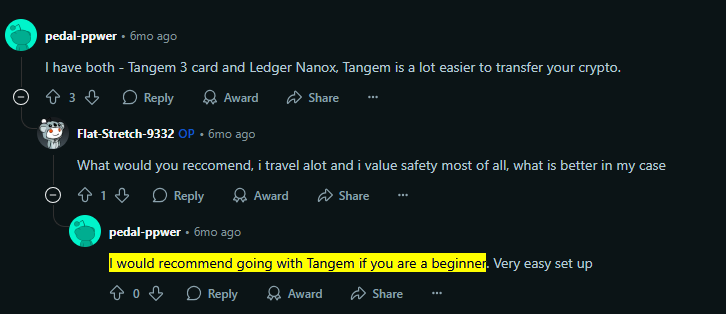
Yet simplicity has its fans. Redditor @pedal-ppwer, who owns both wallets, swears by Tangem for its beginner-friendly setup and effortless transfers.
“I would recommend going with Tangem if you are a beginner,” they write.
Tangem vs Ledger Nano S Plus Discussion – Source: Reddit
That ease becomes a big plus for travelers or on-the-go users — one even mentions using Tangem during a spontaneous in-person crypto trade because of how quickly it lets you transact without a laptop.
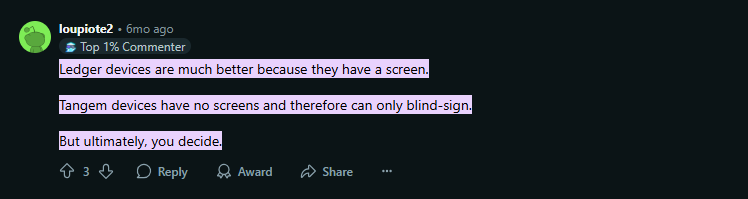
However, not everyone is sold on screenless security. @loupiote2 makes a sharp point:
“Tangem can only blind-sign. Ledger devices have a screen — that’s safer.”
Tangem vs Ledger Nano S Plus Discussion – Source: Reddit
And while hardware failure was mentioned as a downside to Ledger (more parts = more potential faults), it’s worth noting that Ledger’s durability has rarely been questioned in real-world use.
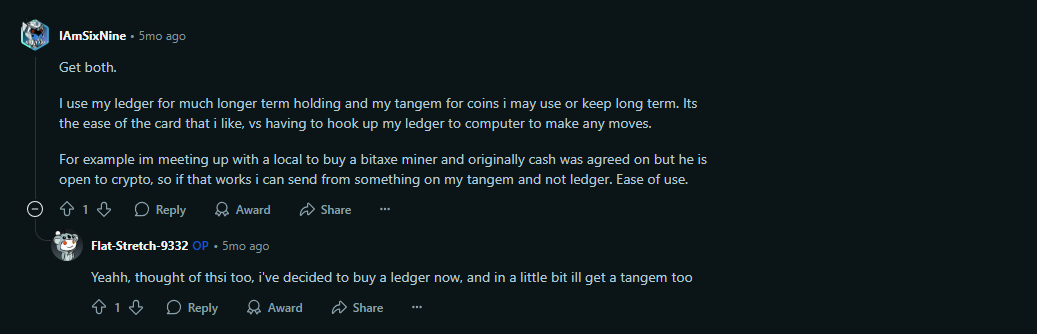
Interestingly, one Redditor @IAmSixNine took the middle ground:
“I use Ledger for long-term storage and Tangem for coins I might use.”
That hybrid approach might just be the sweet spot — cold wallet security for your vault, card-based convenience for your everyday moves. Ultimately, even the original poster landed on that strategy, deciding to start with a Ledger and add Tangem later.
Tangem or Ledger Nano S Plus: Which Wallet Suits You Best?
Still unsure? Here’s a simple way to think about it.
Choose Tangem if:
You want something easy to use and travel-friendly
You prefer not dealing with seed phrases or written backups
You value minimalism, privacy, and mobility
You’re just starting out or want to gift crypto securely
Go for Ledger Nano S Plus if:
You want fine-grained control over transactions
You manage a large portfolio with multiple chains and NFTs
You’re comfortable with a seed phrase and recovery process
You prefer a mature ecosystem with deeper third-party integrations
Both wallets are secure. The real question is: How do you prefer to interact with your crypto?
Where (and How) to Buy: Secure Your Wallet the Right Way
By now, you’ve likely figured out which wallet best suits your crypto journey — whether it’s the tap-and-go freedom of Tangem or the screen-based security of the Ledger Nano S Plus. But just as important as what you buy is where you buy it from. And in the world of crypto security, this decision should never be taken lightly.
Let’s be blunt: never buy a hardware wallet from an unverified third-party seller. Doing so opens you up to the risk of tampered devices — and tampered wallets can silently compromise your private keys before you even get started.
Take it from someone who’s seen it firsthand: I once received a complaint from a guy who bought his wallet from a sketchy seller. It arrived with subtle signs of tampering, and thankfully he spotted it early. The takeaway? Peace of mind starts with purchasing directly from the source.
Guaranteed authenticity – Brand-new, untouched device straight from Ledger.
Free standard shipping (delivery within 15–30 days), or Express Shipping via DHL, FedEx, or UPS in 5–8 days.
3-year warranty and access to Ledger’s responsive customer support.
Multiple secure payment options, including PayPal, BitPay, Crypto.com Pay, Visa, Mastercard, and Google Pay.
Important note: Depending on your country, you may be required to pay a tariff tax of around $28 upon delivery. This is especially true outside the US, so plan accordingly.
The setup experience is smooth, and Ledger’s team is known for being helpful — especially for users who need guidance along the way.
🛍️ Getting the Best Deal on Tangem Wallets
For Tangem, the most reliable way to buy is through their official Tangem website — and the good news is, you don’t need to pay full price.
🧡 Use promo code MARKETSXPLORA at checkout to get 10% off your Tangem Wallet purchase.
Here’s what else you can expect:
Delivery time ranges from 8–17 business days, depending on your location.
Free shipping on orders over $89.
25-year warranty, giving you long-term peace of mind.
Tangem’s pricing already offers great value — especially for bundles like the 3-card set ($69.90) or Tangem Ring pack ($160).
Just like with Ledger, you’ll want to steer clear of any unverified retailers or marketplaces. Tangem wallets come pre-verified and secure — no cables, no worries, just crypto freedom right out of the box.
Takeaway
At the end of the day, both Tangem and Ledger Nano S Plus are excellent cold wallets, but they cater to very different kinds of users.
No matter which wallet you go for, remember this golden rule: buy it right, or you may regret it later. In crypto, there’s no “forgot password” button — so starting with a secure, authentic device is the first step toward responsible self-custody.
If you’re leaning toward Tangem, grab that discount with MARKETSXPLORA. If Ledger Nano S Plus fits your style, go straight to their official store and skip the risks.
Now you’re ready — not just to pick the right wallet, but to buy it the smart way.
What’s the difference between Ledger Nano S Plus and Tangem?
Ledger Nano S Plus is a USB hardware wallet with a screen and buttons for offline security. Tangem, on the other hand, is a screenless NFC smartcard you tap on your phone. Ledger requires a computer or phone connection, while Tangem works via mobile only—no cables, no setup hassle.
Is Tangem wallet or Ledger Nano S Plus safer?
Both are secure, but in different ways. Ledger stores your keys offline and confirms transactions on-screen, making it harder to tamper with. Tangem stores keys on the card’s chip and never reveals them, not even to you. Each has trade-offs—Tangem is simple; Ledger offers more control.
Is Ledger Nano S Plus better than Tangem wallet?
That depends on your needs. Ledger offers more features and supports more apps, ideal for experienced users. Tangem is beginner-friendly, portable, and easy to use. If simplicity matters, choose Tangem. If advanced control and multi-asset support are priorities, Ledger may suit you better.
What coins does Tangem wallet support?
Tangem supports over 6,000 tokens, including Bitcoin, Ethereum, Solana, XRP, Polygon, USDT, and many more. It also supports NFTs. However, some tokens may have limited transaction features, so always check the official website for updated lists.
What happens if I lose my Tangem card?
If you’ve activated at least two or three Tangem backup cards during setup, you can easily recover your wallet using one of the spares. But if you lose all your cards and didn’t generate a recovery seed, your crypto is gone. Always use all 3 cards.
What happens if I lose my Ledger Nano S Plus?
You can recover your crypto using your 24-word recovery phrase on a new Ledger or any compatible wallet. But if you lose the device and the recovery phrase, you lose access to your funds permanently. Safeguard your recovery phrase offline.
Where should I buy Tangem or Ledger Nano S Plus?
Always buy from the official websites to avoid tampered or counterfeit devices. Tangem ships globally in 8–17 business days, and you can use promo code MARKETSXPLORA for a discount. Ledger offers global shipping too, with warranty and express delivery options.
Can I use both Tangem and Ledger together?
Yes. Many users keep long-term holdings on Ledger and use Tangem for quick mobile access or spending. Using both gives you flexibility—cold storage with Ledger, convenience with Tangem.