


Tangem vs. Trezor Safe 3 might be the search that brought you here—but you’re still unsure which is better.
Cold wallets can sound confusing if you’re just starting out. And with so much hype, it’s hard to know who to trust. This guide breaks everything down—features, safety, usability—so you can stop second-guessing and choose the wallet that fits you best.
Let’s start with the basics.
Tangem vs Trezor Safe 3: Quick Specs at a Glance
Before we get into the finer details, here’s a quick side-by-side snapshot of the Tangem Wallet and Trezor Safe 3. This table gives you an instant feel for how they stack up across core features:

Tangem Wallet |
Trezor Safe 3 |
|
Starting Price |
$54.90 (2-card set) |
$79 |
Form Factor |
Slim card (like a credit card) |
Compact USB device with screen |
Battery Required |
No |
No |
Display |
None |
0.96” OLED screen |
Buttons |
None (tap-based) |
2 physical buttons |
Security Chip |
Samsung Secure Element (EAL6+) |
Secure Element (EAL6+) |
Backup |
Multi-card or optional seed phrase |
12-, 20-, or 24-word backup |
App Interface |
Mobile-first (iOS/Android) |
Desktop-first (Trezor Suite) |
Supported Assets |
6,000+ coins and tokens |
1,000+ coins and tokens |
Open Source |
App: Yes / Firmware: Audited |
Fully open-source |
Internet Connection |
NFC-based, mobile required |
USB-C connection |
What is Tangem Wallet?
Tangem Wallet is a modern cold wallet designed in Switzerland and launched in 2021. It’s not your typical hardware wallet—instead of a USB stick with buttons and screens, Tangem looks and feels like a bank card you simply tap against your phone using NFC. 
Despite its sleek, minimalist design, it’s a true cold wallet because your private keys are generated and stored securely inside an EAL6+ certified chip, never touching the internet. That makes it far more secure than hot wallets, which stay connected online and are vulnerable to malware, phishing, and hacks.
Tangem comes in a variety of eye-catching colors, including black, green, blue, and even custom editions. If you’re curious about whether it’s the right fit for you, don’t miss our full Tangem Wallet review.
What is Trezor Safe 3?
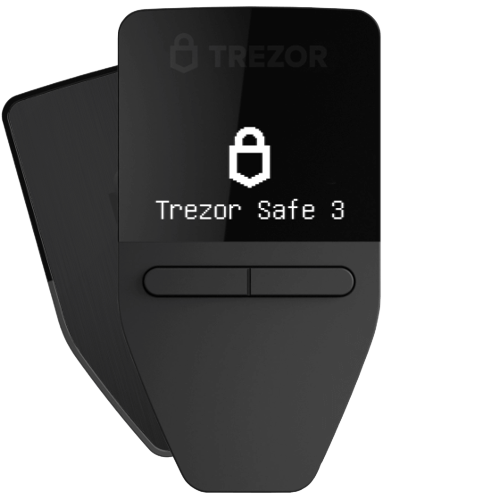
Trezor Safe 3, released in 2023 by SatoshiLabs in the Czech Republic, is the fourth generation of the legendary Trezor line of cold wallets. It’s a hardware wallet that connects via USB and features a bright color screen, physical buttons, and a secure element for storing private keys offline. 
As a cold wallet, Trezor keeps your crypto completely isolated from internet threats—making it a much safer alternative to hot wallets like mobile apps or exchange accounts.
The Safe 3 comes in four colors: Solar Gold, Stellar Silver, Cosmic Black, and Galactic Rose, combining functionality with personality. If you want a deep dive into its features and use cases, check out our full Trezor Safe 3 review.
As you can see, the two wallets are built for very different user experiences. Which brings us to how these wallets actually look and feel in the real world.
Tangem vs Trezor Safe 3: Design & Build Quality
Let’s talk form — because when it comes to something you’ll carry, touch, or store long-term, design really does matter.
Tangem Wallet is the definition of minimalist security. Each card is the size of a standard credit card, only 1mm thick, waterproof, dustproof, and resistant to just about anything — from extreme temperatures to X-rays and EMPs. There’s no screen, no charging, and no buttons. You just tap the card on your smartphone, and you’re in. It’s stealthy, durable, and designed for people who want true portability without sacrificing security. Whether you’re slipping it into your wallet or hiding it in a travel pouch, Tangem is practically invisible — and that’s the point.
On the other hand, Trezor Safe 3 goes for a more traditional hardware wallet feel. It’s a small plastic device with a clear monochrome OLED screen and two clicky buttons. It connects to your computer via USB-C and shows each transaction on-screen so you can confirm or reject it manually. It may not fit in your wallet like Tangem, but it offers the kind of tactile reassurance that many crypto users love — especially when verifying transactions line by line.

Tangem vs Trezor Safe 3: Ease of Use and Setup
Choosing a hardware wallet shouldn’t feel like setting up a new Wi-Fi router. Thankfully, both Tangem and Trezor Safe 3 aim to make onboarding as smooth as possible — but they take very different routes to get you there.
Tangem wins hands-down for sheer simplicity. You don’t need a computer, cables, or even an email address. Just download the Tangem app on your phone, tap the card using NFC, and follow a few easy steps. Within three minutes, you’re ready to manage crypto. No seed phrases to write down unless you want to. It’s built for the mobile-first world — ideal for travelers, beginners, and anyone who doesn’t want to overthink setup.
Trezor Safe 3, on the other hand, gives you more manual control. Setup happens through the Trezor Suite app on desktop. You’ll connect the device via USB-C, create a PIN, and write down a 12-, 20-, or 24-word recovery phrase. 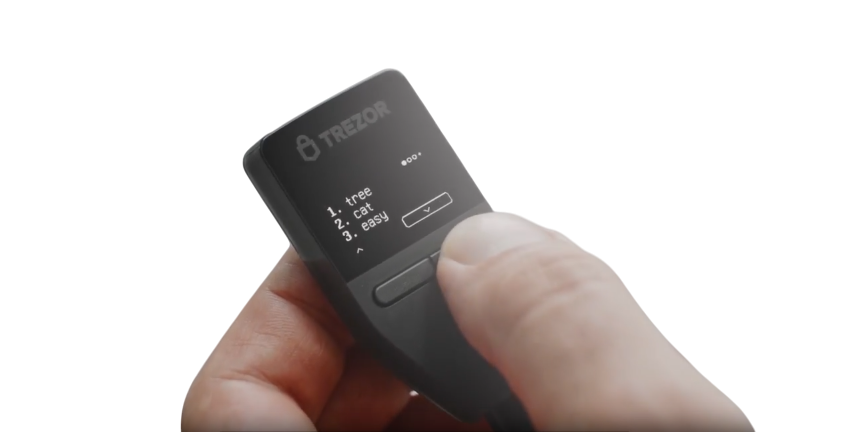 The process takes a little longer, but for users who want to be hands-on and follow every step carefully, it’s a trusted and familiar route.
So the choice is simple: Tangem is fast and foolproof, while Trezor favors control and traditional crypto hygiene. But now let’s dig deeper into what matters most — how each wallet protects your funds.
Trezor Safe 3 vs Tangem: Which Has Better Security?
Both wallets come armed with serious security under the hood — and interestingly, both use an EAL6+ certified Secure Element, which is the same level of protection used in biometric passports and banking cards. But while their hardware is similarly secure, their philosophies around key management and user trust are quite different.
Tangem’s biggest strength is its seedless architecture. When you activate a Tangem card, the chip inside it generates a non-extractable private key that never leaves the device. No one — not even you — can copy or export it. Want extra protection? Just add a second or third card as backup access. And if you prefer seed phrases, Tangem lets you optionally generate one through the app — but it’s not required. No cloud storage, no servers, and no way for hackers to intercept your keys.

Trezor Safe 3, by contrast, is built around the traditional seed phrase model. Your keys are generated during setup and shown to you on the device screen. You write them down — and you’re fully responsible for storing them safely. The upside? You can recover your crypto from any compatible wallet if your Trezor is lost. The downside? If someone sees or steals that seed phrase, they can access your funds.
Where Tangem gives you “what you don’t have, can’t be stolen” logic, Trezor leans into “trust yourself, not the company”. Both are valid — but they require different comfort levels with responsibility and risk. That leads us straight into the next critical piece: how each wallet handles backup and recovery.
Trezor Safe 3 vs Tangem: Backup & Recovery Options
Let’s face it — things happen. You could misplace a card, break your phone, or drop your wallet in a puddle. So how do Tangem and Trezor handle recovery when life throws a curveball?
Tangem’s approach is refreshingly modern. Instead of relying on a single recovery phrase, Tangem lets you set up your wallet with multiple identical cards. Think of them as duplicate keys — each one gives you full access to your wallet. Lose one? You’ve still got the others. This method not only avoids the risk of seed phrase theft, but also eliminates the need to memorize or hide sensitive words. And for those who still prefer traditional methods, you can generate a seed phrase optionally during setup and store it if needed.
Trezor sticks to the tried-and-true method: when you set it up, you’re given a 12-, 20-, or 24-word recovery phrase. Write it down carefully, because it’s your only lifeline if the device is lost or damaged. For extra peace of mind, Trezor also supports Multi-share Backup — a feature that lets you split your recovery into multiple pieces for added redundancy and protection.
So, which recovery method suits you better? Tangem favors simplicity and physical redundancy, while Trezor gives you traditional control with optional upgrades for security pros. Either way, both wallets take backup seriously — it just comes down to how you prefer to secure your keys.

Trezor Safe 3 vs Tangem: Supported Assets
A good hardware wallet should do more than just hold your coins. It should help you grow, manage, and even move them when needed. Both Tangem and Trezor Safe 3 understand this — but they offer very different levels of support and flexibility.
Tangem is the clear winner in terms of sheer numbers. It supports over 6,000 coins and tokens across multiple blockchains, including Bitcoin, Ethereum, Solana, BNB Chain, Polygon, and many more. Whether you’re into stablecoins, DeFi tokens, or altcoins, Tangem likely has you covered. Through its built-in app features, you can buy, sell, swap, and stake crypto directly from your mobile device — no need for third-party integrations.
Trezor Safe 3, on the other hand, supports 1,000+ coins and tokens — including all the major players like BTC, ETH, ADA, and DOT. It doesn’t chase every token under the sun, but it’s reliable and integrates well with third-party wallets like MetaMask, Exodus, and Electrum for broader functionality. In Trezor Suite, you can send, receive, stake, trade, and even track your portfolio, but some tokens might require connecting to external apps.
So if you’re looking for wide coin coverage and native features out of the box, Tangem wins on convenience. But if you’re more focused on long-term holds or prefer managing fewer, more established assets with more detailed control, Trezor Safe 3 delivers just fine — especially when paired with third-party wallets.
App Experience
How you interact with your wallet daily can make or break the experience — especially for newer users. This is where Tangem and Trezor really split into different user worlds.

Tangem is built mobile-first, and it shows. The Tangem app is smooth, intuitive, and packed with useful features: real-time crypto price tracking, token analysis tools, seamless swaps, and portfolio management — all wrapped in a sleek interface. Just tap your card on your phone using NFC and everything happens right there. For people who live on their phones, this setup feels natural and modern.
Trezor, meanwhile, is very much a desktop-first experience. You interact with it through the Trezor Suite app, which offers a more technical, control-focused interface. You’ll confirm every transaction on the device screen, manage your backups, and even tweak privacy settings like coin control and Tor routing. For seasoned users and privacy-conscious holders, Trezor Suite feels empowering.
In short: Tangem favors speed and simplicity on mobile, while Trezor leans into customization and precision on desktop. If you want crypto in your pocket, Tangem feels like second nature. If you prefer to sit down and manage your portfolio with surgical accuracy, Trezor is the better fit.
Privacy & Transparency
When dealing with crypto, trust is earned — not given. And for many users, how open and transparent a wallet is matters just as much as the security tech behind it.
Trezor has long been a champion of open-source principles. Every line of code — firmware, software, and hardware schematics — is public and available for anyone to inspect. This transparency allows the crypto community to audit, improve, and verify that Trezor isn’t hiding anything. If you’re someone who values “don’t trust, verify”, Trezor sets the gold standard.
Tangem takes a slightly different approach. While the Tangem app is open-source (available on GitHub), the firmware itself is closed-source — but not blindly trusted. It has undergone two independent audits from security giants Kudelski Security and Riscure, both confirming that there are no hidden vulnerabilities or backdoors. This hybrid model balances security with protection of proprietary tech.
Also important: Tangem doesn’t collect personal data or use servers to route your blockchain interactions — everything is done on-chain and locally via your phone. Likewise, Trezor gives you tools to protect your identity, like routing traffic through Tor and letting you control how coins are selected and moved.
So here’s the tradeoff: Tangem is private by design, and audit-verified — ideal for those who want a low-maintenance wallet that keeps their identity off the grid. Trezor is transparent by principle and community-reviewed — better for users who want to inspect the code themselves or trust in collective oversight.
Tangem vs Trezor Safe 3: Price & Value
Both Tangem and Trezor Safe 3 come in under $100, but the value you get depends on your priorities — not just the sticker price.
Tangem starts at $54.90 for a 2-card set and goes up to $69.90 for a 3-card set, which many consider the “safe zone” for backup. There’s also a $160 Tangem Ring + Card combo for those who want wearable security. With every set, each card gives full access to the same wallet, making it easy to recover funds if one card goes missing. You also get free shipping on orders over $89, and a whopping 25-year warranty, which is practically unheard of in the hardware wallet space.

Trezor Safe 3 is priced at $79, and that includes the device, USB-C cable, backup cards, and access to the full Trezor Suite software. You don’t get multiple devices like Tangem, but you do get more advanced control features, open-source transparency, and the ability to expand into Multi-share Backup (sold separately). There’s also a Bitcoin-only version for purists who want nothing but BTC on their device.
Bottom line? Tangem offers more physical wallets per dollar, which is great for families or users who want redundancy without added complexity. Trezor gives you software power and privacy features, which appeals to more advanced users. In either case, both wallets provide tremendous value depending on your needs.
Pros and Cons of Tangem and Trezor Safe 3
If you’re still torn between Tangem and Trezor Safe 3, here’s a quick snapshot of what each wallet does best—and where they fall short.
Tangem Wallet
Pros:
- Ultra-portable and lightweight—fits in your pocket like a bank card
- No cables, no battery—just tap with your phone to use
- Ideal for everyday use and fast transfers on the go
- Supports a wide range of tokens and blockchains
- Now supports seed phrase and hidden wallets (with newer versions)
- 10 wrong passcode attempts? The card locks permanently—great anti-theft protection
Cons:
- No built-in screen for on-device transaction verification
- Requires trust in the mobile app interface
- If you lose two of the three cards (without a seed backup), recovery is impossible
- Lacks multisig and advanced features favored by hardcore security users
Trezor Safe 3
Pros:
- Screen lets you verify transactions directly on the device
- Open-source firmware and transparent security architecture
- Supports passphrases, hidden wallets, and Shamir Backup
- Works with Trezor Suite for a full-featured desktop experience
- Doesn’t rely on a smartphone—fully offline-capable
Cons:
- Less convenient for daily use or travel—requires USB connection
- Fewer tokens supported out of the box (some require third-party apps)
- Not as “plug and play” for absolute beginners
- Lacks native Bluetooth or mobile support
Trezor Safe 3 or Tangem: Which Should You Choose?
By now, it’s clear that these two wallets are built for different types of users — and that’s a good thing. Here’s how to know which one is right for you.
Choose Tangem if you:
- Prefer tap-and-go simplicity
- Want a mobile-first wallet with no computer required
- Like the idea of seedless recovery using multiple cards
- Need something that’s lightweight, discreet, and travel-friendly
- Are buying a wallet for multiple users or family members
Choose Trezor Safe 3 if you:
- Prefer a desktop-first setup with manual transaction control
- Want complete transparency through open-source firmware
- Are comfortable managing seed phrases or exploring Multi-share Backup
- Value privacy tools like Tor routing and coin control
- Are an advanced user who wants a wallet that can grow with your knowledge
If you’re a beginner or someone who doesn’t want to worry about seed phrases and technical details, Tangem feels like second nature. If you’re experienced, privacy-focused, or just love the idea of verifying everything yourself, Trezor gives you the tools to go deeper.
💬 What Real Redditors Are Saying About Tangem vs. Trezor Safe 3
The Tangem vs. Trezor Safe 3 debate is alive and well on Reddit — and it’s clear these two wallets attract very different types of users. For beginners looking to decide between them, the community offers plenty of firsthand experience, but also some strong opinions (and a bit of confusion) that need clarifying.
Some Trezor fans are quick to dismiss Tangem. One user claimed, “If you want a gimmick that isn’t cold storage and just makes spending and losing your BTC easier, then get a Tangem,” warning that any wallet without a screen “is asking for trouble.”

Others insisted that a “true” cold wallet must have a display to verify transactions offline — a valid concern in some cases, but not the whole story.
In reality, Tangem is a cold wallet — the private keys are generated and stored securely inside the chip, and never leave the device. While it doesn’t have a screen, the Tangem app works with secure NFC authentication, and the cards self-destruct after 10 failed passcode attempts, adding a strong layer of protection. That said, screenless wallets do require trust in the phone interface, so advanced users may prefer screen verification like Trezor offers.
Other Redditors, especially those who’ve used both wallets, paint a more nuanced picture. One user wrote, ‘
“I have Trezor, Tangem, and Ledger — but I really only use my Tangem. It’s more convenient, plus travelling with it is more discreet.”

Another added,
“Tangem doesn’t need batteries or cables. I take one card with me and leave the others at home — simple and sleek.”
Some go even further:
“Every time I buy crypto on the exchange, I instantly move it to my Tangem. It supports more tokens than Trezor and is always with me.”
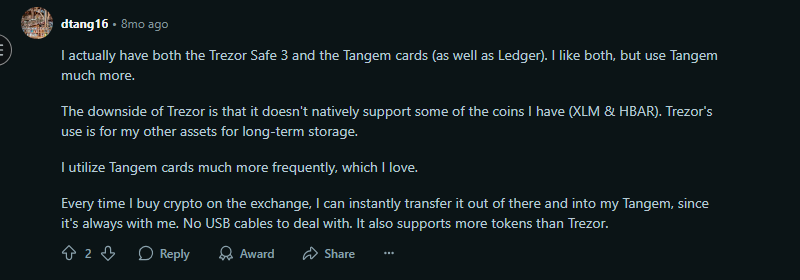
Others noted that Trezor is still their go-to for deep storage, praising its use of passphrases, hidden wallets, and full transparency: “You know your seed never touched a phone or computer, and that’s what gives me peace of mind.”
As for security features, Tangem now supports seed phrase generation and hidden wallets — a fact many users miss. One newer Tangem Ring owner noted,
“The new Tangem can generate a 24-word seed and even create hidden wallets with a passphrase — I love it.”
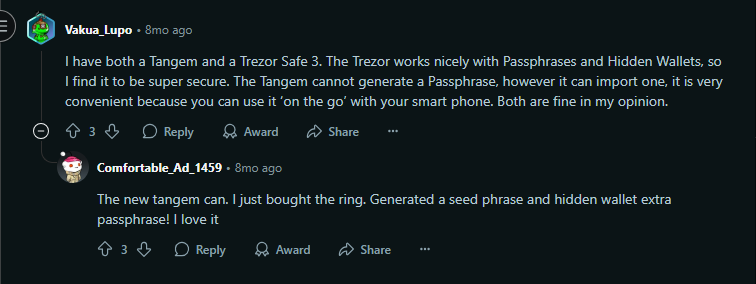
One power user broke it down this way:
“Tangem is more an advanced software wallet. It has its pro and cons. Trezor is a cold storage with an actual screen not just a card and a mobile device that could be hacked.”

Both sides make valid points. Just make sure you’re clear on what trade-offs matter most to you — and avoid judging one wallet by standards the other was never meant to meet.
Where—and How—to Buy Tangem or Trezor Safe 3
So you’ve made your choice? Great. Now let’s make sure you get the real deal. When it comes to hardware wallets, where you buy is just as important as what you buy.
🔐 Buying Trezor Safe 3
Always order your Trezor wallet directly from the official Trezor website. This is non-negotiable. Avoid marketplaces like Amazon, eBay, or third-party crypto sites—some users have received tampered or repackaged devices that could compromise their funds.
Trezor ships globally, with free shipping for U.S. buyers (3 business days) and affordable rates for international customers. For example:
- UK: $5.51 standard (2 business days)
- Australia: $13.53 UPS Express Saver (5 business days)
- Nigeria: $30 via DHL Express (4 business days)
Delivery is fast and secure thanks to air freight options like DHL and UPS. You can also choose your preferred checkout method—PayPal, Apple Pay, Google Pay, debit/credit cards, or even Bitcoin and altcoins.
💳 Buying Tangem Cards
For Tangem, you can buy directly from their official website. Place your order—delivery usually takes 8–17 business days depending on your location. The best part? You can instantly save 10% by using our exclusive promo code: MARKETSXPLORA.
Tangem also supports cryptocurrency payments along with major cards and digital wallets, and ships globally with tracked delivery. Many users praise how fast and discreet the packaging is, especially for the Tangem Ring.
Related ↓
Takeaway
There’s no one-size-fits-all when it comes to crypto wallets — and that’s exactly why both Tangem and Trezor Safe 3 exist. They approach security, usability, and recovery from completely different angles — and both succeed in their own right.
Whichever one you choose, you’re already on the right track. You’re taking control of your crypto, securing your future, and stepping away from the risk of centralized exchanges. That alone puts you ahead of the curve.
FAQs: Tangem vs Trezor Safe 3
- Are Tangem Wallet and Trezor Safe 3 both secure?
Yes—both wallets are secure, but they take different approaches. Trezor Safe 3 offers traditional cold storage with open-source firmware, PIN protection, and a secure screen. Tangem, on the other hand, uses a secure chip certified to EAL6+ and stores private keys offline with optional seed phrase support. Each has its own strengths depending on how you want to manage your crypto.
- What’s the key difference between Trezor Safe 3 and Tangem Wallet?
Trezor Safe 3 is a screen-based hardware wallet that connects via USB and supports passphrases, hidden wallets, and seed recovery. Tangem is a card-based NFC wallet you tap with your phone. It’s sleek, mobile-friendly, and designed for simplicity, while Trezor is more feature-rich and ideal for long-term cold storage.
- Is Trezor Safe 3 better than Tangem?
Not necessarily—it depends on your needs. Trezor Safe 3 is better for those who want full control over seed phrases, advanced security settings, and broader integration with desktop wallets. Tangem is better if you prioritize ease of use, portability, and fast mobile access. Some users even own both for different purposes.
- What happens if I lose my Tangem card?
If you’ve set up a 3-card backup, you’re safe—any 2 of the 3 cards can restore your wallet. If you’ve also enabled a seed phrase, you can recover your wallet using that. Without either backup, your crypto is permanently lost. That’s why backing up is crucial with Tangem.
- What happens if I lose my Trezor Safe 3?
Your crypto is safe as long as you have your recovery seed phrase. Just use it to restore your wallet on another Trezor or compatible hardware wallet. Without the seed, your funds cannot be recovered.
- What coins are supported by Tangem Wallet?
Tangem supports 6,000+ coins and tokens, including Bitcoin, Ethereum, USDT, XRP, ADA, BNB, and most ERC-20, TRC-20, and BEP-20 tokens. It’s regularly updated, and support is integrated directly in the Tangem mobile app. Always check the official list before buying.
- Where should I buy Tangem and Trezor Safe 3?
Always buy directly from the official websites:
- Buy Tangem Wallet here — use code MARKETSXPLORA for 10% off
- Buy Trezor Safe 3 here — avoid third-party resellers to reduce the risk of tampering
- Can I use both Tangem and Trezor together?
Yes—many users own both wallets and use them for different purposes. For example, they use Trezor for long-term storage and Tangem for daily use or travel. Using both gives you flexibility and layers of security based on your habits.