

If you’re curious about Fidelity’s robo-advisor, this Fidelity Go Review explains how it works and who it’s best for. The platform combines trusted Fidelity investing with automated management. Let’s see if it delivers real value for everyday investors.
Fidelity Go Review: Quick Stats
- Parent Company: Fidelity Investments (founded 1946)
- Fidelity Go Launched: 2016
- Assets Under Management: Part of Fidelity’s $4.9+ trillion total AUM
- Management Fee: $0 (under $25K); 0.35% annually ($25K+)
- Account Minimum: $0 to open, $10 to start investing
- Headquarters: Boston, Massachusetts
- Regulatory Status: SEC-registered, FINRA/SIPC member
- Award: Barron’s Best Robo Advisor 2024
Best For:
✅ Beginners with small starting balances (free under $25K)
✅ Existing Fidelity customers wanting integrated management
✅ Cost-conscious investors seeking zero expense ratio funds
✅ Hands-off investors wanting human portfolio oversight
✅ Those needing unlimited advisor coaching ($25K+ accounts)
Not Ideal For:
❌ Tax-loss harvesting seekers (not offered)
❌ Socially responsible investors (no SRI portfolios)
❌ Goal-based planners (limited to single goal)
❌ Advanced traders wanting customization
❌ Those switching from other custodians (Flex funds lock-in)
What is Fidelity Go?
Fidelity Go is the robo-advisor offering from Fidelity Investments, one of the largest and most trusted financial services firms in America. Launched in 2016, Fidelity Go offers automated portfolio management with zero advisory fees for accounts under $25,000 and includes access to Fidelity Flex mutual funds with zero expense ratios—making it one of the most cost-effective robo-advisors available. Fidelity Go was awarded Best Robo Advisor of 2024 in Barron’s annual Best Robo-Advisors Ranking.

Unlike pure digital robo-advisors, portfolios are overseen by human advisors from a team of registered investment advisors that is part of Fidelity. They make day-to-day trading decisions and handle trades in the accounts. This hybrid approach combines algorithmic efficiency with human oversight.
Fidelity Go customers have access to Fidelity Flex Funds, which are Fidelity mutual funds that have zero expense ratios. This eliminates the typical 0.05-0.20% annual drag from ETF expense ratios seen at competing robo-advisors.
Pricing and Fees
Tiered Pricing Structure
Accounts Under $25,000:
- Advisory Fee: $0 (completely free)
- Fund Expense Ratios: $0 (Fidelity Flex Funds)
- Total Cost: $0
- Example: $10,000 account = $0/year
Accounts $25,000 and Above:
- 0.35% advisory fee for balances of $25,000+
- Fund Expense Ratios: $0 (included in advisory fee)
- Total Cost: 0.35% all-in
- Example: $100,000 account = $350/year
No Additional Fees
There are no trading fees, transaction fees, or rebalancing fees
Zero fees for:
- Account opening or closure
- Deposits or withdrawals
- Rebalancing (automatic)
- Trading commissions
- Fund expenses (Flex Funds have 0% ER)
- Transfers in or out
Fee Comparison
Robo-Advisor |
Management Fee |
Fund Expenses |
Total Cost |
|---|---|---|---|
 |
0.35% |
0.00% |
0.35% |
 |
0.25% |
0.08% avg |
~0.33% |
 |
0.25% |
0.10% avg |
~0.35% |
 |
0.15% |
0.06% avg |
~0.21% |
 |
0.00% |
0.08% avg |
~0.08% (but 6-30% cash drag) |
Key Insight: Fidelity Go’s all-in cost is competitive, and the free tier (under $25K) is unmatched among major robo-advisors.
Account Types Available
Investment Accounts
Fidelity Go manages personal investment accounts and retirement accounts including: Taxable investment accounts (individual and joint)
Available:
- Individual taxable accounts
- Joint taxable accounts
- Traditional IRA
- Roth IRA
- SEP IRA (for self-employed)
- Rollover IRA (401k transfers)
NOT Available:
- 529 College Savings Plans
- HSA (Health Savings Accounts)
- UGMA/UTMA (Custodial accounts)
- Trust accounts
- 401(k) management
Account Minimums
There is no minimum initial investment to open a Fidelity Go® account
Once your account hits $10 we’ll start investing for you according to the investment strategy you’ve chosen
Minimum for Human Coaching: The minimum account balance to access financial coaching with our trained advisors is $25,000
Investment Philosophy and Portfolio Construction
Investment Strategy
Fidelity Go uses passive indexing through proprietary Fidelity Flex mutual funds. Fidelity Go portfolios are made up of a combination of proprietary active and passive Fidelity Flex mutual funds. They are generally made up of domestic or foreign stocks, bonds or short-term investments.
Risk-Based Asset Allocation
Fidelity Go offers investment strategies that range from conservative to aggressive. Our most conservative investment strategy targets 20% stocks and 80% bonds and short-term investments, while our most aggressive strategy targets 100% stocks.
Risk Tolerance Scale: 1-10
- 1-3 (Conservative): 20-40% stocks, 60-80% bonds/cash
- 4-6 (Moderate): 50-70% stocks, 30-50% bonds
- 7-10 (Aggressive): 80-100% stocks, 0-20% bonds
Portfolio Composition
Fidelity’s robo advisor invests primarily in Fidelity Flex funds including asset classes like domestic stocks, foreign stocks, bonds, and short-term investments
Asset Classes:
- US Large-Cap Stocks
- US Mid-Cap Stocks
- US Small-Cap Stocks
- International Developed Markets
- International Emerging Markets
- US Bonds (Government & Corporate)
- Municipal Bonds (for taxable accounts in higher tax brackets)
- Short-Term Investments (cash equivalents)
Number of Funds: Typically 6-8 Fidelity Flex mutual funds per portfolio
Rebalancing
We monitor the markets and automatically rebalance the portfolio to keep you on track
Fidelity rebalances portfolios when allocations drift significantly from targets, ensuring your risk level stays consistent with your goals.
Smart Shift Feature
Some robo advisors allow you to shift your strategy over time, like Fidelity Go through its Smart Shift feature. This feature automatically adjusts your risk allocation as your goal date approaches.
What Fidelity Go Lacks
No Tax-Loss Harvesting
One major feature you won’t find at Fidelity Go is the use of tax-loss harvesting. Instead, municipal bond funds are used to help limit taxes in certain portfolios.
Why This Matters: Tax-loss harvesting can add 0.5-1.5% annually in tax benefits for taxable accounts. Competitors like Betterment and Wealthfront offer this feature to all clients, potentially offsetting their management fees.
Fidelity’s Tax Approach:
- Uses municipal bonds in taxable accounts for high-income investors
- Tax-efficient fund placement (bonds in IRAs, stocks in taxable)
- No proactive loss harvesting
No Socially Responsible Investing
No specialty portfolio or SRI option: Although Fidelity Go’s portfolios are well-diversified, the robo-advisor doesn’t offer socially responsible investing options, which can be limiting for some investors.
Competitors like Betterment (3 SRI portfolios) and Wealthfront (SRI option) cater to ESG-conscious investors.
Limited Goal Planning
Unlike other robo-advisors that may offer goal-based investing with multiple potential goals, you have to pick one option with Fidelity Go. You can opt for a retirement goal or some other goal (which is assumed to be in a taxable account).
Limitation: Single goal per account vs. Betterment/Wealthfront’s multiple simultaneous goals
Human Advisor Access
Financial Coaching ($25K+ Accounts)
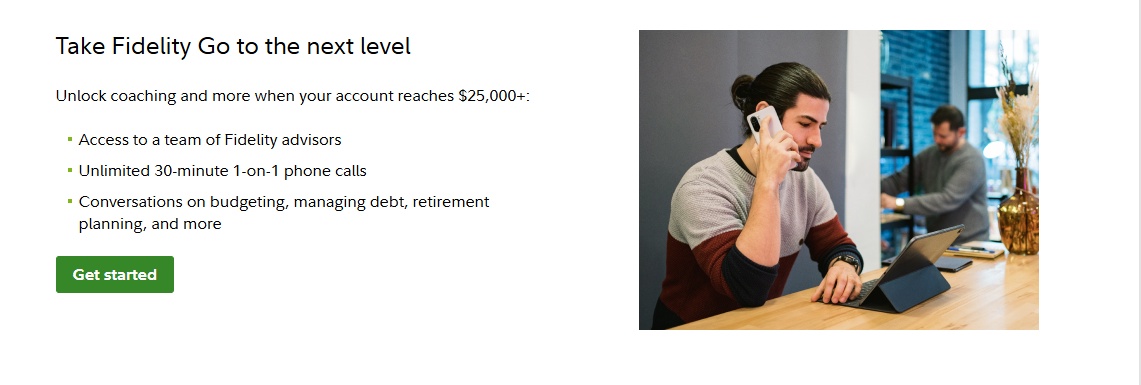
Once your account reaches $25,000, you will be able to schedule 30-minute calls with Fidelity’s trained advisors to discuss specific topics. There is no limit to the number of coaching calls that you can schedule, and there is no extra cost for these calls.
What Coaches Can Help With:
- Annual portfolio reviews
- Retirement strategy discussions
- Budgeting and debt management
- Investment strategy questions
- Achieving financial goals
- Rollovers and account transfers
What Coaches DON’T Provide:
- Tax preparation or specific tax advice
- Legal advice or estate planning
- Active trading recommendations
- Business planning advice
Customer Support (All Accounts)
24/7 Phone Support: Available to all Fidelity customers regardless of account type
Live Chat: Live chat is available Monday to Friday from 8:00 am to 6:00 pm Eastern time
Email Support: Available through Fidelity message center
Help Center: Comprehensive FAQ and educational resources
User Experience and Technology
Mobile App
Fidelity Go is available on the main Fidelity app and is accessible to users in both iOS and Android. The functionality of the mobile app is very similar to what users would see using the desktop version.
App Features:
- Portfolio performance tracking
- Goal progress monitoring
- Recurring deposit setup
- Quick deposits/withdrawals
- Tax document access
- Integrated with other Fidelity accounts
Ratings: Strong ratings across app stores (part of main Fidelity app)
Account Opening Process
Fidelity Go makes it easy to start investing because of its intuitive account setup process. I liked that after filling out a questionnaire, which only took a couple of minutes out of my day, I could see a proposed strategy for how my money would be invested based on my risk tolerance and a timeline of when I’d hit my savings goal.
Setup Steps:
- Answer questionnaire (2-3 minutes)
- View proposed portfolio allocation
- Choose account type (taxable, IRA)
- Link bank account
- Fund with minimum $10
- Investing begins automatically
Timeline: 5-10 minutes to open account
Integration with Fidelity Ecosystem
Major Advantage: Fidelity integration: Customers who already have an IRA or a taxable account with Fidelity can easily take advantage of the company’s robo offering
Benefits:
- Single login for all accounts
- Unified view of investments
- Easy transfers between accounts
- Access to Fidelity’s full platform
- Research tools and education
- Customer service across all products
Security and Safety
Regulatory Protection
SEC-Registered: Fidelity Go is advised by Strategic Advisers LLC (merging with FPWA), an SEC-registered investment advisor
SIPC Coverage: Fidelity accounts, including Fidelity Go accounts, are covered by the Securities Investor Protection Corporation (SIPC), adding a level of protection
Protection Limits:
- Up to $500,000 per account
- Includes $250,000 cash protection
- Protects against firm failure (not market losses)
Company Stability
Fidelity Investments Founded: 1946 (79 years in business)
Assets Under Management: $4.9+ trillion (one of largest in world)
Ownership: Privately held by Johnson family
Financial Strength: One of most financially stable firms in industry
Pros and Cons
Fidelity Go Pros
- ✅ Free management under $25K
- ✅ Zero-fee Fidelity Flex Funds
- ✅ Low 0.35% all-in cost above $25K
- ✅ No trading or rebalancing fees
- ✅ $0 to open, $10 to start investing
- ✅ Easy integration with Fidelity accounts
- ✅ Human oversight on portfolios
- ✅ Coaching calls for $25K+ accounts
- ✅ 24/7 customer support
- ✅ Globally diversified portfolios with auto-rebalancing
- ✅ Smart Shift adjusts risk over time
- ✅ Fast setup, beginner-friendly app
- ✅ Barron’s Best Robo Advisor 2024
Fidelity Go Cons
- ❌ No tax-loss harvesting
- ❌ No SRI or specialty portfolios
- ❌ One goal per account only
- ❌ No 529 or HSA options
- ❌ Fidelity funds can’t transfer in-kind (creates exit costs)
- ❌ Reports of underperformance vs S&P 500
- ❌ Coaching only for $25K+ balances
- ❌ Advanced planning services costly ($500K+ tiers)
- ❌ Limited customization
- ❌ Uses only Fidelity funds (no third-party options)
How Fidelity Go Compares
vs. Betterment
|
|
|
|---|---|---|
Management Fee |
$0 (under $25K); 0.35% ($25K+) |
0.25% (Digital); 0.65% (Premium) |
Fund Expenses |
0.00% |
~0.08% |
Total Cost |
0.35% |
~0.33% (Digital) |
Account Minimum |
$10 |
$10 |
Tax-Loss Harvesting |
No |
Yes (all accounts) |
SRI Portfolios |
No |
Yes (3 options) |
Human Advisors |
Coaching ($25K+) |
Unlimited CFPs (Premium, $100K) |
Goal Planning |
Single goal |
Multiple goals |
Best For |
Fidelity customers, free tier |
Tax optimization, SRI investors |
Winner: Fidelity Go for existing Fidelity customers and free tier; Betterment for features and tax optimization
vs. Wealthfront
|
|
|
|---|---|---|
Management Fee |
0.35% ($25K+) |
0.25% (flat) |
Account Minimum |
$10 |
$500 |
Tax-Loss Harvesting |
No |
Yes (daily, advanced) |
Direct Indexing |
No |
Yes ($100K+) |
529 Plans |
No |
Yes |
Human Advisors |
Yes ($25K+ coaching) |
No |
Financial Planning |
Basic |
Path tool (comprehensive) |
Free Tier |
Yes (under $25K) |
No |
Winner: Fidelity Go for beginners with small balances; Wealthfront for tax optimization and advanced features
vs. Vanguard Digital Advisor
|
|
|
|---|---|---|
Management Fee |
0.35% |
0.15% |
Account Minimum |
$10 |
$3,000 |
Fund Expenses |
0.00% |
~0.06% |
Total Cost |
0.35% |
~0.21% |
Tax-Loss Harvesting |
No |
Yes |
Human Advisors |
Yes ($25K+) |
Limited ($50K+) |
Free Tier |
Yes (under $25K) |
No |
Winner: Vanguard for lowest total cost; Fidelity Go for accessibility and free tier
Who Should Choose Fidelity Go?
Ideal Candidates
Beginners with Small Balances ($10-$25K)
- Perfect for first-time investors
- Completely free management
- No fund expenses
- Can start with just $10
- Learn investing without fees
Existing Fidelity Customers
- Seamless account integration
- Single login for all accounts
- Familiar interface
- Easy transfers between products
- Access to full Fidelity ecosystem
Cost-Conscious Investors
- Free under $25K is unbeatable
- 0.35% all-in at $25K+ is competitive
- No hidden fund fees
- No trading or rebalancing costs
IRA Investors
- Tax-loss harvesting not applicable in IRAs anyway
- Fidelity Go’s main weakness (no TLH) doesn’t matter
- Great for Roth IRA, Traditional IRA, SEP IRA
- Free coaching at $25K+
Hands-Off Investors
- Want professional management
- Don’t want to pick investments
- Appreciate human oversight
- Value Fidelity’s reputation
Not Right For
Taxable Account Investors Seeking Tax Optimization: Tax-loss harvesting absence is critical disadvantage. Choose Betterment or Wealthfront instead.
Socially Responsible Investors: No SRI/ESG portfolios. Choose Betterment (3 SRI options) or Wealthfront (SRI portfolios).
College Savers: No 529 plans. Use Wealthfront, Vanguard 529, or Fidelity’s direct 529 (not through Go).
Goal-Based Planners: Limited to single goal. Choose Betterment or Wealthfront for comprehensive multi-goal planning.
Those Planning to Leave Fidelity: Flex fund lock-in creates exit friction. Consider Betterment or Wealthfront if future portability matters.
How to Get Started
Step-by-Step Account Opening
1. Visit Fidelity Go
- Go to fidelity.com/go
- Or download Fidelity mobile app
2. Answer Questionnaire (2-3 minutes): We’ll help you choose your Fidelity Go® investment strategy by suggesting one according to your goals, your time horizon, and your comfort with risk
Questions cover:
- Financial goals (retirement or other)
- Time horizon
- Risk comfort level (1-10 scale)
- Age and income
- Investment experience
3. Review Proposed Portfolio: See suggested asset allocation and specific Fidelity Flex Funds
4. Choose Account Type
- Individual taxable
- Joint taxable
- Traditional IRA
- Roth IRA
- SEP IRA
5. Link Bank Account
- Instant verification (most banks)
- Or manual routing/account numbers
6. Fund Account
- Minimum $10 to start investing
- ACH transfer (3-5 business days)
- Set up automatic deposits (recommended)
7. Portfolio Construction Begins: Fidelity builds your portfolio within 1 business day after funds arrive
Timeline: Account open in 5-10 minutes; investing begins once funds clear
Final Verdict
Overall Rating: 4.4/5 ⭐⭐⭐⭐
Fidelity Go delivers on its promise: simple, low-cost, professionally managed investing backed by one of America’s most trusted financial firms. For beginners and IRA investors, it’s among the best robo-advisors available. The free tier under $25K is unmatched. However, the absence of tax-loss harvesting is a significant weakness for taxable accounts, where competitors provide meaningful tax benefits that can exceed management fees.
Get started at: fidelity.com/go
Frequently Asked Questions
Is Fidelity Go really free for accounts under $25,000?
Yes, completely free. No advisory fees, no fund expense ratios, no hidden costs.
What happens when my account reaches $25,000?
The 0.35% annual advisory fee begins, charged quarterly. You also gain access to unlimited 30-minute coaching calls with Fidelity advisors.
Why doesn’t Fidelity Go offer tax-loss harvesting?
Fidelity hasn’t publicly stated why. Likely due to the complexity of implementing TLH with mutual funds (vs. ETFs) and potential conflict with their direct brokerage platform.
Can I transfer my Fidelity Go account to another broker?
Yes, but Fidelity Flex Funds must be sold first (cannot transfer in-kind), potentially triggering capital gains taxes.
How does Fidelity Go compare to just buying index funds myself?
DIY costs less (just fund ER ~0.05%) but requires active management, rebalancing, and discipline. Fidelity Go automates everything and provides human oversight.
Is Fidelity Go FDIC insured?
No, investments are SIPC-protected (up to $500K) not FDIC. Cash awaiting investment may have limited FDIC coverage through sweep program.
Disclaimer: This Fidelity Go review is for educational purposes. Investment decisions should be based on your personal situation. All information accurate as of January 2026 but subject to change.