Tangem vs Ledger Nano X: Which Is Best for Beginners?
Tangem vs. Ledger Nano X — if you’re thinking of buying your first hardware wallet, this comparison is for you. You might be wondering which one is easier to use, what they can do, or how safe they really are. We’ve made it simple by putting both wallets side by side, so you can pick with confidence and get started the right way.
Quick Comparison: Tangem vs Ledger Nano X at a Glance
Before we dive deeper, here’s a quick side-by-side snapshot of how Tangem and Ledger Nano X compare on the essentials:
Price
From $54.90 (2-card set)
$149
Form Factor
Credit-card sized (1mm thick, 6g)
USB stick-style with screen (34g)
Power Source
No battery needed
Rechargeable battery (100mAh)
Security Certification
EAL6+ (chip-level)
EAL5+ (chip-level)
Backup/Recovery
Extra cards or optional seed phrase
24-word seed phrase or optional Ledger Recover
Supported Coins
6,000+
5,500+ (plus NFTs)
NFT Support
Yes
Yes
Mobile Access
Native app (NFC, no cable/Bluetooth needed)
Bluetooth-enabled with Ledger Live app
Firmware Updates
Not updatable (security by design)
Requires periodic updates
What is Tangem Wallet?
Launched in 2018, the Tangem Wallet is a new breed of hardware wallet that redefines what cold storage can look and feel like. Instead of the typical USB stick or touchscreen device, Tangem comes in the shape of a credit card — sleek, waterproof, tamper-proof, and powered by NFC. It stores your private keys completely offline, with no need for Bluetooth, batteries, or charging. That’s what makes it a true cold wallet — the kind of crypto protection that’s virtually immune to online hacks and malware.
Unlike hot wallets (software apps or exchange accounts that stay connected to the internet), Tangem doesn’t expose your keys online. This keeps your crypto safe from phishing, SIM swaps, and other remote attacks. Tangem is currently available in Matte Black, Green, White, and limited edition designs — so it’s not only secure but stylish too. If you’re curious about how it works and how to use it, check out our full Tangem Wallet review →
What is Ledger Nano X?
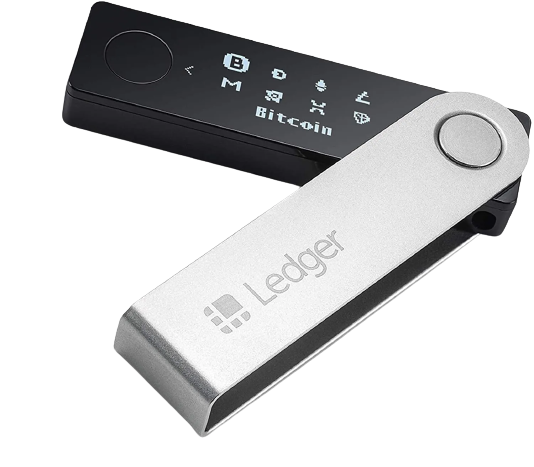
The Ledger Nano X, introduced in 2019, is one of the most iconic hardware wallets in the crypto space. It stores your private keys on a secure offline chip, completely isolated from internet access — the key characteristic of a cold wallet. That isolation is what makes devices like Ledger far safer than hot wallets, which are always online and vulnerable to malware, browser exploits, and phishing scams.
Unlike Tangem’s card format, the Nano X resembles a sleek USB stick with a built-in OLED screen and physical buttons, letting you review and confirm transactions directly on the device. It comes in classic Matte Black, but Ledger has also released limited color editions like Blazing Orange, Lagoon Blue, and Cosmic Purple, adding personality to an already powerful tool. Want to know if the Nano X lives up to the hype? Dive into our full Ledger Nano X review here →
As you will see in this article, Tangem and Ledger Nano X take very different approaches to security, convenience, and usability. But what may look like a simple difference in design or tech specs actually affects your experience in a big way. Let’s explore that starting with what you get for your money.
Pricing & What’s in the Box
Let’s talk value — because price is one thing, but what you actually get matters even more.
Tangem Wallet
Tangem keeps things simple and modular. You choose how many access points (cards or ring + cards) you want:
2-Card Set – $54.90: Entry-level option. Two identical cards, both giving full access to the same wallet.
3-Card Set – $69.90: A safer choice. Even if you lose one card, the remaining two can still restore your wallet.
Tangem Ring Set – $160.00: Includes a stylish, NFC-enabled ring and two backup cards.
Family Pack – $139.80: Two full 3-card sets, perfect for couples or family members.
Every card is the wallet. There’s no screen, no battery, no cables — just a secure chip that lasts up to 25 years, protected against water, dust, heat, and even X-rays.
Ledger Nano X
Ledger takes a more traditional approach, offering a single powerful device:
Price – $149: You get one Nano X hardware wallet with a built-in screen, Bluetooth, and a USB-C cable.
Included in the box: The device, USB cable, keychain strap, 3 paper recovery sheets, and setup instructions.
The Nano X is a feature-rich wallet built for multitasking and flexibility. It supports up to 100 apps simultaneously, works with desktop and mobile, and includes a rechargeable battery — great for users who want full control across DeFi, staking, NFTs, and more.
But price alone doesn’t tell the full story — especially when it comes to security and long-term usability. So next, let’s see how both wallets stack up when it really matters: keeping your crypto safe.
Here’s where the differences between Tangem and Ledger Nano X become instantly obvious — even before you power them on.
The Tangem Wallet is built like a credit card. It’s just 1mm thick, weighs only 6 grams, and slips right into your physical wallet. No buttons, no screens, no charging ports. It’s essentially a smart chip embedded in a flexible plastic card, designed to survive extreme conditions — from water and dust to X-rays and electromagnetic pulses. Whether you’re hiking, traveling, or just tossing it in a drawer, it’s made to last. Tangem even boasts an IP69K protection rating, which is about as durable as tech gets.
On the flip side, the Ledger Nano X has a more traditional USB-drive shape. It’s heavier (34g) and made of brushed stainless steel and plastic, giving it a premium, solid feel in the hand. It includes a small OLED screen and physical buttons, allowing you to review and confirm transactions directly on the device — a major plus for people who want that extra level of visibility.
So what does that mean for portability? Tangem is practically invisible in your pocket, perfect for minimalist users or those always on the move. Ledger Nano X feels more like a tech gadget, which might appeal more to users who prefer tactile control and don’t mind the bulk.
But no matter which one you choose, how easy is it to get started? That’s where we’re heading next.
Ease of Use & Setup
When it comes to getting up and running, Tangem is as plug-and-play as crypto wallets get. There’s no computer setup, no battery to charge, and no seed phrase unless you really want one. Simply tap the card to your NFC-enabled phone, download the Tangem app, and follow the on-screen steps. Setup takes just 1–3 minutes, and once done, you’re good to go — no updates, no cables, no nonsense.
What’s more, you can use any of the cards in your set to access your wallet. All cards are equal, so if you lose one, just grab another. It’s a great system for beginners who want less stress and fewer technical steps.
Ledger Nano X, while more complex, offers a robust experience for users who want more control. You’ll need to download the Ledger Live app (on desktop or mobile), initialize the device by choosing a PIN and writing down your 24-word recovery phrase, then install apps for the coins you want to use. You can connect to your phone via Bluetooth, or plug into a PC via USB-C for setup and firmware updates.
Yes, it takes a bit more time, but that effort pays off in flexibility. Ledger lets you run up to 100 crypto apps simultaneously, which is a game-changer if you’re active across different chains and tokens.
Bottom line? Tangem wins on simplicity. Ledger wins on control. But that ease or complexity becomes more meaningful when we talk about security — so let’s dive into that next.
Security Architecture
Security is the heart of any hardware wallet — and both Tangem and Ledger take it seriously, but in very different ways.
Tangem uses a certified EAL6+ secure chip, which is currently one of the highest levels of chip certification in the industry — even higher than Ledger’s EAL5+. At the time of activation, Tangem’s chip generates a private key offline, directly on the card, and stores it inside the chip. That key can never be extracted, copied, or seen — not by you, not by Tangem, not by anyone. The chip has also passed independent security audits by Kudelski Security and Riscure, confirming that the firmware is immutable and free from backdoors.
To access your wallet, you’ll need to enter an access code (like a PIN), and for backups, you can either use multiple cards or opt-in to generating a BIP39 seed phrase. But unlike traditional wallets, the seed is optional, not default. This makes Tangem feel refreshingly secure without the pressure of storing a sensitive paper phrase.
On the other hand, Ledger Nano X relies on a secure EAL5+ chip and stores your private keys offline, disconnected from the internet. All transactions must be confirmed physically on the device using the screen and buttons. Ledger’s security model is built around a 24-word Secret Recovery Phrase — lose it, and you’re at risk of losing access forever. But if you want extra peace of mind, Ledger offers an optional paid service called Ledger Recover, which can store encrypted backups of your seed with ID-based recovery.
Also important: Ledger Nano X requires occasional firmware updates, which means you’ll need to connect it to a computer from time to time — a potential risk point if you’re not careful. Tangem avoids this by using non-updatable firmware that’s already been locked and audited.
No matter how secure a wallet is, things go wrong — cards get lost, devices fail, and accidents happen. That’s why backup and recovery options are just as important as security.
Tangem takes a physical-first approach to backups. When you set up your wallet with two or three cards, each one acts as a fully functional key to the same wallet. You don’t store anything externally — no written-down seed phrases unless you opt to. If you lose one card, the others still give you full access. And since the keys are generated and stored within the chip, there’s zero exposure to the internet or any third-party service.
Want a traditional seed phrase? You can choose to generate one during setup, but Tangem makes it optional — not mandatory. This appeals to users who fear losing a paper backup or who want a more modern, touch-and-go recovery system.
Ledger Nano X, on the other hand, sticks with the tried-and-tested 24-word recovery phrase. It’s generated during setup and must be written down and stored securely — your entire crypto access depends on it. Lose it, and you’re locked out forever. That may sound intense, but it’s the backbone of most hardware wallets and offers maximum compatibility with other wallets in case of migration.
Ledger also offers an additional service called Ledger Recover (subscription-based), which lets you split and encrypt your seed phrase across secure third-party servers. You can restore access using ID verification if you ever lose both your device and recovery sheet — convenient, but some users are understandably cautious about sharing custody with any external party.
So while Tangem offers backup simplicity through redundancy, Ledger gives you deeper control — but with more personal responsibility. Now that we’ve covered recovery, let’s look at what really brings a wallet to life: the coins you can store and manage.
Coin & Token Support
Both Tangem and Ledger Nano X support a massive range of cryptocurrencies — but there are some notable differences in scope and flexibility.
Tangem Wallet currently supports over 6,000 coins and tokens, including major ones like Bitcoin, Ethereum, USDT, Solana, Cardano, and BNB, as well as a growing list of tokens across various blockchains. Since the Tangem app connects directly with your card, there’s no need to install separate apps for each coin — once you add an asset in the app, you’re ready to go. This makes the user experience feel seamless and scalable, especially for those managing a diverse portfolio.
Importantly, Tangem also supports NFTs — not directly through the app interface, but via WalletConnect. This means you can connect your Tangem wallet to NFT marketplaces like OpenSea, and manage your NFTs directly through those platforms. It’s a solid solution that gives Tangem users access to Web3 and NFT assets without compromising on security.
Ledger Nano X supports over 5,500 coins and tokens, which includes virtually all major cryptocurrencies and native NFT viewing on Ethereum and Polygon directly through Ledger Live. Ledger uses a modular approach — you install apps for each coin inside the device. With up to 100 apps installable at once, it’s powerful, but you may need to swap apps in and out if you’re dealing with a very large number of assets.
Still, Ledger’s deep integration with DeFi tools, third-party dApps, and advanced features like custom token support makes it a favorite for power users.
So while Tangem wins on sheer numbers and simplified access, Ledger leads in native NFT handling and DeFi integration. But tokens aren’t everything — how you interact with them matters just as much. Let’s explore the wallet apps and features next.
App & Feature Integration
A hardware wallet is only as good as the app that powers it — and here’s where both Tangem and Ledger show their personalities.
Tangem pairs with its proprietary Tangem App, available on iOS and Android. It connects via NFC, meaning all you have to do is tap your card on the back of your phone. There are no cables, no Bluetooth, and no battery requirements. Once connected, you can buy, sell, stake, swap, and track over 6,000 coins. The interface is clean, fast, and designed with mobile-first users in mind.
What sets Tangem apart is its ease of use. The app provides real-time prices, intuitive portfolio tracking, and even token analytics. Tangem handles swaps, buys, and staking via integrated providers — all while keeping your private key inside the card. There’s no reliance on cloud servers, and the app is open-source, so anyone can verify the code on GitHub.
Ledger Nano X is powered by the Ledger Live app, which works on both desktop and mobile. The app supports portfolio management, buy/sell/swap/stake, NFT browsing, and third-party integrations for dApps like Uniswap, Compound, and more. You can even manage coins from different blockchains at once.
Unlike Tangem, Ledger Live offers more in-depth asset management, including DeFi connectivity and custom transaction fee settings. However, it also has a steeper learning curve, especially for beginners. Bluetooth support makes mobile access smooth, but firmware updates and certain operations still require a USB connection to a computer.
In short, Tangem wins on speed and simplicity, perfect for users who want a wallet that “just works.” Ledger shines in power and versatility, giving experienced users access to every corner of the crypto universe.
Connectivity is the bridge between your hardware wallet and the crypto world — and how that bridge is built says a lot about how the wallet fits into your lifestyle.
Tangem doesn’t rely on cables, Bluetooth, or Wi-Fi. It connects via NFC (Near Field Communication) — the same technology used for tap-to-pay cards. You simply tap the Tangem card (or ring) to the back of your smartphone to authorize a transaction. No battery, no charging, no port maintenance. The chip is always ready, even if it’s been sitting untouched for years.
This design makes Tangem completely maintenance-free, ideal for people who travel often or just want something reliable without needing to worry about charging schedules or firmware updates.
Ledger Nano X offers more tech flexibility but adds complexity. It connects to your phone using Bluetooth, and to your desktop using a USB-C to USB-A cable. The device has a built-in 100mAh lithium-ion battery, which needs to be charged occasionally — especially if you rely on mobile use. Also, some operations, including firmware updates, can only be performed via a desktop connection.
So if you like the idea of a wallet that just works — no battery, no cords, no software fuss — Tangem nails it. But if you want a device that plays well with both mobile and desktop workflows, Ledger’s connectivity options offer more flexibility. Either way, security remains the backbone of both devices — which brings us to the next point.
Audit, Certification & Community Trust
When you’re trusting a device with your life savings, it’s not enough to take a company’s word for it. You want independent audits, high-grade certifications, and transparency — and thankfully, both wallets bring a lot to the table here.
Tangem is built on a secure chip with EAL6+ certification, one of the highest levels of chip security used in consumer electronics — even higher than biometric passports. The firmware is non-updatable by design, reducing the risk of future exploits or supply-chain attacks. On top of that, Tangem has undergone two independent security audits, one by Kudelski Security (2018) and another by Riscure (2023) — both confirming no backdoors, no vulnerabilities, and full transparency.
Tangem also gets community points for open-sourcing its mobile app, allowing anyone to inspect the code and verify that it’s not collecting personal data or behaving unexpectedly. Plus, it doesn’t rely on any centralized servers to process transactions — everything happens on the blockchain, as it should.
Ledger Nano X is certified with EAL5+ chip security, which is still industry-grade and widely trusted. The device is also backed by Ledger’s in-house OS (BOLOS), used in millions of wallets globally. However, Ledger faced community backlash in 2023 after announcing Ledger Recover, a controversial backup service that stores parts of a user’s recovery phrase on external servers. While the service is opt-in and now more transparent, it raised concerns about trust and security philosophy.
Despite that bump, Ledger remains a well-established name, widely adopted and recommended by crypto veterans, institutional investors, and even governments. Their devices are constantly reviewed by white-hat hackers, and the company remains active in addressing vulnerabilities.
If your trust lies in open-source transparency and chip-level immutability, Tangem delivers. If you value a time-tested product with deep community integration and a proven security model, Ledger still holds strong.
Now that we’ve seen their security backgrounds and philosophies, the next question is simple — which one is right for you?
Ledger Nano X or Tangem: Which Should You Choose?
At this point, it’s clear: Tangem and Ledger Nano X don’t compete in the same way — they complement different types of users.
Choose Tangem if you want a wallet that’s:
Effortless to use, even if it’s your first time self-custodying crypto
Built for mobile-first users who live on their phones
Ultra-portable and durable, ideal for travel, emergencies, or daily carry
Free of batteries, firmware updates, and maintenance
Designed around simplicity, but still offering optional seed phrases and NFT access via WalletConnect
Tangem is perfect for everyday users, families (with multi-card sets), and people who want to hold and use crypto without becoming a tech expert.
Choose Ledger Nano X if you’re looking for a wallet that’s:
Packed with advanced features for serious crypto management
Fully integrated with DeFi, staking, and NFT ecosystems
Trusted by long-time crypto holders, institutional investors, and developers
Equipped with a screen, letting you manually verify every transaction
Compatible with desktop and mobile workflows, with app flexibility
Ledger Nano X is best for power users, NFT collectors, and anyone managing assets across multiple chains who wants fine-grained control over every detail.
💬 Ledger Nano X vs Tangem: What Users Are Saying on Reddit
Reddit never disappoints when it comes to brutally honest feedback — and the Tangem vs. Ledger Nano X debate has sparked some pretty passionate takes. One popular comment lays it out simply:
“Ledger for laptop or desktop users, Tangem for mobile users.” 👈 That right there sums up a lot of what people are saying.
Tangem vs Ledger Nano X Discussion – Source: Reddit
Tangem gets loads of love for how effortless it is, especially for travel:
“No need to plug it in, just have your phone with you… Tangem never got hacked in their 2 million+ units sold history.” That’s peace of mind you can fit in your wallet—or wear on your finger.
Tangem vs Ledger Nano X Discussion – Source: Reddit
But it’s not all roses. Some power users flagged limitations:
“Tangem doesn’t support HD wallets… it lacks isolated input/output like a real hardware wallet.” And others worry that the blind-signing model may be too trusting for large holdings.
Ledger, on the other hand, wins with security traditionalists:
“It doesn’t rely on your phone or PC being secure. Your keys stay in a certified chip with a screen to verify everything.”
Tangem vs Ledger Nano X Discussion – Source: Reddit
Still, the Tangem crowd fires back:
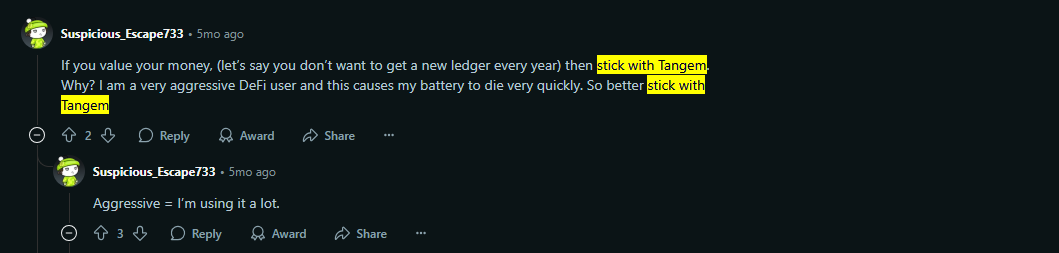
“If you value your money… stick with Tangem. I am a very aggressive DeFi user and this causes my battery to die very quickly.” And for those doing a lot of transactions, the convenience can’t be overstated.
Tangem vs Ledger Nano X Discussion – Source: Reddit
One experienced user wrapped it up best:
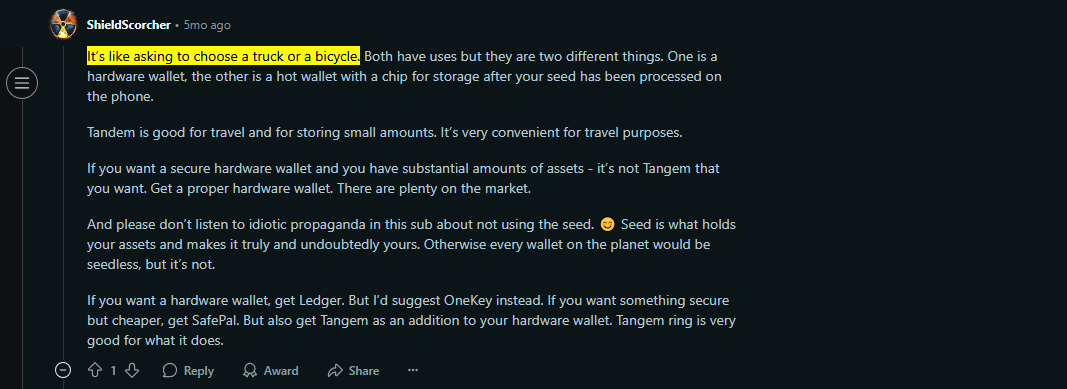
“It’s like choosing between a truck and a bicycle. Both have uses… it depends on your lifestyle.” He even recomended other solid hardware wallets like OneKey and SafePal, giving new buyers more trusted options to explore.
Tangem vs Ledger Nano X Discussion – Source: Reddit
What’s clear from the community? Both wallets have loyal supporters, and each shines in different real-life scenarios. If you’re more about convenience and minimalism, Tangem wins hearts. But if you’re looking for power features and control, Ledger still carries serious weight.
Let’s wrap things up with a quick bird’s-eye view of where each wallet shines — and where each one may fall short. This helps bring all the points home before we land on a verdict.
🔵 Tangem Wallet
Pros:
No battery, no charging, no cables — just tap and go
Waterproof, bend-proof, tamper-resistant card form factor
Affordable pricing, especially for families (2 or 3-card sets)
Supports 6,000+ coins with no need to install apps
Open-source mobile app and offline-only security model
Backups available via multiple cards or optional seed phrase
NFT support via WalletConnect
Cons:
No screen, so all approvals must be confirmed via smartphone
Some features require WalletConnect workarounds
Firmware cannot be upgraded, which is both a pro and con
⚫ Ledger Nano X
Pros:
Secure chip (CC EAL5+) with proven security over time
Supports over 5,500 assets, with deep DeFi and NFT integration
Built-in screen and buttons for on-device transaction verification
Works with both mobile and desktop, including USB and Bluetooth
Trusted brand, used by millions globally
Regular firmware updates with feature enhancements
Cons:
More expensive upfront than most hardware wallets
App installation limits (100 max at a time)
Battery requires charging, and device needs occasional maintenance
Ledger Recover controversy raised questions about long-term trust
Now that we’ve seen where both wallets stand on convenience, compatibility, and credibility, let’s settle the most important question: which one should you actually choose?
🛒 Where & How to Buy: Safe Options for Both Wallets
So you’ve made up your mind — or at least narrowed it down — between the Tangem Wallet and the Ledger Nano X. The next crucial step? Buying safely. Because in the world of crypto, where you buy your hardware wallet is just as important as which wallet you buy.
🔐 Buying the Ledger Nano X
If you’re going for the Ledger Nano X, do yourself a favor: only buy from the official Ledger website. This cannot be stressed enough. I once heard from a user who ordered from a random third-party site, only to receive a device that showed signs of tampering. That’s a nightmare scenario — because once a hardware wallet’s security is compromised, your crypto is too.
The official Ledger store gives you peace of mind, with every device shipped factory-sealed and covered by a 1–3 year warranty and full tech support. You’ll also enjoy free standard shipping (15–30 days), or you can choose Expedited Express Shipping via FedEx, DHL, or UPS (5–8 days). Keep in mind: depending on your location outside the U.S., a tariff tax of around $28 may apply — but the added security and support are worth it.
The checkout process is also smooth. Ledger supports multiple payment methods including PayPal, Visa, BitPay, Crypto.com Pay, Google Pay, and more. I’ve had to reach out to their customer support in the past, and the experience was top-notch — fast, clear, and helpful. That’s not something you get from a sketchy reseller.
If you’re leaning toward the Tangem Wallet, the smartest move is to buy directly from Tangem’s official website or from one of their verified distributors listed on the site. Not only does this guarantee that you’re getting a genuine, untampered product, but it also gives you access to ongoing deals and discounts — including 10% off when you use our exclusive promo code: MARKETSXPLORA at checkout.
Shipping is available worldwide, and depending on your country of residence, your wallet typically arrives within 8 to 17 business days. Tangem ships its wallets in sealed, tamper-evident packaging, so you can be confident your cards arrive secure and untouched — straight from the factory.
Payment is easy and flexible. Tangem accepts major credit/debit cards, Apple Pay, Google Pay, and even cryptocurrency, making it simple to buy your wallet with whatever method works best for you.
The choice between Tangem Wallet and Ledger Nano X doesn’t come down to which is “better” — it comes down to which one fits the way you use crypto.
If you want a wallet that’s ready anytime you need it, Tangem is the clear pick. It’s simple, secure, and strong enough to survive just about anything life throws at it.
But if you’re someone who’s deeply into NFTs, DeFi, custom tokens, and on-screen transaction approvals, Ledger Nano X is still one of the most trusted and battle-tested wallets in the world.
Both wallets are solid, secure, and well-made. So whichever you pick, you’re taking a big step toward owning your crypto — the right way.
Yes, both are hardware (cold) wallets, meaning they store your private keys offline—making them far more secure than software (hot) wallets. Tangem uses EAL6+ certified secure chips, and Ledger Nano X uses a CC EAL5+ certified chip with custom OS and a display screen for transaction verification. Each has a solid reputation and track record.
Where should I buy the Tangem Wallet and Ledger Nano X?
To avoid tampered or fake devices, always buy from official websites.
Tangem is available at Tangem.com. Use promo code MARKETSXPLORA for 10% off. Delivery takes 8–17 business days, depending on your country.
Ledger Nano X is best purchased from Ledger.com to guarantee authenticity. They offer free standard shipping, or faster express shipping via FedEx/DHL/UPS.
Is Ledger Nano X better than Tangem Wallet?
It depends on your needs. Ledger Nano X offers more advanced features, a screen for on-device verification, and greater control. It’s ideal for tech-savvy users. Tangem, however, wins on simplicity, mobility, and setup ease. It’s better for beginners, travelers, and mobile-first users. Both are excellent—but cater to different lifestyles.
What coins and tokens does Tangem Wallet support?
Tangem supports 6,000+ coins and tokens, including Bitcoin, Ethereum, Solana, XRP, USDT, USDC, and many ERC-20, BEP-20, and Polygon tokens. It also supports NFTs via WalletConnect, which lets you manage your NFTs through integrated marketplaces.
Can I store NFTs on Tangem Wallet?
Yes. While you can’t view NFTs directly inside the Tangem app, you can connect Tangem to an NFT marketplace using WalletConnect. This allows you to store and manage NFTs securely through external interfaces.
What happens if I lose my Tangem card?
If you set up your Tangem wallet with 2 or 3 backup cards, losing one doesn’t mean you lose access. You’ll still be able to sign and recover your wallet using any of the remaining cards. However, if you lose all cards and didn’t set up a backup, your wallet is unrecoverable.
Does Ledger Nano X have a backup and recovery option?
Yes. Ledger Nano X uses a 24-word Secret Recovery Phrase during setup. As long as you have this phrase written down and stored securely, you can recover your wallet on any compatible device, even if your Nano X is lost or damaged.
Can I use both Tangem and Ledger together?
Absolutely. Some users use Tangem for spending and travel, and Ledger for long-term storage. Having both can provide flexibility—just make sure to keep each device secure and their respective recovery methods safe.