

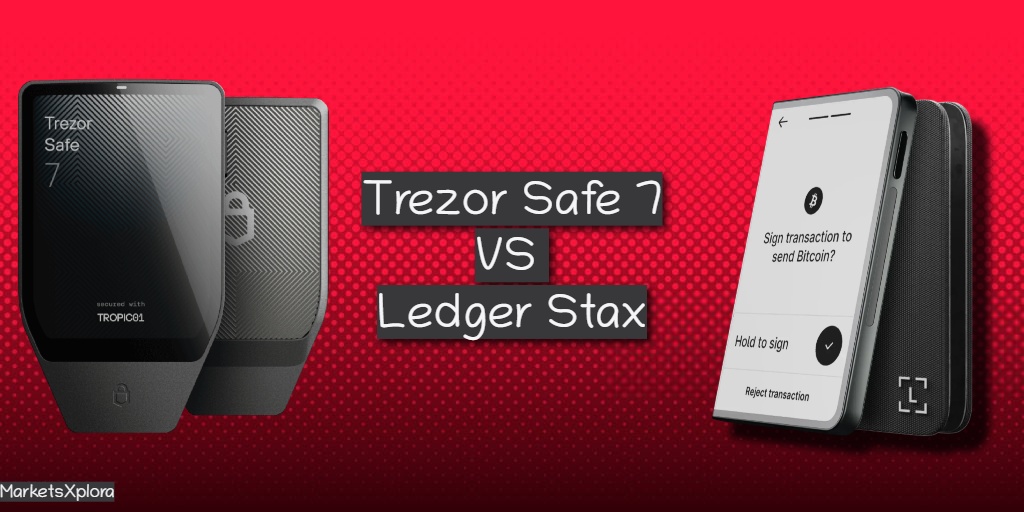
Choosing between the Trezor Safe 7 vs Ledger Stax means deciding between two flagship hardware wallets at premium price points. This comprehensive comparison will help you determine which wallet delivers the best value for your specific needs.
Trezor Safe 7 vs Ledger Stax: Quick Specs Comparison
Here’s how the Trezor Safe 7 vs Ledger Stax stack up side by side:
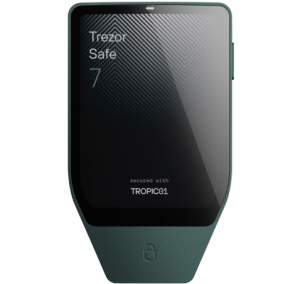 |
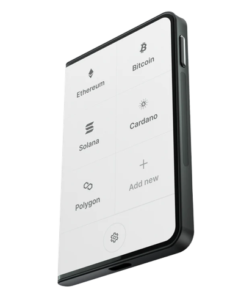 |
|
|---|---|---|
Price |
$249 |
$399 |
Launch Date |
October 21, 2025 |
May 2024 |
Display Type |
Color LCD |
E-Ink (grayscale) |
Screen Size |
2.5″ (520x380px) |
3.7″ (672x400px) |
Display Technology |
Vibrant color |
16 shades of gray |
Display Brightness |
700 nits |
No backlight (E-Ink) |
Weight |
45g |
45g |
Battery Capacity |
330mAh LiFePO₄ |
200mAh Li-ion |
Wireless Charging |
Yes (Qi2 magnetic) |
Yes (Qi standard) |
Bluetooth |
Yes (encrypted) |
Yes (Bluetooth 5.2) |
NFC |
No |
No |
Secure Chips |
TROPIC01 + EAL6+ (dual) |
ST33K1M5 (CC EAL6+, single) |
Quantum-Ready |
Yes |
No |
Firmware |
Open-source |
Closed-source (~95% open) |
Water/Dust Rating |
IP54 |
None |
Body Material |
Aluminum unibody |
Aluminum + plastic back |
Glass Protection |
Gorilla Glass 3 |
Curved E-Ink (no glass) |
Colors Available |
3 options |
Black (limited editions exist) |
Haptic Feedback |
Yes |
No |
Stackable Design |
No |
Yes (magnetic stacking) |
What’s in the Box:
Trezor Safe 7: Hardware wallet, USB-C cable, 2x 20-word backup cards, startup guide, safety guide, stickers, free Qi2 magnetic wireless charger
Ledger Stax: Hardware wallet, USB-C cable, recovery sheet, quick start guide, Ledger Recovery Key (physical backup card), magnetic protective shell
The $150 price gap between the Ledger Stax vs Trezor Safe 7 primarily reflects screen technology and design philosophy differences.
Design & Build Quality
Both wallets represent the pinnacle of hardware wallet design, but they achieve premium status through different aesthetics.
Trezor Safe 7 Build:
- Premium aluminum unibody construction (single block of metal)
- Reinforced glass backplate with NCVM coating
- Gorilla Glass 3 screen protection (scratch and impact resistant)
- IP54-rated protection against dust and water splashes
- Weighs 45g—solid but portable
- Compact dimensions: 75.4 x 44.5 x 8.3mm
- Thicker profile at 8.3mm accommodates larger battery
- Three color choices: Charcoal Black, Obsidian Green, Bitcoin Orange
- Traditional rectangular form factor
Ledger Stax Build:
- Aluminum frame with plastic back cover (hybrid construction)
- Curved E-Ink display wraps around the device’s spine
- No water/dust resistance rating
- Credit card-sized form factor: 85 x 54 x 6mm
- Ultra-thin at only 6mm—thinner than five credit cards stacked
- Weighs 45g (same as Safe 7 despite different materials)
- Embedded magnets enable stacking multiple devices
- Primarily available in graphite black (limited editions like Bitcoin Orange and Balenciaga collaboration exist)
- Futuristic, curved design by Tony Fadell (iPod creator)
Design Philosophy:
The Stax vs Trezor comparison reveals fundamentally different design priorities. The Safe 7 emphasizes rugged durability with its all-metal construction and IP54 rating—perfect for travelers or outdoor enthusiasts who need splash and dust protection. The Stax prioritizes sleek aesthetics and thinness, fitting perfectly in a wallet alongside credit cards. Its curved E-Ink display creates an iconic, futuristic appearance that stands out.
Stackability Feature:
The Ledger Stax includes embedded magnets that let you stack multiple devices together with a satisfying “click.” This feature appeals to users managing multiple wallets for different purposes (one for Bitcoin, one for DeFi, one for NFTs). The magnets also enable the protective shell to attach securely. The Trezor Safe 7 lacks this feature but doesn’t need it—its compact rectangular design stores easily anywhere.
Build Quality Winner: Safe 7 for durability and ruggedness; Stax for sleek, ultra-thin premium aesthetics.
Display Comparison
The screen is where the Trezor Safe 7 vs Ledger Stax comparison gets most interesting—these are completely different display technologies.
Display Feature |
Trezor Safe 7 |
Ledger Stax |
|---|---|---|
Technology |
Color LCD with backlight |
Curved E-Ink (no backlight) |
Screen Size |
2.5 inches |
3.7 inches |
Resolution |
520 x 380 pixels |
672 x 400 pixels |
Colors |
Full color spectrum |
16 shades of gray (up to 4 for menus) |
Brightness |
700 nits (very bright) |
Reflects ambient light (like Kindle) |
Screen Curvature |
Flat |
Curves around spine |
Outdoor Visibility |
Excellent (bright backlight) |
Excellent (reflective like paper) |
Dark Environment |
Perfect (backlit) |
Poor (no backlight needed) |
Power Consumption |
Higher (backlight uses power) |
Extremely low (only updates use power) |
Always-On Display |
No |
Yes (shows name/NFT when off) |
Haptic Feedback |
Yes |
No |
Eye Strain |
Minimal (quality LCD) |
Minimal (paper-like E-Ink) |
Touch Response |
Fast, responsive |
Responsive but slower (E-Ink refresh) |
Trezor Safe 7 Display Experience:
The Safe 7’s 2.5-inch color LCD with 700 nits brightness delivers a smartphone-like experience. Colors pop vibrantly, making transaction details and addresses easy to read at a glance. The bright backlight ensures perfect visibility in any lighting condition—from pitch-black rooms to bright sunlight. Haptic feedback provides satisfying tactile confirmation with every tap. This display excels for users who frequently verify transactions in varied lighting conditions.
Ledger Stax Display Experience:
The Stax’s 3.7-inch curved E-Ink touchscreen represents a breakthrough in hardware wallet design. Like a Kindle reader, it reflects ambient light rather than emitting it, creating a paper-like reading experience that’s easy on the eyes during extended use. The larger 3.7-inch screen displays more information simultaneously, reducing scrolling. The curved design allows your device name and battery status to display on the spine even when powered off.
The E-Ink Trade-Off:
E-Ink technology offers exceptional battery efficiency—the Stax can display your name and favorite NFT on the lock screen for months without power. However, E-Ink has limitations: no backlight means dark environments require external lighting, and screen refresh rates are slower than LCD (you’ll notice a brief flash when changing screens). The grayscale-only display means no color verification for NFTs or visual elements.
Screen Size Winner: Ledger Stax with 3.7″ display vs. 2.5″ on Safe 7 Display Technology Winner: Depends on priority—Safe 7 for color/brightness, Stax for battery life/always-on display
Security Architecture
Security is the foundation of any hardware wallet, and both devices offer exceptional protection with different approaches.
Trezor Safe 7 Security:
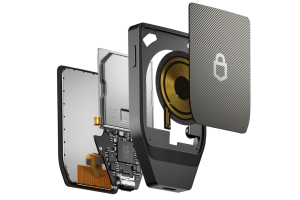
- Dual Secure Element Protection: Revolutionary TROPIC01 chip (world’s first auditable Secure Element) + additional NDA-free EAL6+ certified chip
- Quantum-Ready Architecture: Specifically designed to receive quantum-secure firmware updates
- Complete Open-Source Transparency: 100% of firmware publicly auditable
- Auditable TROPIC01 Chip: Transparent Secure Element allows anyone to verify security mechanisms
- PIN Protection: Up to 50 digits
- Advanced Multi-share Backup: SLIP39 Shamir Backup for distributed recovery
- Passphrase Protection: 25th word capability
- MicroSD Encryption: Additional PIN encryption layer
- No History of Hacks: Clean security record
Ledger Stax Security: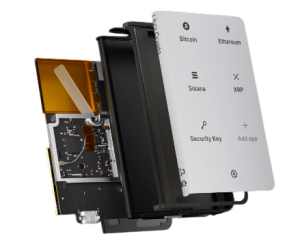
- Single Secure Element: ST33K1M5 chip with CC EAL6+ certification (same chip used in billions of bank cards)
- No Quantum Readiness: Standard current-generation security
- Mostly Open-Source: ~95% open-source (Ledger Live, OS, apps)—Secure Element low-level code is proprietary (NDA-protected)
- Ledger OS: Proprietary operating system running on Secure Element
- Secure Touchscreen Connection: Screen connects directly to Secure Element (not through MCU)
- PIN Protection: Standard PIN with auto-reset after 3 wrong attempts
- 24-Word Recovery: Industry-standard BIP39 backup
- Passphrase Protection: 25th word capability
- Ledger Recovery Key: Optional physical backup card (included)
- No History of Device Hacks: Clean security record (Ledger Live had a 2020 data breach affecting customer info, not wallet security)
The Open-Source Debate:
This is the most significant security difference in the Stax vs Trezor comparison. Trezor’s completely open-source firmware (including the auditable TROPIC01 chip) means every security mechanism can be independently verified by researchers worldwide. This transparency eliminates “trust” from the equation—you can verify rather than believe security claims.
Ledger’s approach keeps the Secure Element’s low-level code proprietary due to manufacturer NDAs. While ~95% of Ledger’s software is open-source, the most critical security component remains closed. Ledger argues this “security through obscurity” prevents attackers from finding vulnerabilities, while critics counter that open verification is more trustworthy.
Dual Chip Advantage:
The Safe 7’s dual Secure Element architecture provides redundant protection. Even if an extremely sophisticated attack compromised one chip, the second provides backup security. The TROPIC01 chip’s auditability represents a breakthrough—it’s the first Secure Element where the public can verify how it protects private keys rather than trusting proprietary implementations.
Quantum-Ready Protection:
The Trezor Safe 7 is the only hardware wallet specifically built with quantum-ready architecture. When quantum computers eventually threaten current cryptographic standards (predicted in 10-20 years), the Safe 7 can receive quantum-secure firmware updates. The Ledger Stax lacks this future-proofing. If you plan to hold crypto for decades as generational wealth, quantum readiness matters significantly.
Secure Touchscreen Architecture:
The Ledger Stax connects its touchscreen directly to the Secure Element chip rather than routing through a microcontroller unit (MCU). This architecture prevents potential attacks targeting the display connection. Both devices ensure what you see on screen is what you’re actually signing.
Security Verdict: Safe 7 offers superior long-term security with dual chips, complete transparency, and quantum readiness. Stax provides excellent current-generation security with battle-tested Ledger architecture.
|
|
|---|---|
Connectivity & Power
Both premium wallets offer wireless freedom, but their power management philosophies differ significantly.
Connectivity Comparison:
Connection Type |
Trezor Safe 7 |
Ledger Stax |
|---|---|---|
USB-C |
Yes |
Yes |
Bluetooth |
Yes (THP encryption) |
Yes (Bluetooth 5.2) |
NFC |
No |
No |
Wireless Charging |
Yes (Qi2 magnetic) |
Yes (Qi standard) |
Cable Included |
USB-C to USB-C |
USB-C to USB-C |
Mobile Compatibility |
Wireless + wired |
Wireless + wired |
Desktop Use |
Wireless + wired |
Wireless + wired |
Bluetooth Encryption |
Trezor Host Protocol (THP) |
Proprietary Ledger protocol |
Disable Wireless |
Yes (in settings) |
Yes (airplane mode) |
Both the Trezor Safe 7 and Ledger Stax deliver true wireless freedom via encrypted Bluetooth. You can manage transactions from your couch, approve smart contracts from bed, or sign transactions while away from your desk. The encrypted Bluetooth connections match wired security—no compromise for convenience.
Wireless Charging:
The Ledger Stax vs Trezor Safe 7 both support wireless charging, but with different standards:
- Safe 7: Qi2 magnetic wireless charging (includes free magnetic charger in box worth $30-40). The magnetic alignment ensures perfect positioning for efficient charging.
- Stax: Standard Qi wireless charging (no charger included—requires separate purchase). Works with iPhone, Samsung, and other Qi-compatible chargers you may already own.
The Safe 7’s included magnetic charger adds significant value, while the Stax assumes you already have Qi chargers at home.
Battery Performance:
This is where the display technology creates dramatically different power profiles:
Trezor Safe 7:
- LiFePO₄ battery (lithium iron phosphate)—330mAh capacity
- 4x more charge cycles than standard lithium batteries
- Retains power for years in storage without degradation
- Safe to fully drain repeatedly
- Thermal stability prevents overheating
- Battery designed to outlast the device’s usable lifetime
- Can operate via USB-C if battery eventually fails
- Active use duration not specified (but lower than Stax due to color LCD)
Ledger Stax:
- Standard lithium-ion battery—200mAh capacity
- Up to 10 hours of active use (~150 transactions per charge)
- Weeks or months in standby mode
- E-Ink display consumes minimal power
- Always-on lock screen displays name/NFT for months without power
- Can operate via USB-C if battery dies
- Expected 5-year battery lifespan
- Full charge in ~2 hours
Battery Philosophy:
The Safe 7’s larger LiFePO₄ battery prioritizes longevity and safety over capacity. It’s designed to last decades without degradation, perfect for cold storage devices you might not use for years. The Stax’s smaller lithium-ion battery benefits from the ultra-efficient E-Ink display, achieving weeks of standby time despite the smaller capacity.
User Experience
Daily usability determines whether your premium hardware wallet feels like a luxury or a burden.
Setup Process:
Both wallets offer streamlined setup through their respective apps:
Trezor Safe 7:
- Trezor Suite (desktop and mobile)
- 15-20 minutes initial setup
- Color display with clear, intuitive prompts
- Wireless or wired setup options
- Create PIN (up to 50 digits)
- Generate 12/20/24-word recovery phrase
- Verify recovery phrase on device
Ledger Stax:
- Ledger Live (desktop and mobile)
- 15-20 minutes initial setup
- Large E-Ink touchscreen guides you through
- Scan QR code with phone to download app
- Create PIN
- Generate 24-word recovery phrase
- Name your device and customize lock screen
- Optional Ledger Recovery Key setup (physical backup card)
Learning Curve:
- Complete beginners: Stax’s larger screen shows more information, reducing overwhelm. Ledger Live’s extensive tutorials help newcomers.
- Experienced users: Safe 7’s open-source transparency and quantum readiness appeal to security-conscious crypto veterans.
- Mobile-first users: Both excel with Bluetooth, but Stax’s thinner profile fits better in pockets.
- Desktop users: Both work identically via USB-C.
Special Features:
- Safe 7: IP54 water/dust protection means you don’t panic over spills or dust
- Stax: Stackable magnetic design organizes multiple wallets elegantly; always-on lock screen displays your chosen NFT or photo
Cryptocurrency Support
Both wallets support thousands of cryptocurrencies since they use mature, established ecosystems.

Trezor Safe 7:
- 1,000+ coins and tokens supported
- Bitcoin, Ethereum, Solana, Cardano, Polkadot, Arbitrum, USDC, USDT
- All major ERC-20 tokens
- BEP-20, TRC-20, and other token standards
- 70,000+ dApps via WalletConnect
- 30+ third-party wallet apps (MetaMask, Rabby, Backpack, Exodus, MyEtherWallet, Lace, Ronin, Monero wallet)
- NFT support through WalletConnect integration
- Continuous expansion with firmware updates
Ledger Stax:
- 500+ coins natively supported in Ledger Live
- 5,500+ total coins/tokens with third-party wallet integration
- Bitcoin, Ethereum, Solana, Ripple, Cardano, and all major networks
- All major token standards (ERC-20, BEP-20, TRC-20)
- 50+ third-party wallet apps (MetaMask, MyEtherWallet, Crypto.com Onchain Wallet, Guarda, Tronscan)
- Native NFT viewing and management in Ledger Live
- Ethereum and Polygon NFTs displayed directly on device
- Display your favorite NFT on lock screen (grayscale)
Cryptocurrency Support Winner:
The Ledger Stax offers more native support (500 vs. 1,000+ is unclear—Trezor claims “1,000s” without specific numbers). Ledger’s mature ecosystem with 500+ natively supported assets in Ledger Live provides smoother management for diverse portfolios. However, both wallets support virtually all significant cryptocurrencies through third-party integrations.
NFT Management:
The Stax excels for NFT collectors with native display capabilities and the ability to showcase your favorite NFT on the always-on lock screen (though in grayscale). The Safe 7 manages NFTs through connected wallets but doesn’t display them directly on the device.
|
|
|---|---|
Ecosystem & Compatibility
Both devices integrate with comprehensive ecosystems, but they differ in maturity and features.
Native Apps:
Trezor Suite |
Ledger Live |
|
|---|---|---|
Platforms |
Desktop, Mobile, Web |
Desktop, Mobile |
Portfolio Tracking |
Yes |
Yes |
Price Charts |
Yes |
Yes |
News Feed |
No |
Yes |
DeFi Integration |
Via WalletConnect |
Built-in + WalletConnect |
NFT Gallery |
Through third-party |
Native support with viewing |
Staking Interface |
Available |
Available |
Transaction History |
Comprehensive |
Comprehensive |
Account Management |
Multi-account support |
Multi-account support |
CL Card Integration |
No |
Yes (crypto debit card) |
Ledger Live Advantages:
Ledger Live is more mature with 10+ years of development. It includes a news feed, more built-in DeFi integrations, and the CL Card—a crypto debit card powered by Ledger that lets you spend crypto directly. The app natively displays NFTs from your collection.
Trezor Suite Advantages:
Trezor Suite emphasizes privacy with built-in Tor integration, advanced coin control for Bitcoin, and CoinJoin support. The interface is clean and uncluttered, focusing on essential features without overwhelming users.
dApp Support:
- Trezor Safe 7: 70,000+ dApps accessible via WalletConnect
- Ledger Stax: Extensive dApp support through Ledger Live and WalletConnect
Both wallets connect seamlessly to DeFi platforms (Uniswap, Aave, Jupiter, Balancer, Lido, Curve), NFT marketplaces (OpenSea, Rarible, Foundation), and Web3 applications. Your transaction signing always happens on the physical device, maintaining complete security.
Trading & Staking Features
Modern flagship wallets must support more than storage—active users need trading and staking capabilities.
Built-in Trading:
Both devices enable buying, selling, and swapping crypto through their companion apps:
Trezor Safe 7:
- Buy crypto with credit/debit card, Apple Pay, Google Pay
- Sell crypto and withdraw to bank accounts
- Swap between cryptocurrencies
- Compare rates across multiple providers
- Direct integration with exchange partners
Ledger Stax:
- Buy crypto with credit/debit card, PayPal
- Sell crypto with fiat withdrawal
- Swap tokens with provider comparison
- Access to institutional-grade exchanges
- CL Card for spending crypto directly
Staking Options:
Network |
Annual Yield |
Safe 7 |
Stax |
|---|---|---|---|
Ethereum |
3-5% |
Yes |
Yes |
Solana |
6-8% |
Yes |
Yes |
Cardano |
4-6% |
Yes |
Yes |
Polkadot |
12-14% |
Yes |
Yes |
Cosmos (ATOM) |
15-20% |
Yes |
Yes |
Toncoin (TON) |
4-6% |
Yes |
Yes |
Polygon |
5-8% |
Yes |
Yes |
Tezos |
5-7% |
Yes |
Yes |
Tron |
3-5% |
Yes |
Yes |
Algorand |
4-6% |
Yes |
Yes |
Both wallets support staking for major proof-of-stake networks directly through their apps. You earn passive income while maintaining complete custody—no third-party staking services required.
Privacy Features
Privacy capabilities are software-based, so differences reflect ecosystem priorities.
Trezor Safe 7 Privacy:
- Built-in Tor Integration: Hide your IP address and online activity
- Advanced Coin Control: Sophisticated UTXO selection prevents transaction linking
- CoinJoin Support: Mix Bitcoin with others for enhanced privacy
- Address Reuse Prevention: Automatic new address generation
- No Account Requirement: Use completely anonymously without Trezor account
- Passphrase Protection: Create hidden wallets with 25th word
- Multi-Account Support: Separate accounts for different purposes
- MicroSD PIN Encryption: Additional security layer
Ledger Stax Privacy:
- Basic Coin Control: Standard address management
- No Built-in Tor: Must use external tools
- Privacy-Focused Coins: Support for Monero and privacy tokens
- Passphrase Protection: Hidden wallets via 25th word
- Multi-Account Support: Separate accounts per cryptocurrency
- Optional Account: Anonymous usage possible without Ledger account
- No Advanced Privacy Tools: Relies on third-party wallet integrations
Privacy Winner: Trezor Safe 7 with built-in Tor, advanced coin control, and CoinJoin support. The Safe 7 prioritizes privacy-conscious users.
Advanced Features
Power users demand sophisticated capabilities beyond basic storage.
Two-Factor Authentication:
Both wallets support FIDO2/U2F authentication, transforming your hardware wallet into a universal security key:
- Log into Google, Amazon, GitHub, Binance, Coinbase without passwords
- Tap your device to authenticate
- Hardware-level protection for your online accounts
- Works with thousands of services
Backup & Recovery:
Backup Feature |
Trezor Safe 7 |
Ledger Stax |
|---|---|---|
Standard Recovery |
12/20/24 words |
24 words |
Enhanced Backup |
Multi-share (SLIP39 Shamir) |
Ledger Recovery Key (physical card) |
Passphrase Protection |
Yes (25th word) |
Yes (25th word) |
Shamir Backup |
Yes (split recovery) |
No |
Cloud Recovery |
No |
Optional Ledger Recover ($9.99/month) |
MicroSD Encryption |
Yes |
No |
Backup Philosophy:
The Safe 7’s Shamir Backup (SLIP39) splits your recovery across multiple shares (e.g., 3 of 5 required). Store shares in different locations—even if someone finds one share, they can’t access your crypto. The Stax includes a physical Ledger Recovery Key (backup card) and offers optional Ledger Recover, a paid subscription that stores encrypted recovery shards with third parties.
Firmware Updates:
- Safe 7: Wireless updates via Bluetooth or USB-C
- Stax: Wireless updates via Bluetooth or USB-C
App/Coin Storage:
- Safe 7: Supports 1,000s of assets simultaneously through dual-chip architecture (specific storage not disclosed)
- Stax: Approximately 1.1MB storage for cryptocurrency apps, allowing 5-15 apps simultaneously installed
The Stax’s limited storage means you’ll need to uninstall/reinstall apps for less-used cryptocurrencies, while the Safe 7 appears to support more simultaneous assets.
Price & Value
The $150 price difference between these premium wallets represents distinct value propositions.
Trezor Safe 7 at $249:
What You Get:
- Dual Secure Element protection (TROPIC01 + EAL6+)
- World’s first auditable Secure Element chip
- Quantum-ready architecture for decades of security
- 2.5″ vibrant color display at 700 nits brightness
- Complete open-source transparency (100% firmware)
- Encrypted Bluetooth wireless connectivity
- Superior LiFePO₄ battery (330mAh, years-long lifespan)
- Free Qi2 magnetic wireless charger (worth $30-40)
- Premium aluminum unibody construction
- IP54 water and dust resistance
- Gorilla Glass 3 protection
- Haptic feedback
- Lighter package: wireless charger included
Actual Cost After Charger Value: Approximately $210-220
Ledger Stax at $399:
What You Get:
- Single Secure Element (ST33K1M5 CC EAL6+)
- Current-generation excellent security
- Largest 3.7″ curved E-Ink touchscreen in hardware wallets
- Revolutionary design by iPod creator Tony Fadell
- Ultra-thin 6mm profile (credit card-sized)
- Standard Qi wireless charging (charger not included)
- Smaller 200mAh lithium-ion battery (10 hours active use)
- Aluminum frame with plastic back
- Magnetic stacking design for multiple devices
- Customizable lock screen (display NFT or photo)
- Always-on display shows name/NFT when powered off
- Magnetic protective shell included
- Ledger Recovery Key physical backup card
- ~95% open-source (Secure Element proprietary)
- More mature ecosystem (Ledger Live)
Value Verdict:
The Safe 7 delivers better security value per dollar with dual chips, quantum readiness, and complete transparency at $150 less. The Stax commands premium pricing for its larger curved E-Ink display, ultra-thin design, and always-on customizable lock screen—essentially, you’re paying for design innovation and screen technology.
|
|
|---|---|
Pros & Cons
Trezor Safe 7
Strengths:
- $150 cheaper than Ledger Stax ($249 vs. $399)
- World’s first auditable TROPIC01 chip (dual Secure Element)
- Only quantum-ready hardware wallet available
- Complete 100% open-source firmware transparency
- Vibrant color display with 700 nits brightness
- Haptic feedback for tactile confirmation
- IP54-rated water and dust resistance
- Superior LiFePO₄ battery lasts years without degradation
- Free Qi2 magnetic wireless charger included
- Premium aluminum unibody construction
- Built-in Tor integration for privacy
- Advanced coin control and CoinJoin support
- MicroSD PIN encryption layer
- Better for outdoor use (bright backlit display)
- Instant screen refresh (no E-Ink delay)
Weaknesses:
- Smaller 2.5″ display (vs. Stax’s 3.7″)
- Thicker profile (8.3mm vs. 6mm)
- No always-on lock screen display
- Cannot display NFTs on device
- No magnetic stacking feature
- Fewer color options (3 vs. special editions)
- Newer device with less established user base
- Color LCD consumes more power than E-Ink
- No customizable lock screen
Ledger Stax
Strengths:
- Largest 3.7″ curved E-Ink display (48% bigger than Safe 7)
- Revolutionary design by Tony Fadell (iPod creator)
- Ultra-thin 6mm profile fits in wallet like credit card
- Customizable lock screen (display NFT or photo)
- Always-on display shows name/NFT when powered off
- Magnetic stacking design for organizing multiple devices
- Exceptional battery efficiency (10 hours active, weeks standby)
- Paper-like E-Ink reduces eye strain
- More mature Ledger ecosystem (10+ years)
- Native NFT viewing and management
- Magnetic protective shell included
- Ledger Recovery Key physical backup card
- CL Card crypto debit card integration
- Excellent for reading in bright sunlight (anti-glare)
Weaknesses:
- $150 more expensive ($399 vs. $249)
- Single Secure Element (vs. Safe 7’s dual chips)
- No quantum-ready architecture
- ~95% open-source (Secure Element proprietary)
- No water/dust resistance rating
- E-Ink has slower screen refresh (brief flashes)
- Grayscale only (no color display)
- No backlight (requires external light in darkness)
- No haptic feedback
- Smaller 200mAh battery (vs. 330mAh)
- No wireless charger included
- Plastic back vs. all-metal Safe 7
- No built-in Tor support
- Ledger Recover is paid subscription
- Limited app storage (5-15 apps simultaneously)
Which Should You Buy: Ledger Stax or Trezor Safe 7?
Choosing between Trezor Safe 7 vs Ledger Stax depends on your priorities and budget.
Choose Trezor Safe 7 if you:
- Want maximum security for the money (dual chips + quantum-ready at $150 less)
- Value complete open-source transparency (100% auditable)
- Plan to hold crypto for 10+ years (quantum-proofing essential)
- Need rugged protection for travel or outdoor use (IP54 rating)
- Prefer vibrant color displays over grayscale E-Ink
- Want instant screen response without E-Ink refresh delays
- Frequently transact in dark environments (backlit display)
- Care deeply about privacy (built-in Tor, CoinJoin)
- Appreciate haptic feedback confirmation
- Want superior battery longevity (LiFePO₄ technology)
- Need a free wireless charger included
- Are security-conscious and technically savvy
- Have a limited budget but want premium features
Choose Ledger Stax if you:
- Want the largest hardware wallet display available (3.7″)
- Love cutting-edge, ultra-thin design (6mm profile)
- Value the iconic Tony Fadell design aesthetic
- Want to display your favorite NFT on lock screen (even when off)
- Need credit card-thin portability for wallet storage
- Prefer paper-like E-Ink reading experience
- Manage multiple wallets and want magnetic stacking organization
- Are an NFT collector who wants native viewing
- Value the mature Ledger ecosystem and extensive support
- Don’t mind paying premium for design innovation
- Want always-on display showing device name/battery
- Prefer reading-focused displays that reduce eye strain
- Are comfortable with ~95% open-source (Secure Element proprietary)
- Have $399 budget for top-tier hardware wallet
For Long-Term HODLers:
The Trezor Safe 7 wins decisively. Quantum-ready architecture ensures your crypto remains protected when quantum computers eventually threaten current cryptography (10-20 years). The LiFePO₄ battery retains charge for years without degradation, perfect for cold storage you won’t touch for decades.
For NFT Collectors:
The Ledger Stax excels with native NFT viewing in Ledger Live and the ability to showcase your favorite NFT on the always-on lock screen. While it displays in grayscale, the 3.7-inch curved E-Ink creates an elegant gallery piece on your desk.
For Mobile Power Users:
Both devices offer excellent mobile experiences via Bluetooth, but the Stax’s ultra-thin 6mm profile slips into pockets more easily. However, the Safe 7’s bright 700-nit display provides better outdoor visibility for on-the-go transactions.
For Security Maximalists:
The Trezor Safe 7 offers superior security with dual Secure Elements (including the auditable TROPIC01 chip), quantum-ready architecture, and complete open-source transparency. Security researchers can verify every claim independently.
For Design Enthusiasts:
The Ledger Stax represents the pinnacle of hardware wallet industrial design. Tony Fadell’s curved E-Ink innovation, magnetic stacking, and always-on customizable display create an iconic device that’s as much art as function.
For Budget-Conscious Buyers:
The Trezor Safe 7 delivers more security features per dollar. At $249 (effectively $210-220 after the included wireless charger value), you get dual chips, quantum readiness, and IP54 protection for $150 less than the Stax.
|
|
|---|---|
Final Verdict
The Trezor Safe 7 vs Ledger Stax debate has no universal winner—these are two exceptional premium wallets with different strengths. Your decision should align with your specific needs: maximum security and value (Safe 7) or largest display and cutting-edge design (Stax). The $150 price difference is significant—the Safe 7 delivers more security features per dollar, while the Stax offers unmatched display technology and industrial design.
Compare
Trezor Safe 7 vs Ledger Flex: The 2026 Winner You Didn’t Expect
Trezor Safe 7 vs Safe 5 — Which Next-Gen Wallet Should You Buy?
Frequently Asked Questions
Which has better security: Safe 7 or Stax?
The Trezor Safe 7 offers superior security with dual Secure Element protection (TROPIC01 + EAL6+) versus the Stax’s single chip, quantum-ready architecture for future-proofing, and complete 100% open-source transparency versus Stax’s ~95% open-source. Both provide excellent current-generation security with clean track records, but the Safe 7’s additional security layers and quantum readiness matter for long-term holdings (10+ years).
Which battery lasts longer?
The Safe 7’s larger 330mAh LiFePO₄ battery retains charge for years in storage and offers 4x more charge cycles than standard batteries. The Stax’s 200mAh lithium-ion battery provides 10 hours of active use (~150 transactions) and weeks in standby mode thanks to ultra-efficient E-Ink.
Which is better for beginners?
The Ledger Stax’s larger 3.7-inch display shows more information simultaneously, reducing overwhelm for newcomers. Ledger Live’s extensive documentation and mature ecosystem (10+ years) help beginners learn. However, the Safe 7’s color display is more intuitive than grayscale E-Ink, and its lower $249 price is less intimidating than the Stax’s $399. Both offer excellent beginner experiences; choose based on your budget and display preference.
What happens if I lose my hardware wallet?
Your crypto remains completely safe. Simply purchase a replacement wallet (can be any brand supporting BIP39), enter your recovery phrase, and regain full access to your funds. The hardware wallet only stores keys—your actual crypto lives on the blockchain. Never share your recovery phrase with anyone, as it provides complete access to your funds.