

By Samson Ononeme | Last updated: May 2026 | 13-min read
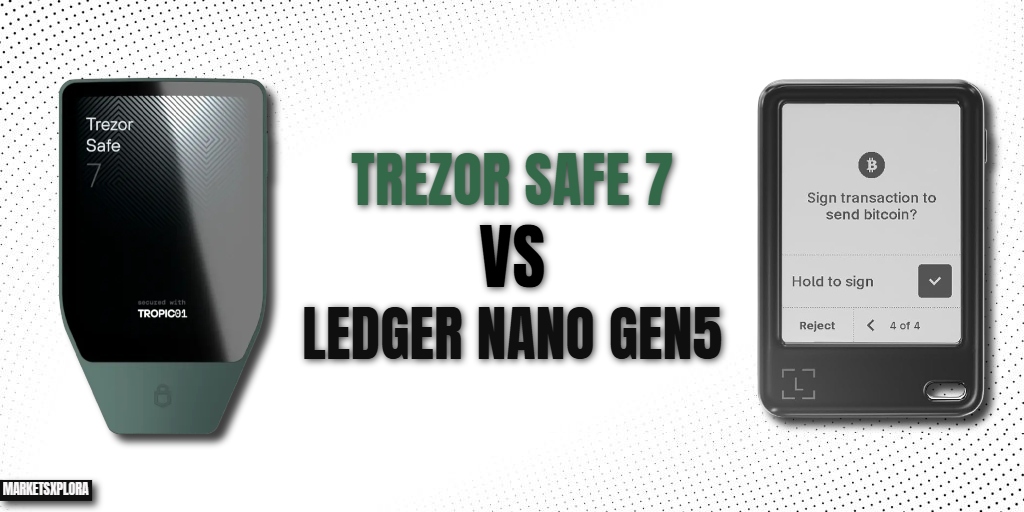
The Trezor Safe 7 ($249) and the Ledger Nano Gen5 ($179) both launched within days of each other in October 2025 — and they represent two completely different answers to the same question: what does a modern hardware wallet look like in 2026?
Seventy dollars separates them. The question is whether what the Safe 7 adds is worth the premium for your specific use case. This article answers that directly.
Quick verdict:
- Buy the Trezor Safe 7 ($249) if open-source auditability is non-negotiable, you want the most advanced dual-chip security architecture available, future-proofing against quantum threats matters to you, or you want a premium all-metal device with wireless charging.
- Buy the Ledger Nano Gen5 ($179) if you want EAL6+ certified security at $70 less, NFC matters to your workflow, you hold 5,000+ diverse assets, or you prefer a larger screen with Bluetooth and full iOS support without paying flagship prices.
Trezor Safe 7 vs Ledger Nano Gen5: Quick Comparison
Feature |

Trezor Safe 7 |

Ledger Nano Gen5 |
|---|---|---|
Price |
$249 |
$179 |
Launch |
October 21, 2025 |
October 23, 2025 |
Display size |
2.5 inches |
2.76 inches |
Display type |
Color LCD |
E-Ink touchscreen |
Display brightness |
700 nits |
No backlight (E-Ink) |
Resolution |
520×380px |
300×400px |
Screen protection |
Gorilla Glass 3 |
None |
Haptic feedback |
Yes |
No |
Secure Element |
Dual: TROPIC01 + OPTIGA Trust M (EAL6+) |
Single: ST33K1M5 (EAL6+) |
Firmware |
Fully open-source |
Proprietary (Ledger BOLOS) |
Open-source hardware |
Yes |
No |
Quantum-ready |
Yes (SLH-DSA-128) |
No |
Certified Secure Screen |
Yes |
Yes |
Clear Signing |
Yes |
Yes |
Bluetooth |
Yes (THP encrypted) |
Yes (Bluetooth 5.2) |
NFC |
No |
Yes |
Wireless charging |
Yes (free Qi2 charger included) |
No |
Battery |
LiFePO4 |
330mAh LiFePO4 |
USB-C |
Yes |
Yes |
iOS support |
Yes — Full |
Yes — Full |
IP rating |
IP54 |
None |
Frame material |
Unibody anodized aluminum |
Plastic |
Shamir Backup |
Yes (SLIP39) |
No |
Coin support |
1,000+ |
5,000+ |
FIDO2 / 2FA |
Yes |
Yes |
Colors |
Charcoal Black, Obsidian Green, Bitcoin Orange |
Black + Limited Edition |
Software |
Trezor Suite (desktop + mobile) |
Ledger Wallet (desktop + mobile) |
Price and Value
At $249 and $179 respectively, the Safe 7 costs $70 more than the Gen5 — the same gap as between the Gen5 and the Ledger Flex. Before spending the extra $70, it is worth being precise about what it buys.
What the $70 premium buys on the Safe 7:
- Dual secure element architecture (two EAL6+ chips vs one)
- Fully open-source hardware and firmware — independently auditable by anyone
- Post-quantum boot architecture (SLH-DSA-128)
- Unibody anodized aluminum construction vs plastic
- 700-nit color LCD display vs monochromatic E-Ink
- Gorilla Glass screen protection
- Free Qi2 wireless charger in the box
- Shamir Backup (SLIP39) support
- IP54 dust and water resistance
- Hardware-enforced PIN slot destruction (vs firmware-enforced wipe)
What the $70 saves on the Gen5 without losing:
- EAL6+ certified Secure Element security — same certification tier
- Certified Secure Screen architecture
- Clear Signing and Transaction Check
- Full Bluetooth and iOS support
- NFC (which the Safe 7 lacks)
- Larger display (2.76″ vs 2.5″)
- Broader coin support (5,000+ vs 1,000+)
- 330mAh battery
Value verdict: The Safe 7 is a better device in most security dimensions. But the Gen5 is not a compromised device — it is a strong device at a lower price. The $70 premium is justified for users who specifically need what the Safe 7 adds. It is not justified for users who primarily need EAL6+ certified security and wireless mobile convenience.
Design and Build Quality
Trezor Safe 7
The Safe 7 is the most premium hardware wallet Trezor has ever made — and it shows. The unibody is milled from a single block of anodized aluminum, a manufacturing process described by several component suppliers as unusually difficult for a consumer device. The result is a device that feels more like a compact premium smartphone than a security peripheral.
The front is dominated by a 2.5-inch color LCD display behind Gorilla Glass 3. The rear panel is reinforced glass with NCVM (Non-Conductive Vacuum Metallization) coating — a process borrowed from high-end consumer electronics manufacturing that gives the device its metallic visual finish while maintaining non-conductive properties.
The Safe 7 carries an IP54 dust and splash resistance rating — sufficient for rain, coffee splashes, and the wear of daily travel. No competing touchscreen hardware wallet at this price offers a comparable IP rating.
Available in Charcoal Black, Obsidian Green, and Bitcoin Orange — the last of which ships with Bitcoin-only firmware for BTC maximalists who want a reduced attack surface.
In the box: device, USB-C cable, two 20-word backup cards, startup guide, stickers, and a free Qi2 magnetic wireless charger. The charger alone carries meaningful retail value, partially offsetting the $70 premium over the Gen5.
Ledger Nano Gen5
The Gen5 is plastic throughout — a lighter, more affordable material that keeps the device at 46 grams and the price at $179. There is no aluminum, no Gorilla Glass, and no IP rating. The display is unprotected against scratching, which will accumulate with daily pocket carry over time.
The device is physically compact — 79.40 × 53.35 × 8.64mm — and the 2.76-inch E-Ink screen actually gives it a larger active display surface than the Safe 7 despite the smaller overall footprint implied by the 2.5-inch figure on the competitor. Susan Kare-designed magnetic decorative badges are sold separately as optional personalization.
Build verdict: Safe 7 wins decisively — unibody aluminum, Gorilla Glass, IP54, and significantly more premium construction at every level. The Gen5 is functional and durable enough for careful daily use, but there is no contest on materials.
Display Comparison
Both devices have touchscreens. Beyond that, almost everything about their display approach is different.
Trezor Safe 7: 2.5-Inch Color LCD, 700 Nits
The Safe 7 uses a backlit color LCD display — the same display technology found in smartphones. At 700 nits of brightness, it is one of the most readable hardware wallet displays in any lighting condition, including direct sunlight. Full color renders transaction details, token logos, and interface elements with visual hierarchy. Haptic feedback confirms every tap.
At 520×380 pixels, text is sharp and addresses are legible in their entirety without requiring full-screen zoom. For complex DeFi transactions, multi-token approvals, and NFT interactions, the color display provides visual differentiation between fields that monochromatic displays cannot.
The trade-off: color LCD consumes significantly more power than E-Ink. The Safe 7’s battery drains faster during active use than the Gen5’s.
Ledger Nano Gen5: 2.76-Inch E-Ink Monochrome
The Gen5’s E-Ink display is physically larger than the Safe 7’s — 2.76 inches versus 2.5 inches. Counterintuitively, the cheaper device has the larger screen. The Gen5’s larger display surface means full Ethereum addresses and multi-field contract details often fit without scrolling — a practical advantage over the Safe 7 for text-heavy transactions.
The trade-offs are color and backlight. E-Ink renders in pure black and white only. There is no color-coded visual hierarchy, no haptic feedback, and no backlight — meaning the Gen5 requires external light in dim environments.
In direct sunlight, E-Ink wins clearly over any backlit screen. For outdoor use, the Gen5 is more readable than the Safe 7 despite the lower resolution.
Display verdict: Safe 7 wins on color, brightness, and haptic feedback — better for indoor and DeFi-heavy use. Gen5 wins on physical screen size and outdoor readability. The right choice depends on your primary use environment.
Security Architecture: The Main Difference
Both devices are secure. The difference between them is not about whether your funds are safe — it is about how that safety is implemented and verified. This is the most important section in this comparison.
Trezor Safe 7: Dual Open-Source Secure Elements
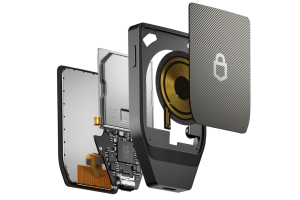
The Safe 7 uses two independent Secure Element chips working together:
TROPIC01 — the world’s first fully open-source, NDA-free Secure Element chip, developed by Tropic Square (a SatoshiLabs subsidiary). Its entire architecture — hardware design, firmware, and cryptographic implementation — is publicly auditable. Any security researcher worldwide can read the complete code and verify the chip does exactly what Trezor claims, at any time, after any firmware update.
TROPIC01 handles PIN enforcement through one-time physical hardware slots — each incorrect PIN attempt consumes a slot that cannot be reset or restored through any firmware mechanism. When all slots are used, the chip is permanently destroyed. Brute-force attacks are not just blocked — they are physically impossible beyond the slot limit.
OPTIGA Trust M (EAL6+) — serves as the secondary secure element for signing operations. An attacker must compromise both chips simultaneously in a physical attack. Each chip has independent tamper sensors that shut the respective chip down independently if a breach attempt is detected.
The combined architecture means:
- Both chips must be defeated simultaneously for a physical key extraction attack
- The open-source TROPIC01 is continuously audited by the global security community
- PIN enforcement is hardware-bound, not firmware-bound
The firmware — all of it — is publicly readable on GitHub. Every update can be independently verified before installation.
Ledger Nano Gen5: Single Certified Closed-Source Secure Element
The Gen5 uses a single ST33K1M5 Secure Element — EAL6+ certified by independent government-accredited laboratories. The certification is rigorous, internationally respected, and the same tier used in biometric passports. It is genuinely strong hardware security.
The limitation is the verification model. Ledger BOLOS firmware is proprietary. The Secure Element driver is under NDA. After any firmware update, users cannot independently verify what the new code does. Security assurance depends on the CC EAL6+ certification — a point-in-time evaluation — and Ledger’s internal Donjon security team.
Ledger’s incident history (three customer data breaches, the Ledger Recover controversy) does not reflect a hardware failure — but it does reflect a company trust record that some users factor into their hardware wallet decisions.
PIN brute-force protection on the Gen5 is firmware-enforced — the device wipes after repeated failed attempts. This is strong in practice, but theoretically more vulnerable to advanced chip-level attacks than the Safe 7’s hardware-slot destruction.
Security verdict: Trezor Safe 7 wins on every measurable dimension — dual chips, open-source auditability, hardware-enforced PIN destruction, and post-quantum readiness. The Gen5 is a strong device with certified security, but the Safe 7’s architecture is objectively more advanced.
Quantum Readiness
Trezor Safe 7: Genuinely Quantum-Ready
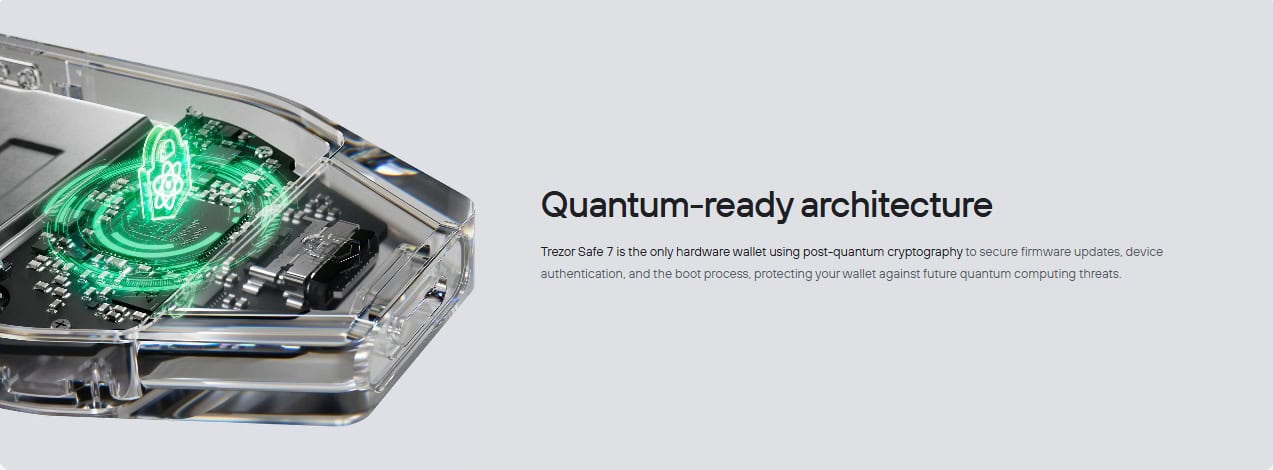
The Safe 7 uses SLH-DSA-128 — a post-quantum signature scheme standardized by NIST in 2024 — to verify the bootloader and firmware at every startup. The internal chain of trust is protected by cryptography that known quantum computing techniques cannot break.
The hardware is also built to receive post-quantum firmware updates without device replacement — meaning when blockchain networks transition to post-quantum cryptographic standards, the Safe 7 can accept corresponding firmware updates.
Important nuance: the Safe 7 does not fully protect your Bitcoin against quantum threats on its own. Full protection requires the underlying blockchain networks to upgrade their own cryptography. What the Safe 7 provides is: quantum-resistant internal security today, and a hardware path to full post-quantum protection when networks upgrade.
NIST has set 2035 as the target for phasing out currently-vulnerable algorithms. Buying a Safe 7 now means your hardware will not need replacement when those standards change.
Ledger Nano Gen5: No Quantum-Ready Features
The Gen5 has no post-quantum cryptography in its current boot architecture. Ledger has not disclosed a post-quantum roadmap for the Nano line at time of writing. Whether future firmware updates could bring quantum-resistant features to the Gen5 without hardware changes is not publicly confirmed.
For users with a long-term security horizon, this is a meaningful gap between the two devices.
Quantum verdict: Safe 7 wins clearly — the Gen5 has no current quantum-resistant features.
Backup and Recovery
Trezor Safe 7: Shamir Backup (SLIP39)
The Safe 7 uses Shamir’s Secret Sharing (SLIP39) as its default backup standard. Your seed is split into multiple shares — for example, 2-of-3, where any two shares recover the wallet but one alone is useless. Shares can be stored in genuinely separate locations: a home safe, a bank safety deposit box, a trusted family member.
This architecture is meaningfully more resilient than a single seed phrase. An attacker who finds one share cannot access your funds. Losing one share does not lose your wallet.
Ledger Nano Gen5: Standard 24-Word Phrase
The Gen5 uses a standard BIP39 24-word phrase. The included Ledger Recovery Key NFC card provides encrypted physical backup. Shamir Backup is not supported — your entire recovery secret exists in one place.
The optional Ledger Recover cloud service is available but introduces third-party seed custody with the associated trust implications.
Backup verdict: Safe 7 wins — Shamir Backup is architecturally superior for long-term cold storage.
Connectivity
Trezor Safe 7
- Bluetooth via Trezor Host Protocol (THP) — application-layer encryption independent of Bluetooth’s own security; can be fully disabled for wired-only use
- Qi2 wireless charging — free magnetic charger included in box; LiFePO₄ battery with 4× standard lithium charge cycles
- USB-C — full wired connectivity to Windows, macOS, Linux
- Full iOS support — Trezor Suite mobile app, full signing workflow from iPhone
- No NFC — the one connectivity feature the Gen5 has that the Safe 7 lacks
Ledger Nano Gen5
- Bluetooth 5.2 — wireless pairing to iOS and Android; private keys never transmitted
- NFC — for Ledger Recovery Key and Ledger Security Key (FIDO2) authentication
- USB-C — full wired desktop connectivity
- 330mAh LiFePO₄ battery — weeks of standby, hours of active use
- No wireless charging — charges via USB-C only despite the Safe 7 including Qi2 free
The key connectivity difference favoring the Gen5: NFC. The Ledger Recovery Key NFC card and Ledger Security Key FIDO2 authentication both depend on NFC — features that the Safe 7 does not support. For users who specifically want NFC-based password-less authentication alongside crypto storage, the Gen5 is the only option between the two.
The key connectivity difference favoring the Safe 7: wireless charging. The included Qi2 charger means the Safe 7 is always charged and ready with zero cable friction — a convenience premium the Gen5 cannot match.
Connectivity verdict: Tie with use-case splits. Safe 7 wins on wireless charging convenience. Gen5 wins on NFC functionality.
Coin and Token Support
This is the most counterintuitive difference in this comparison: the cheaper device supports more coins.
Trezor Safe 7: 1,000+ cryptocurrencies across 30+ networks. Bitcoin, Ethereum, Solana, XRP, Tron, Sui, Arbitrum, and major EVM chains. 70,000+ dApps via WalletConnect. Strong Monero support.
Ledger Nano Gen5: 5,000+ cryptocurrencies via Ledger Wallet, with broader coverage through third-party integrations. All major chains covered, with a larger total asset count than the Safe 7.
The Safe 7’s 1,000+ figure reflects Trezor’s more conservative approach to officially supporting new chains — each integration is reviewed and approved before inclusion. The Gen5’s 5,000+ includes a broader range of community-contributed and third-party integrations.
- For the top 50 chains by market cap, both devices cover everything.
- For users holding assets across many smaller or emerging chains, the Gen5’s broader coverage is a real practical advantage.
- For Monero-focused users, both devices offer strong support.
Coin support verdict: Gen5 wins — 5,000+ vs 1,000+ is a significant gap that matters for diversified portfolios.
App and Software Ecosystem
Trezor Suite is available on Windows, macOS, Linux, and Android (iOS via Bluetooth on Safe 7). It is fully open-source, community-extensible, and powerful for advanced users. Features include CoinJoin for Bitcoin privacy, Shamir Backup management, token swaps, staking, and deep third-party wallet compatibility. The learning curve is steeper for beginners but the feature ceiling is higher.
Ledger Wallet is available on Windows, macOS, Linux, iOS, and Android. The mobile app runs fully via Bluetooth on the Gen5 — a complete portfolio management experience from a smartphone. The ecosystem is broader in officially supported dApps and integrations. WalletConnect, NFT management, staking, and in-app swaps are all available within a polished, curated environment.
Both software ecosystems are mature and capable. Trezor Suite is better for users who value open-source extensibility and privacy features. Ledger Wallet is better for users who want a curated, mobile-first experience.
Ecosystem verdict: Tie with preference-based splits — Trezor Suite for advanced/open-source users; Ledger Wallet for mobile-first users.
Setup and Daily Use Experience
Trezor Safe 7
Setup via Trezor Suite on desktop or mobile. Connect via USB-C or Bluetooth, run the firmware check, set a PIN on the color touchscreen, and generate your Shamir Backup shares. Setup takes 15–20 minutes, slightly longer than the Gen5 due to the multi-share backup configuration.
Daily use is centered around the 2.5-inch color display and haptic feedback. Transaction details are color-coded and visually hierarchical. Approving a send, confirming a DeFi interaction, or verifying a token approval feels responsive and visually clear. Wireless charging means the device is always ready — no searching for cables.
For mobile users, Trezor Suite’s iOS and Android apps connect via Bluetooth using THP encryption. The wireless charging workflow — charge overnight on the Qi2 pad, pick up and sign transactions wirelessly throughout the day — is the closest to a frictionless signing experience available in a non-custodial hardware wallet.
Ledger Nano Gen5
Setup via Ledger Wallet on desktop or mobile. Connect via USB-C or Bluetooth, run the Genuine Check firmware verification, set a PIN, back up the 24-word phrase. Setup takes 10–15 minutes — faster than the Safe 7 due to the simpler single-phrase backup.
Daily use is anchored by the 2.76-inch E-Ink display. Transactions are readable without scrolling on most standard transfers. The monochromatic display lacks visual hierarchy for complex interactions, but the larger screen compensates partially with raw space.
The Ledger Wallet iOS app running via Bluetooth gives iPhone users a complete wireless signing experience that rivals the Safe 7 in practice. The Gen5’s NFC adds a second wireless interaction layer for Recovery Key and Security Key use cases.
Ledger Nano Gen5 vs Trezor Safe 7: Side-by-Side Use Cases
Use case |
Better choice |
Reason |
|---|---|---|
Maximum security architecture |
Safe 7 |
Dual chips, open-source, hardware PIN slots |
Open-source auditability required |
Safe 7 |
Fully auditable firmware and hardware |
Quantum future-proofing |
Safe 7 |
SLH-DSA-128; Gen5 has no quantum features |
Long-term cold storage vault |
Safe 7 |
Dual chips + Shamir Backup + open-source |
Premium build quality |
Safe 7 |
Full aluminum unibody, Gorilla Glass, IP54 |
Wireless charging convenience |
Safe 7 |
Free Qi2 charger included; Gen5 has none |
Budget-conscious buyer |
Gen5 |
$70 less with EAL6+ certified security |
Large altcoin portfolio |
Gen5 |
5,000+ vs 1,000+ supported assets |
NFC Security Key / FIDO2 via NFC |
Gen5 |
Safe 7 has no NFC |
Large E-Ink display preference |
Gen5 |
2.76″ vs 2.5″; Gen5 larger despite cheaper |
Color display preference |
Safe 7 |
700-nit color LCD vs monochromatic E-Ink |
Outdoor / bright sunlight use |
Gen5 |
E-Ink far superior to LCD in direct light |
Indoor DeFi power user |
Safe 7 |
Color display + haptics + larger battery life |
iOS mobile-first user |
Tie |
Both fully support iOS via Bluetooth |
First-time hardware wallet buyer |
Gen5 |
Full security at $70 less; simpler backup |
Upgrading from Trezor Safe 5 |
Safe 7 |
Same ecosystem, major security step up |
Upgrading from Ledger Nano X |
Gen5 |
Same ecosystem, significant security upgrade |
Bitcoin-only holder |
Safe 7 |
Bitcoin Orange variant, BTC-only firmware |
Ledger Nano Gen5 vs Trezor Safe 7: Pros & Cons Summary
Trezor Safe 7
Strengths:
- First and only quantum-ready hardware wallet
- World’s first auditable TROPIC01 chip (dual Secure Element)
- 100% open-source transparency (every line of code)
- Vibrant 2.5″ color LCD with 700-nit brightness
- Haptic feedback for tactile confirmation
- 74% larger battery (330mAh LiFePO₄ vs. 190mAh lithium-ion)
- Qi2 magnetic wireless charging + free charger included ($30-40 value)
- Premium aluminum unibody construction
- IP54-rated water and dust resistance
- Gorilla Glass 3 screen protection
- Built-in Tor integration for privacy
- CoinJoin support for Bitcoin mixing
- Advanced coin control features
- MicroSD slot for PIN encryption
- Instant LCD screen refresh (no E-Ink delay)
- Perfect for dark environments (backlit)
Weaknesses:
- $70 more expensive ($249 vs. $179)
- Smaller 2.8″ screen (12% smaller than Nano Gen5)
- No Clear Signing feature
- No NFC capability (no tap-to-restore convenience)
- Color LCD consumes more power than E-Ink
- Brand new device (launched November 2024, no long-term track record)
- Fewer native coins documented (1,000+ claimed vs. 500+ clearly stated)
- No playful customization badges
- E-Ink’s paper-like reading experience unavailable
Ledger Nano Gen5
Strengths:
- $70 cheaper ($179 vs. $249)
- Larger 2.8″ E-Ink touchscreen (12% bigger than Safe 7)
- Clear Signing technology (human-readable transactions)
- NFC capability (tap Recovery Key to restore, tap-to-login for 2FA)
- Ledger Recovery Key included in box (NFC backup card)
- Paper-like E-Ink reading experience (easy on eyes)
- Anti-glare coating for outdoor use
- Ultra-low E-Ink power consumption
- Specified 10 hours active battery life
- Battle-tested Ledger OS (10+ years proven)
- Native support for 500+ coins clearly documented
- Up to 100 apps installable simultaneously
- Scratch-resistant glass with anti-glare
- Susan Kare Badge customization (playful personalization)
- Mature Ledger Wallet ecosystem
- Clear documentation of specs
Weaknesses:
- Single Secure Element (vs. Safe 7’s dual chips)
- No quantum-ready architecture
- ~95% open-source (Secure Element proprietary)
- Monochrome E-Ink only (no color display)
- No haptic feedback
- No wireless charging (USB-C cable only)
- No IP rating for water/dust resistance
- E-Ink screen refresh has brief flash delay
- Smaller 190mAh battery capacity (though ultra-efficient)
- Requires external light in darkness (no backlight)
- Optional Ledger Recover is paid subscription ($9.99/month)
Who Should Buy the Trezor Safe 7?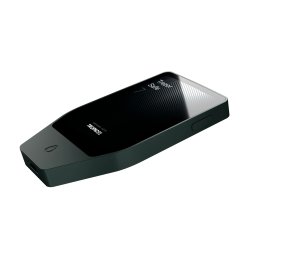
You require open-source, independently auditable security. The Safe 7’s TROPIC01 chip and fully open-source firmware let any security researcher verify what the device does — at any time, after any update. If you need to verify rather than trust your security, the Safe 7 is the only device at this price point that delivers this.
You want the most advanced physical security architecture available. Dual secure element chips with independent tamper sensors, hardware-enforced PIN slot destruction, and a three-layer boot process represent the most sophisticated consumer hardware wallet security architecture available in 2026. No device at $249 or below comes close.
Post-quantum future-proofing matters to you. The Safe 7 is built to receive post-quantum firmware updates without hardware replacement. The Gen5 has no quantum-ready features. If you are storing funds you plan to hold through the post-quantum transition period (NIST’s 2035 target), the Safe 7 is the only choice between these two.
You store significant long-term holdings. For $50,000+ in crypto you plan to hold for years, the marginal cost of $70 is trivial relative to the additional security architecture you are buying. The Shamir Backup distributed storage model, dual-chip physical security, and open-source auditability are all worth more than $70 at meaningful holdings.
Premium build quality and wireless charging matter. If you want a device that feels like a premium product — full aluminum, Gorilla Glass, IP54, color display — and you want to charge it wirelessly, the Safe 7 is the only option between these two.
You are a Bitcoin maximalist. The Bitcoin Orange variant ships with Bitcoin-only firmware that reduces the attack surface to Bitcoin-specific operations only. No other touchscreen hardware wallet offers a dedicated Bitcoin-only firmware variant in a premium metal housing.
Who Should Buy the Ledger Nano Gen5?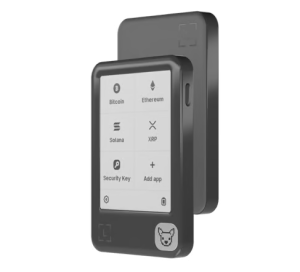
You want EAL6+ certified security at $70 less. The Gen5 delivers the same chip certification tier as the $249 Ledger Flex and $399 Ledger Stax at $179. For users who are satisfied with certified-by-authority assurance rather than open-source verification, the security model is strong at a lower price.
You hold assets across many chains including less common tokens. The Gen5 supports 5,000+ assets versus the Safe 7’s 1,000+. If your portfolio includes assets on smaller or emerging chains, the Gen5’s broader coverage is a real daily-use advantage.
NFC is part of your workflow. The Gen5 supports Ledger Security Key (FIDO2) authentication via NFC for password-less Web2 logins. The Safe 7 has no NFC. If you want a single device that handles both crypto signing and hardware-key Web2 authentication, the Gen5 is the only option between these two.
You prefer E-Ink for display. The Gen5’s 2.76-inch E-Ink display is larger than the Safe 7’s 2.5-inch color LCD and dramatically more readable in direct sunlight. For users who regularly use their hardware wallet outdoors or in bright environments, or who simply prefer the E-Ink aesthetic, the Gen5 has the better display for those conditions.
You are a first-time hardware wallet buyer. The Gen5’s simpler 24-word backup, polished Ledger Wallet onboarding, and lower price make it the more accessible entry point. The Safe 7’s Shamir Backup configuration and Trezor Suite setup add a slightly steeper learning curve for first-time users.
You are upgrading within the Ledger ecosystem. If you own a Nano X or Nano S Plus, staying with the Gen5 means no seed phrase migration, Ledger Wallet continuity, and a significant EAL5+ to EAL6+ security upgrade with the Certified Secure Screen added.
Trezor Safe 7 and Ledger Nano Gen5: Final Verdict
The Trezor Safe 7 and Ledger Nano Gen5 are strong hardware wallets that serve meaningfully different buyers.
The Safe 7 is the more advanced device. However, the Gen5 is the smarter value device.
- Buy the Safe 7 ($249) if your holdings are significant, open-source auditability and post-quantum future-proofing are priorities, or you want the most architecturally advanced consumer signing device available today.
- Buy the Gen5 ($179) if you want proven EAL6+ certified security at $70 less, NFC matters to your workflow, you hold a diverse portfolio across many chains, or you want the cleaner value proposition at the entry to the premium tier.
The $70 difference is real. Whether it is worth paying depends entirely on which side of the trust-vs-verify and value-vs-premium divide you fall on.
FAQ
Is the Trezor Safe 7 worth $70 more than the Ledger Nano Gen5?
For specific users, yes — and clearly so. If open-source auditability, dual-chip physical security, post-quantum firmware, Shamir Backup, full-metal construction, or wireless charging are part of your requirements, the Safe 7 is worth the premium. If you primarily need EAL6+ certified security in a wireless mobile-friendly device and can accept closed-source firmware, the Gen5 delivers that at $70 less.
Which is more secure — Trezor Safe 7 or Ledger Nano Gen5?
The Safe 7 is more advanced in security architecture across multiple dimensions: dual secure element chips vs single, open-source vs closed-source, hardware-enforced PIN destruction vs firmware-enforced wipe, and post-quantum boot architecture vs none. Both devices protect private keys effectively against the most common real-world attack vectors. The Safe 7’s advantages are most meaningful for high-value holdings and sophisticated threat models.
Does the Trezor Safe 7 support more coins than the Ledger Nano Gen5?
No — counterintuitively, the cheaper Gen5 supports more. The Safe 7 supports 1,000+ cryptocurrencies; the Gen5 supports 5,000+. For the top 50 chains, both cover everything. For diverse or long-tail altcoin portfolios, the Gen5’s broader coverage is a real advantage.
Does the Ledger Nano Gen5 have NFC but the Safe 7 does not?
Yes. The Gen5 includes NFC for the Ledger Recovery Key and Ledger Security Key (FIDO2) authentication. The Trezor Safe 7 has no NFC. If NFC-based hardware authentication is important to your workflow, this is a genuine advantage for the Gen5.
Does the Trezor Safe 7 include a wireless charger?
Yes — a free Qi2 magnetic wireless charger is included in the box with every Safe 7. The Gen5 charges via USB-C only and does not include a wireless charger.
Is the Ledger Nano Gen5 quantum-ready?
No. The Gen5 has no current post-quantum cryptographic features in its boot architecture. The Trezor Safe 7 uses SLH-DSA-128 (NIST 2024 standard) in its boot process and is built to receive post-quantum firmware updates. For long-term holdings through the post-quantum transition period, the Safe 7 is the only option between these two.
Which device has a bigger screen?
The Gen5 has a larger screen — 2.76 inches vs the Safe 7’s 2.5 inches — despite being the cheaper device. The Safe 7 has a color display at 700 nits; the Gen5 has a larger but monochromatic E-Ink display. Screen size favors Gen5; screen quality and color favors Safe 7.
Can I migrate from Ledger Gen5 to Trezor Safe 7 (or vice versa)?
Yes. Both devices support standard BIP39 seed phrases. You can restore your wallet on either device using your existing recovery phrase. Switching ecosystems requires migrating your seed phrase — straightforward in practice.
Which is better for iPhone users?
Both support full iOS via Bluetooth. The Safe 7 connects via Trezor Host Protocol (THP) Bluetooth; the Gen5 via Bluetooth 5.2 with the Ledger Wallet iOS app. iOS experience is comparable on both devices. Neither has a meaningful advantage for iPhone users specifically.
Which device is better for a first-time buyer?
The Gen5 is the more accessible entry point — simpler backup (24-word phrase), lower price, and the polished Ledger Wallet onboarding experience. The Safe 7’s Shamir Backup setup adds a small additional complexity at first configuration. Both are beginner-friendly in daily use once set up.
Related Articles
- Trezor Safe 7 Review
- Ledger Nano Gen5 Review
- Is the Ledger Nano Gen5 Safe?
- Trezor Safe 5 vs Ledger Nano Gen5
- Ledger Flex vs Ledger Nano Gen5
About the Author
Samson Ononeme is a crypto investor, blockchain writer, and content strategist with 12 years of experience in the cryptocurrency and Web3 space. He is the founder of MarketsXplora, an independent platform covering crypto security, hardware wallets, and digital asset investing. His work has been published across EarnForex, Kryptomoney, Cryptorunner, and AtoZ Markets.